
A well-maintained grinding wheel is vast difference from a poorly maintained grinding wheel because a well-maintained grinding wheel will produce a clean cut in the workpiece and a poorly maintained grinding wheel will ruin the workpiece. Over time, every grinding wheel that is used will load up with metal particles, glaze over, or lose it’s roundness. The only real fix for a grinding wheel that has become loaded up with metal particles, glazed over, or lost its roundness is to dress the grinding wheel.
Dressing a grinding wheel require the use of the right tool for the job; if the user uses the wrong tool, time will be wasted, the grinding wheels may be ruined and dangerous vibrations may be created while grinding. It is not too complicated to select the correct tool for dressing a grinding wheel because each type of dresser will perform a specific function for the grinding wheel and each type of dresser has its time and place in the workshop. Grinding wheels come in many different form and compositions so the dressers that restore those grinding wheels has to match the type of grinding wheel.
Some grinding wheel dressers remove a large amount of material from the grinding wheel while others leave the cutting face of the grinding wheel looking like a mirror. Some dressers are used on a bench while others are mounted to the machine upon which the grinding wheel is installed. The list of grinding wheel dressers is presented in the order in which most machine shops use those grinding wheel dressers.
Common Types of Grinding Wheel Dressers
Each type of dressing tool has a specific job to perform with the grinding wheel and a specific reason for why it is found on the shelf beside the other grinding wheel dressers.
1. Single Point Diamond Dressers
Single point diamond dressers are the first tool that most machinists will reach for when dressing a grinding wheel. Diamond dressers come in many different forms but the most common is the single point diamond dresser; this tool features an industrial diamond that is brazed into the end of a steel shank.
The single point diamond dresser is used to shave off the dull outer layer of the grinding wheel to expose the fresh abrasive grains of the grinding wheel. Because diamonds are the hardest substance in the world, the single point diamond will easily cut into aluminum oxide grinding wheels and silicon carbide grinding wheels. Another important task with single point diamond dressers is to rotate the tool a few degree each time it is used to dress a grinding wheel to ensure that a fresh corner of the diamond is in contact with the grinding wheel.
By doing so, one single point diamond tool can dress hundreds of grinding wheels before the diamond wears down enough to require replacement. Single point diamond dressers are used for precision grinding work with surface grinders and cylindrical grinders. However, single point diamond dressers are not ideal to use on grinding wheels that are very soft because they will load up the diamond quickly.
Additionally, single point diamond dressers are not ideal to use on superabrasive grinding wheels because the superabrasive wheels will wear down the diamond at a faster rate then the superabrasive grinding wheels wear down the grinding wheel.
2. Multi-Point Diamond Dressers
Multi-point diamond dressers are another tool that some workshops may use. These tools feature several diamonds embedded in a cluster or in a line at the working end of the tool.
The increased area of contact between the grinding wheel and the multi-point diamond allows for the dressing of larger grinding wheels in fewer passes with the dressing tool. Additionally, the increased area also allows for the tool to take more pressure with the superabrasive grinding wheels without the diamonds of the tool chipping. These tools may be seen on pedestal grinding machines in the foundries as well as on roll grinding machines in the steel mills where time is money.
The main disadvantage of using a multi-point diamond dresser is that the precision with which the dresser can dress the grinding wheel is slightly less then with a single point diamond tool. For precision grinding work, a single point diamond dresser will be used to finish the grinding wheel work after the larger work is done with the multi-point diamond dressers. However, for the everyday sharpening of grinding wheels as well as in the dressing of loaded grinding wheels between grinding jobs, the use of the multi-point diamond dressers will be effective for the shop.
3. Rotary Grinding Dressers
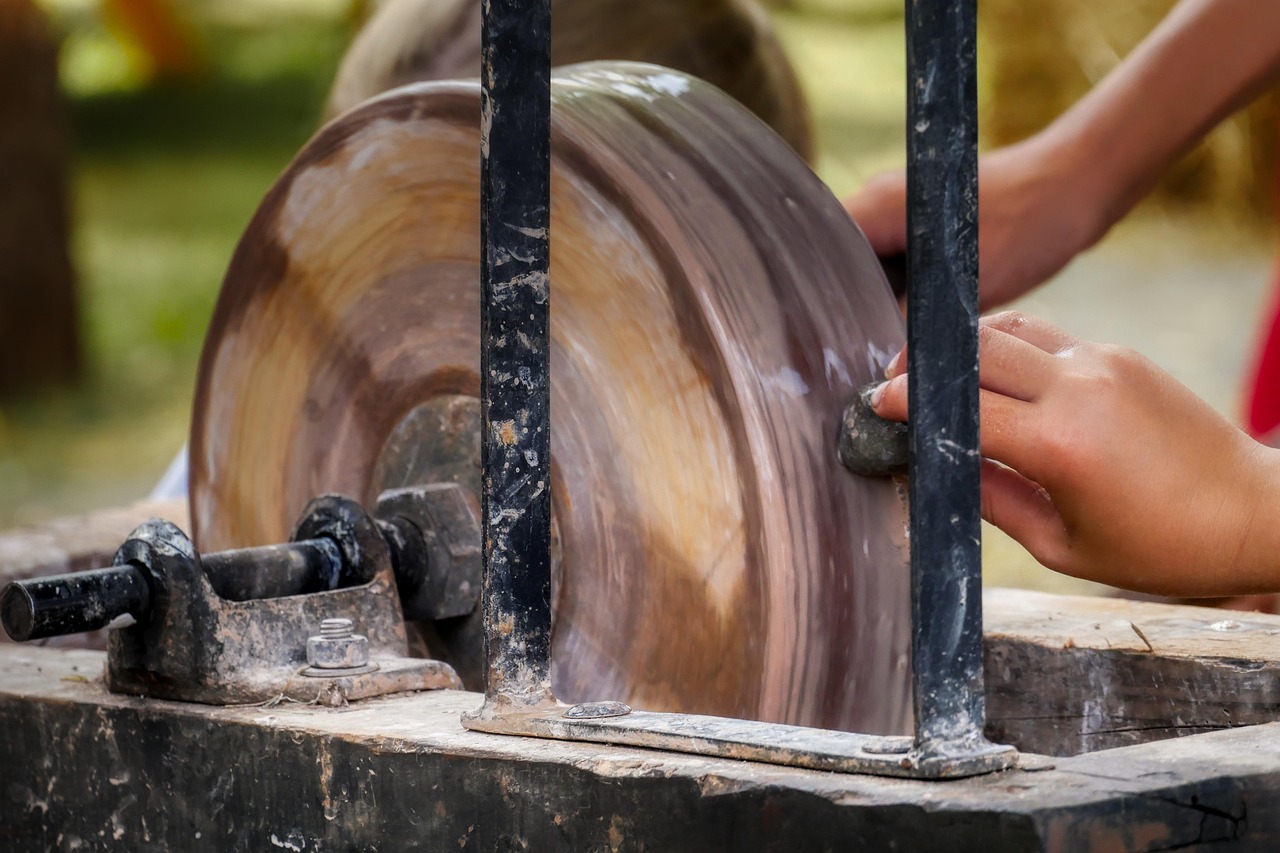
Rotary grinding dressers are used for grinding wheels that require a specific radius to its grinding surface. The tool looks like a grinding wheel with diamonds embedded around the circumference of the tool. By mounting the tool into its holder and rotating the tool with the machine or with a hand-operated tool, the rotary diamond tool will scratch the grinding wheel to put the desired radius onto the grinding wheel.
Rotary grinding dressers are most effective in high production environments wherein hundreds of grinding operations occur each day with the same grinding wheel form. The rolling contact between the two tools minimizes the amount of heat created between the two tools as well as the wear on the tools. However, the disadvantage to these dressers is the cost of the tool as well as the requirement for a different rotary tool for each specific profile of grinding wheel form that a shop wishes to create.
These dressers are costly for job shops that only grind one-of-a-kind parts but are very valuable for the aerospace or the automotive industry for grinding components like turbine blade roots for the same part each month.
4. Star and Disc Dressers
Another tool that is sometimes used is one that does not contain any diamond elements to the tool. Tools like star dressers and disc dressers use hardened steel pins or star-shaped cutters that will crack the bond of the grinding wheel so that new abrasive grains can be made available for the workpiece.
The rotating cutter will press against the grinding wheel to fracture the bond of the grinding wheel and to true the grinding wheel at the same time. These tools are inexpensive, almost indestructible and used for rough grinding wheels. They may be seen in every old-school blacksmith shop and in every foundry.
The surface that the tool creates will be rougher than a diamond dresser but that is appropriate for the rough grinding job in which the tool is used. The cutters on these tools will wear with use but the replacements for them are both inexpensive as well as easy to swap out for a worn out cutter. For achieving the finest forms of grinding as well as dressing superabrasive wheels made of cubic boron nitride or diamond, a crush roll dresser will be the best tool.
5. Crush Roll Dressers
Crush roll dressers are hardened steel rolls or carbide rolls that are precision-ground to match the negative of the desired profile for the grinding wheel. The crush roll will be pressed against the rotating grinding wheel to crush the grinding wheel’s bond to the desired profile. The major advantage of this tool is that there is no cutting between the two tools so there is little heat created and the sharpeness of the grinding wheel can be retained for a longer period of time.
Crush dressing with crush roll dressers is common in thread grinding machines as well as in gear grinding machines. Due to the high requirements for rigidity of the machine as well as precision of the setup, crush dressing tools are mainly seen in dedicated grinding machines for specific tasks instead of in general machine shops. However, crush roll dressers will be used for grinding wheels that need to produce mirror finishes as well as for grinding wheels that hold a specific form within a few microns of the desired size.
6. Handheld Silicon Carbide Stick Dressers
Handheld silicon carbide stick dressers may seem outdated in an age of all of the high-tech grinding dressers but they are still used for specific tasks. The silicon carbide stick dressers are bars of coarse silicon carbide that the hand will drag across the grinding wheel. The silicon carbide stick dressers are inexpensive, require no setup to be used and can be shaped with a hacksaw to leave small radii on the grinding wheel.
These tools may be seen in the tool rooms of every shop as well as in the grinding wheels of foundries that use small grinding wheels. However, the major drawback to using these stick dressers is that they wear quickly with use. Additionally, if not done perfectly with care, the stick dressers will leave the grinding wheel with an uneven surface.
Additionally, these tools should only be used as a temporary fix or as a backup tool if the diamond dressers are not available in the machine shop.
7. Specialized Profile Dressers
Finally, there are also specialized profile dressers that contain only a single diamond that is mounted to a pivoting arm. The pivoting arm allows for the diamond to be swung through an arc that allows the grinding of a radius on the corner of the grinding wheel.
It will take a few minutes to set up the tool in the machine but once it is set up, the grinding wheel will feature the same radius within a tenth of a millimeter of the radius that is desired. These specialized tools are used by the tool and die makers to sharpen the wheels that will be used to make the punches and dies used in machine shops. While the use of these tools takes more time than a rotary diamond tool, the cost of the specialized profile dressers is low and they are a flexible purchase for small machine shops.
These dressers may sit on the shelf in the machine shop for months until a specific grinding job is encountered that requires the grinding of a radius on the grinding wheel. On that day the tool will be of great use for that shop. There is no such thing as a perfect grinding wheel dreser.
The experienced machine shops will have a collection of dressers of each type; a single point diamond dresser will be used for precision work, a multi point diamond dresser will be used for everyday work with a grinding wheel, a star dresser will be used for the rougher grinding wheels, and a radius tool will be used for those grinding wheels that require a specific form. These tools will be able to cover 90% of the grinding work that will go through the shop. The remaining 10% of work may be done with other dressers but they will be the most common tools seen in the shop.
If the grinding wheel begins to rub against the workpiece instead of cutting it, if it glazes over or if the grinding wheel howls at the workpiece, then it is time to dress the grinding wheel properly with the correct tool. The few minutes that will be spent dressing the grinding wheel will save the shop money by producing fewer defective workpieces; it will result in a longer life of each grinding wheel as well as less frustration by the machine shop employees. In the world of grinding operations, the secret is not force but the proper tool.
