Grinder Pump Sizing Calculator
Estimate grinder pump design flow, total dynamic head, force-main friction loss, check-valve loss, curve allowance, pipe velocity, motor horsepower, and basin usable volume from fixture units and site geometry.
📌 Pump presets
⚙ Calculator inputs
📊 Sizing results
🔧 Pump, pipe, and basin spec grid
📋 Fixture-unit flow guide
| Connected load | Typical grinder service | Estimated peak range | Sizing note |
|---|---|---|---|
| 8 to 15 DFU | Single bath or basement suite | 5 to 8 GPM | Often governed by minimum grinder-pump curve flow. |
| 16 to 35 DFU | Small dwelling or ADU | 8 to 14 GPM | Check basin run time if a compact basin is used. |
| 36 to 70 DFU | Duplex, office, or fixture group | 14 to 24 GPM | Pipe velocity and friction can control pump selection. |
| 70+ DFU | Public or high-surge fixtures | 24+ GPM | Use engineered demand and consider duplex pumps. |
📏 Force-main pipe guide
| Nominal pipe | Useful grinder range | Watch point | Planning note |
|---|---|---|---|
| 1.25 in / 32 mm | 8 to 18 GPM | Friction rises quickly on long runs | Good for short residential lift stations. |
| 1.5 in / 40 mm | 12 to 28 GPM | Velocity can be low at small flows | Common balance for residential grinder force mains. |
| 2 in / 50 mm | 20 to 50 GPM | Scouring velocity at low flow | Useful for longer runs or multiple fixtures. |
| 3 in / 75 mm | 45+ GPM | Often too large for single grinder pumps | Use only when pump curve and velocity both fit. |
📈 Pump curve selection table
| Curve item | How this calculator uses it | Good result | Review trigger |
|---|---|---|---|
| Flow at TDH | Peak flow plus curve allowance | Curve crosses above target point | Curve is below required GPM at TDH |
| Shutoff head | Compared indirectly to static lift and losses | Well above static lift | Close to calculated TDH |
| Efficiency zone | Used for horsepower screening | Operating point near curve middle | Far left, far right, or overloaded |
| Solids and grinder rating | Not calculated from hydraulics | Matches wastewater duty | Stormwater, grease, wipes, or unusual solids |
💧 Basin volume and cycle guide
| Usable volume | Typical application | Cycle behavior | Planning note |
|---|---|---|---|
| 5 to 10 gal | Compact indoor basin | Short cycles likely | Confirm motor starts per hour and alarm reserve. |
| 10 to 20 gal | Small residential grinder basin | Often workable | Check 1 minute or longer runtime at pump flow. |
| 20 to 40 gal | Outdoor or duplex-ready basin | More stable cycling | Useful when fixture load arrives in surges. |
| 40+ gal | Higher load or high-inflow service | Longer cycles | Verify retention, alarm level, and code requirements. |
💡 Tips and safety note
Grinder pumps is used to move wastewater from locations that are below the main sewer line to locations that are at or above the main sewer line. Using gravity alone will not allow the wastewater from locations like bathrooms, dwelling, or restaurants to be moved toward the main sewer line if those locations are below the main sewer line; a grinder pump must be use to lift and push the wastewater through a small diameter force main to those locations. The grinder pump that is selected should move the correct amount of water at the correct pressure; if the grinder pump do not move the correct amount of water or if the grinder pump does not move the water at the correct pressure, the grinder pump will fail to function correctly.
Should the grinder pump fail to function correctly, the location will experience frequent service call to attempt to fix the grinder pump, or the grinder pump will trip its alarm. In order to ensure that the grinder pump will be able to effective move the wastewater from the location to which it is to be disposed of, it is first necessary to understand the demand that the system that must be cleaned of its waste water will place upon the grinder pump. Drainage fixture units allow for the estimation of the amount of flow that the group of fixtures that are to be considered will create; the number of drainage fixture units can reveal whether the location has low flow of water from its bathrooms, for instance, or whether it has high flow, such as a duplex or office building.
How to Choose a Grinder Pump
The number of drainage fixture units is converted into the number of gallons of water per minute that will be flushed through the grinder pump each minute; a safety margin is added to the gallons of water per minute that is calculated for the same reasons that the grinder pump will not be able to effectively clear the water from the sink and basin of the facility if the water is continuous being added to that basin; the water must be able to be cleared from the basin before the next addition of water to the basin. After determining the target flow that the grinder pump should move through the system, it is important to calculate the head requirement for the grinder pump. Head requirements are calculated through determining both the static lift that the grinder pump will need to move the wastewater from the location to the main sewer line, as well as calculating the head loss that will result from the friction that will occur within the force main; the longer and narrower the force main, the greater the friction loss within that main.
Additionally, other factor that contribute to the head loss within the system include the number of fittings that are included within the force main, the number of check valve within the system, the static lift of the wastewater from the location of the sink to the main sewer system, the friction loss that results from the length and narrowness of the force main, the head loss that results from the fittings within the force main, the head loss that results from the check valves within the system, and the total head that the grinder pump will need to overcome in order to effectively move the wastewater through the force main. One of the factors to consider for the purchase of a grinder pump is the factor of matching the flow and the total dynamic head to a pump curve for the grinder pump. Many people prefers to purchase a grinder pump whose operating point is near the middle of the pump curve; the efficiency of the grinder pump is best within the middle of the pump curve, rather than at the extreme left or right side of the pump curve.
By purchasing a grinder pump whose operating point exists in the middle of its pump curve, the motor of the grinder pump is provided with the extra room to function appropriately even if the force main becomes partially clog or the basin becomes unusually full with the waste water that the grinder pump must move. It is also important for grinder pumps to consider the velocity of the water within the force main of the grinder pump. Too slow a velocity for the water within the force main will result in the waste water within that main to settle within the main, which will lead to the formation of a waste water plug that the grinder pump cannot remove.
Too fast a velocity within the force main, on the other hand, will result in the creation of both noise and vibration within the main, as well as unnecessary friction losses for the grinder pump. Therefore, the diameter of the force main will have to be chosen appropriately; a 1.5-inch line may be used for residential installations, for example, but a 2-inch line may be necessary for installations that include multiple fixture. Basin volume influences the electrical and mechanical function of the grinder pump.
If a grinder pump is to move a large amount of water from a small basin, for instance, the cycle time of the grinder pump will be short. A short cycle time leads to the starting of the motor of the grinder pump many time each hour; starting a motor so many times each hour will lead to the shortening of the life of the start component for the motor, and may even cause the motor to overheat. Using a larger basin for such a grinder pump will increase the runtime of the motor, as well as the drawdown of water from that basin; however, it may also increase the risk of developing odor within the basin due to the longer length of time that the waste water remains within that basin.
Aside from the math behind the grinder pump selection, there are other variable to consider. For instance, the load of grease that will be introduced into the grinder pump from kitchen sinks may change the operating point of the grinder pump. The wipes that may be used at bathroom sinks that do not contain ingredient that will break down within the grinder pump will also change the operating point of the grinder pump.
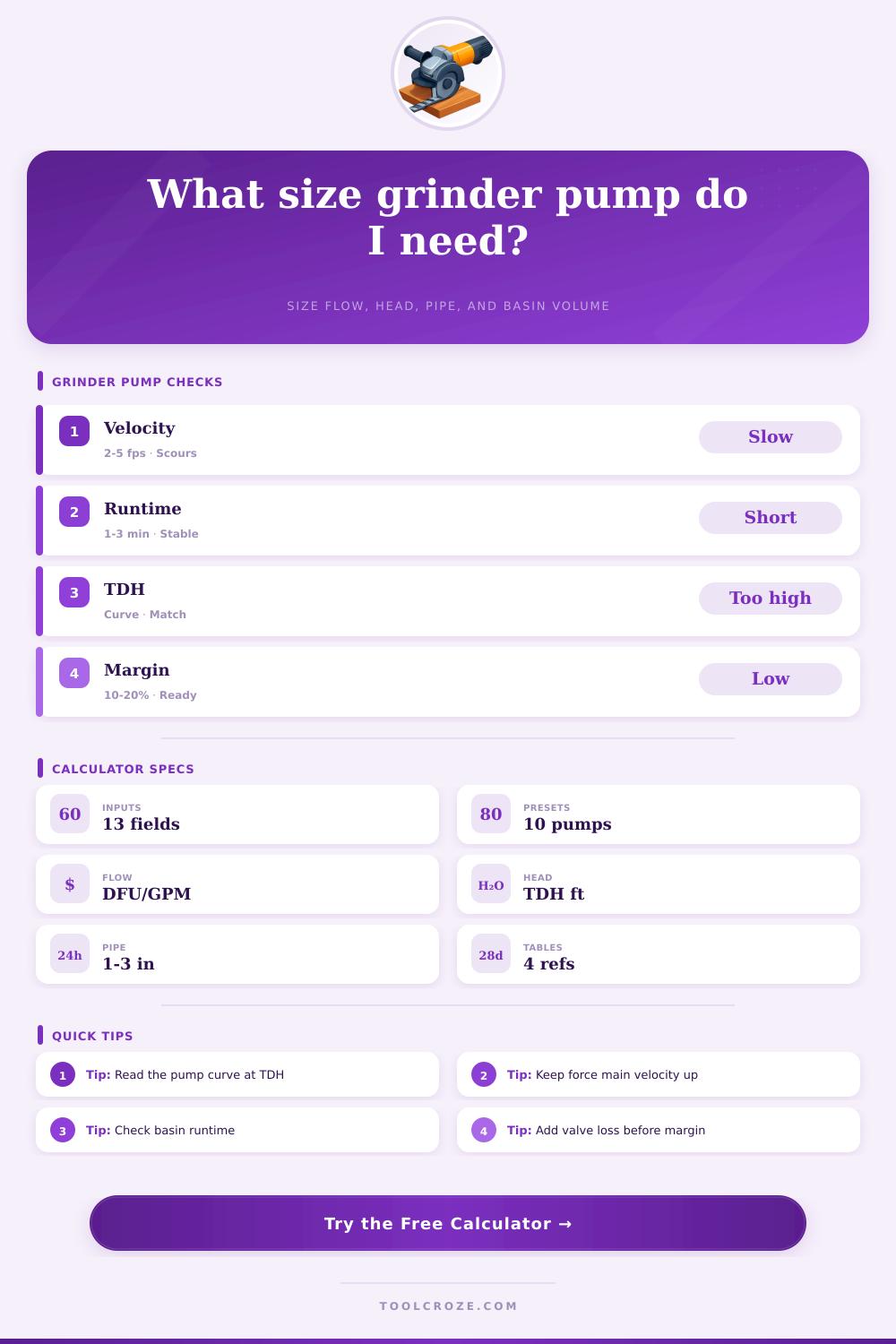
Additionally, seasonal high water table may change the static lift that must be overcome by the grinder pump; local codes may require the use of redundant grinder pumps. Additionally, each manufacturer may publish data sheets for its grinder pump that reveal the amount of solids that will pass through the grinder pump, the temperature limit of the grinder pump, and other factor related to the proper installation of that grinder pump into the intended location. It is also important to consider velocity, runtime, and margin number together in determining the best grinder pump for the system.
For instance, if the velocity of the water within the force main is too low, the size of the pipe will have to change or the length of the force main will have to be shorten. Additionally, if the runtime of the grinder pump is too short, the volume of the basin will have to be increased or the flow of the grinder pump will have to be decreased. Each of these variable must be considered together when selecting a grinder pump that will start at the appropriate time, appropriately clear the basin of waste water, and continue to run until it is necessary to service that grinder pump installation for maintenance.