How Much Gravel Under Concrete Slab Calculator
Estimate compacted gravel base depth, loose order volume, tons, bags, truck loads, drainage suitability, and slab volume context.
📌Project presets
⚙Slab and base inputs
Gravel base estimate
🧱Material and specification grid
📊Recommended compacted base depths
| Concrete slab use | Typical base depth | Better on clay or wet soil | Common stone choice |
|---|---|---|---|
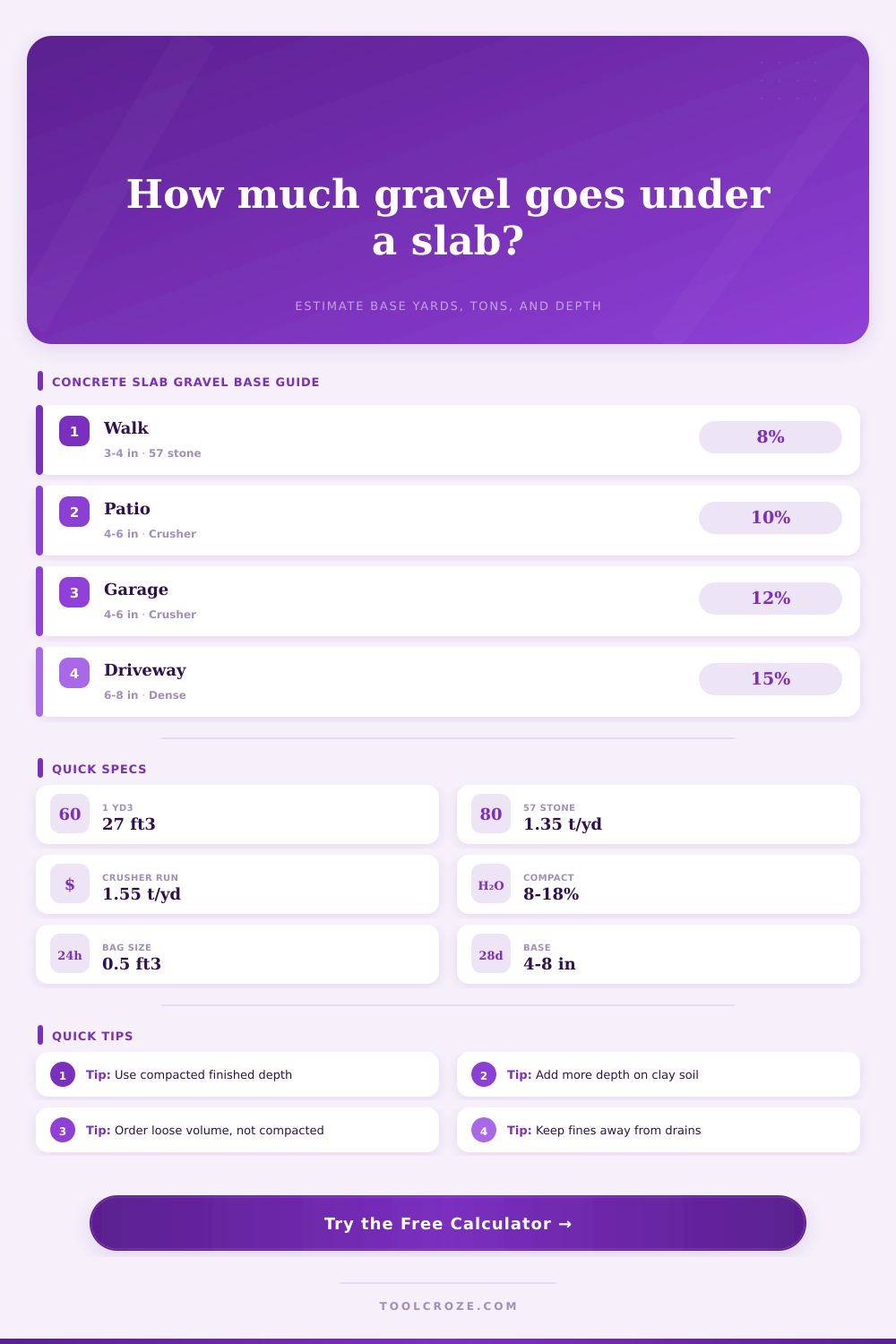
| Sidewalk, garden walk, small pad | 3-4 in compacted | 4-5 in compacted | No. 57 stone or crusher run |
| Patio, porch, shed slab | 4-6 in compacted | 6 in compacted | Dense graded base or No. 57 stone |
| Garage, shop, light vehicle slab | 4-6 in compacted | 6-8 in compacted | Crusher run, road base, limestone |
| Driveway, apron, RV pad | 6-8 in compacted | 8-12 in compacted | Dense graded base with good drainage |
⚒Base material reference
| Material | Typical tons per yd³ | Drainage | Best fit under slabs |
|---|---|---|---|
| Crusher run / dense graded base | 1.55 | Moderate | Garages, driveways, shop slabs |
| No. 57 washed stone | 1.35 | High | Drainage layers, patios, wet subgrade |
| No. 67 drainage stone | 1.38 | High | Thinner drainage base and vapor barrier support |
| Road base / Class 5 | 1.50 | Moderate | Vehicle slabs and compacted pads |
| Pea gravel | 1.25 | High | Light slabs only when confined by forms |
| Recycled concrete aggregate | 1.45 | Moderate | Large pads where fines are acceptable |
📏Volume conversion table
| Area | 4 in base | 6 in base | 8 in base |
|---|---|---|---|
| 100 ft² slab | 1.23 yd³ | 1.85 yd³ | 2.47 yd³ |
| 200 ft² slab | 2.47 yd³ | 3.70 yd³ | 4.94 yd³ |
| 400 ft² slab | 4.94 yd³ | 7.41 yd³ | 9.88 yd³ |
| 800 ft² slab | 9.88 yd³ | 14.81 yd³ | 19.75 yd³ |
🚚Ordering and compaction guide
| Condition | Allowance | Why it matters | Calculator setting |
|---|---|---|---|
| Clean, shallow, firm subgrade | 8-10% | Minor consolidation after spreading | 8% or 10% |
| Typical patio or garage base | 10-12% | Compactor seats angular stone into grade | 10% or 12% |
| Clay, low spots, thick base | 12-15% | More stone disappears into uneven subgrade | 12% or 15% |
| Vehicle pad or heavy storage slab | 15-18% | Deep lifts need extra loose material | 15% or 18% |
💡Calculation tips
Pouring the most expensive concrete mix in the world doesn’t matter, because if you’ve got an inch-deep shifting foundation below it, your slab’s still gonna crack. That’s the kind of knowledge construction pros hold dear and noobs discover far more slowly. Gravel isn’t merely filler, it’s structural. It spread out the weight load and allows for water drainage while giving the slab space to move. Do it wrong, and you’ll learn about compacted vs. Loose stone.
Everyone assumes they know their slab area, and most measure it on paper. They then overlooks how depth affects things. That four inches may look skinny on paper but spread out over your driveway, it equals a lot of volume. And the calculations aren’t something you has to figure out. By plugging in your dimensions into calculator above, it does all the work for you. Why? Because suppliers quote you by the yard (or ton), not by the square footage of whatever you’re creating with your patio design.
Why Gravel Base Is Important for Concrete
You’ll want to know how much compacted foundation you end up with from all your loose material. It settles! Angular materials such as crusher run settle and lock into place as they vibrate, filling in air pockets and dropping down below where the pile sat when dumped off of the truck. Account for this settling factor when you order or you’ll run out halfway.
Depending on what kind of ground your feet are walking across, you have to determine how thick your base should of be. A sand bed can holds weight evenly, and it also drains readily. It is a clay bed. Completely different story. It soaks up water like a sponge; when wet it swells and exerts uneven pressure, which concrete doesn’t like at all. On a clay ground, there’s no choice but to add more depth to the gravel bed; it’s not optional, it’s required.
That’s spelled out in detail in the table of references (on the page). As you’ll notice, driveways or garage floors requires a heavier base of six to eight inches, while even a basic garden path may get by with just three. The selection of stone also matters. If you go with clean washed stone, water can easily drain through while the round stones are free to roll around and not compact. It is great for drainage but bad for compacting.
Crusher run or dense graded base have small particles (fines) that fills the spaces between the larger rocks. These particles help the rocks interlock to become a solid, stable surface that acts as one unit instead of a pile of loose pebbles. The reason we use angular stone with fines on a slab that will be used by people or cars or any other heavy furnitures is no mystery. It may look nice and tidy in a landscaping shot. However, underneath, pea gravel will move when something is put on top of it, causing settling problems in a structural setting.
Then there’s the dirt part, where theory meets compaction. No matter what you do (stomping around doesn’t cut it; neither does a lawnmower), you’ll never get the right density. That requires a plate compactor, which shake the stones into place, removing water and air to form a level surface. The calculator factors in that compaction so that you can tweak the result for your target finished thickness and know how much more of the unfirmed material to order.
This is the biggest pitfall with ordering. We assume four inches of gravel means we’re going to get four inches, but you might order five inches of loose gravel that settle down to four after compaction. There’s one more wrinkle: waste, and odd shapes. Slabs rarely fit perfectly into neat rectangles. There will be areas that need some fill (the low spots) and others where edges needs to be turned down to make them fit into a form. Irregularities in the subgrade demand spot-leveling.
A waste factor protects you from the embarrassment of running out halfway through and having to call for another load. Better to have a little bit left over than to hold up your pour while you wait for additional stone. To conclude, Concrete projects come down to things you don’t see once it’s completed. People give all the credit to the concrete, but the gravel base do the real work. If you spend some extra time making sure your volume calculations are correct, picking the appropriate material and accounting for settling, your slab will last decades without any issues with unevenness or functionality. Spending an extra moment underground saves a bunch of costly repairs above ground.