Gravel for Driveway Calculator
Estimate driveway base stone and top gravel separately, including compaction shrinkage, crown allowance, edging loss, tons, cubic yards, and truckloads.
Driveway Gravel Estimate
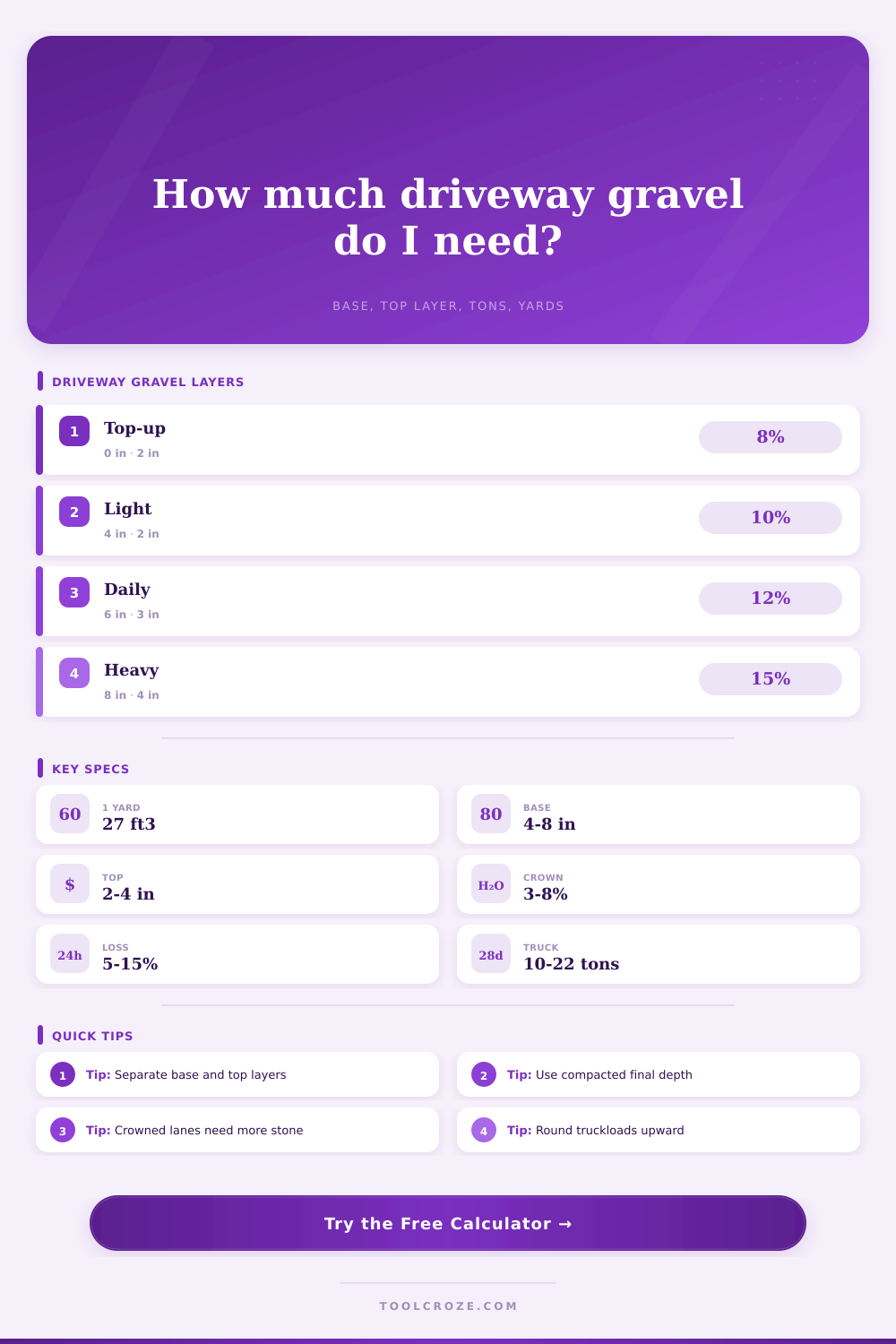
| Driveway Use | Base Layer | Top Layer | Notes |
|---|---|---|---|
| Existing firm driveway top-up | 0 in | 1.5-2.5 in | Use when the old surface is stable and only needs fresh cover. |
| Light residential driveway | 4-5 in | 2-3 in | Good for cars on firm subgrade with limited heavy delivery traffic. |
| Daily residential driveway | 6 in | 3 in | Balanced default for a new driveway with routine passenger vehicles. |
| Truck, RV, or farm access | 8-10 in | 3-4 in | Increase base depth where tires rut the subgrade or loads are frequent. |
| Aggregate | Typical Use | Loose Tons/Yd³ | Compacted Tons/Yd³ |
|---|---|---|---|
| Crusher run / road mix | Base and binding top | 1.45 | 1.65 |
| Dense graded road base | Structural base | 1.50 | 1.70 |
| Washed #57 stone | Top layer and drainage | 1.25 | 1.40 |
| Recycled concrete | Economical base stone | 1.30 | 1.52 |
| Crushed granite | Durable top or base | 1.40 | 1.58 |
| Pea gravel | Light-duty decorative surface | 1.20 | 1.32 |
| Truck Type | Typical Capacity | Best For | Planning Note |
|---|---|---|---|
| Small dump | 5-6 tons | Short top-ups | Useful when access is tight or the driveway is narrow. |
| Single axle | 8-10 tons | Small drives | Often enough for a resurfacing pass or small parking pad. |
| Tandem axle | 12-14 tons | Most homes | Common default for residential gravel delivery planning. |
| Tri-axle or transfer | 18-22 tons | Long lanes | Use only where the site has turning room and suitable access. |
| Layer | Stone Size | Compaction | Common Choice |
|---|---|---|---|
| Sub-base repair | 1.5-3 in | High | Large angular stone under weak spots. |
| Main base | 3/4 in minus | High | Crusher run or dense graded aggregate. |
| Surface top | 3/4 in clean | Medium | Washed #57 or crushed limestone. |
| Decorative cap | 3/8-5/8 in | Low | Use thinly; small rounded stone can migrate. |
Bad Driveways Have a Sound. Tires slap on wet mud. Stones crunch as they are pulled out of a hole.
The first mistake every homeowner makes. “I measured the length and width, multiplied it times the depth I think I need, ordered X cubic feet of gravel.” You forgot about the layers. About the crown. You also has to consider that you’ll drive on it and the stone will shrink.
How to Plan Your Gravel Driveway
Enter your measurements into the calculator. It does the math. No need to guess at conversions or coefficients. But knowing why those inputs are important prevents you from turning your driveway into a parking lot for a month.
But a gravel driveway isn’t a solid slab of rock. It’s a sandwich. The bottom layer is called the “base.” It’s where the heavy work happens. You need to use something in the base layer that has angular, jagged pieces. Dense graded road base works well here; so does crusher run. When you pack this stuff down, the sharp edges interlock. And they form a stable base. This base doesn’t move under the weight of a fully loaded pickup turning on a dime.
The upper layer (the “surface” or “top dressing”) differs. It’s typically some sort of clean stone (such as washed number fifty-seven stone). It’s used for looks, and to promote drainage. You can’t throw any kind of rock around and expect things will turn out okay.
There are two reasons why the calculator breaks the two types into separate layers. If you mix them, you end up with either a too-slippery surface or a non-compacting base.
That’s where depth comes into play, and that’s where most guesses go wrong. A 3-inch layer of top, plus 6-inches of base may work for daily car traffic on solid soil. Clay soils soup up in wet weather. Not so much. Want to drive in with an RV? More. How about eight inches of base? Not too crazy. It is insurance. Adjust based off how you will use it. Adjust accordingly based on whether it is a heavily used farm access road or a light residential lane.
Does the tool account for the shrinkage caused by compaction? You bet. Unpacked stone uses far more space than compacted stone. Guess how much? It is twelve to fifteen percent. If you ordered by the volume of loose stone instead of accounting for shrinkage, you’ll find yourself running out of gravel halfway through.
Driveway shape Finally, there’s the shape of the driveway. On paper, a nice, flat rectangle is great. In real life, water doesn’t like being flat. Your driveway should have a crown, meaning a small curve upwards in the center so that water flows out to either side towards the shoulders. You want your driveway to be a bit higher in the middle than on the sides because otherwise you’re going to turn into a mud pit during spring and an ice rink during winter. That means adding more material in the middle to create the curve. The calculator will add in a percentage allowance for the crown, so you don’t end up with a valley in the middle of your driveway.
It also accounts for loss from edging. When you grade it, you lose some stone. When you spread it, you lose some stone. When it spills over the sides and onto the grass, you lose some stone. A ten to fifteen percent buffer for these losses is standard practice. It’s not padding.
Then there’s that other useful pain-in-the-back: Truckloads. Not many places sell exactly how much stone you want. They sell what they can fit in their trucks. That may be fourteen tons on a tandem axle. Or it may be six tons on a small dump truck. Typically you cannot order less than a full load efficiently or even at all. So you end up rounding up.
How do you know how many truckloads you’ll need? The tool shows you how many cubic yards, but it also shows you how many truckloads so you can visualize it. It’s better to have half a truckload leftover than to call the guy back for another delivery two weeks later.
This is laid out nicely in the reference tables on that page. It shows you the relative densities of different materials. For example, it compares recycled concrete to crushed limestone. The denser material weighs more per yard. Even if you have the same volume, that means you need more or less tonnage. Always check with your local supplier to get their density specs. Stone varies in weight from region to region.
When building a gravel driveway, it is not so much what stone goes on top but rather how much preparation was done beneath it. Nothing can correct a swamp no matter how thick the gravel is. Get that part right by building proper drainage. Select the right aggregate for the base, for stabilization, and for the top. Then, once you have the structure down, all that remains is the finish work.
If you do it right, a gravel driveway will last decades and require little more than a few minutes here or there. Do it wrong and you’ll be attending to it each year. It’s often in the details you almost forget to account for.