Gravel Aggregate Calculator
Estimate compacted volume, loose order volume, tons, truckloads, and bag counts for driveways, drains, pads, pavers, trenches, and round gravel areas.
⚙Project Presets
📐Aggregate Inputs
Aggregate Estimate
📊Material Specification Grid
📘Aggregate Density Reference
| Aggregate | Typical Use | Loose Density | Compaction Behavior |
|---|---|---|---|
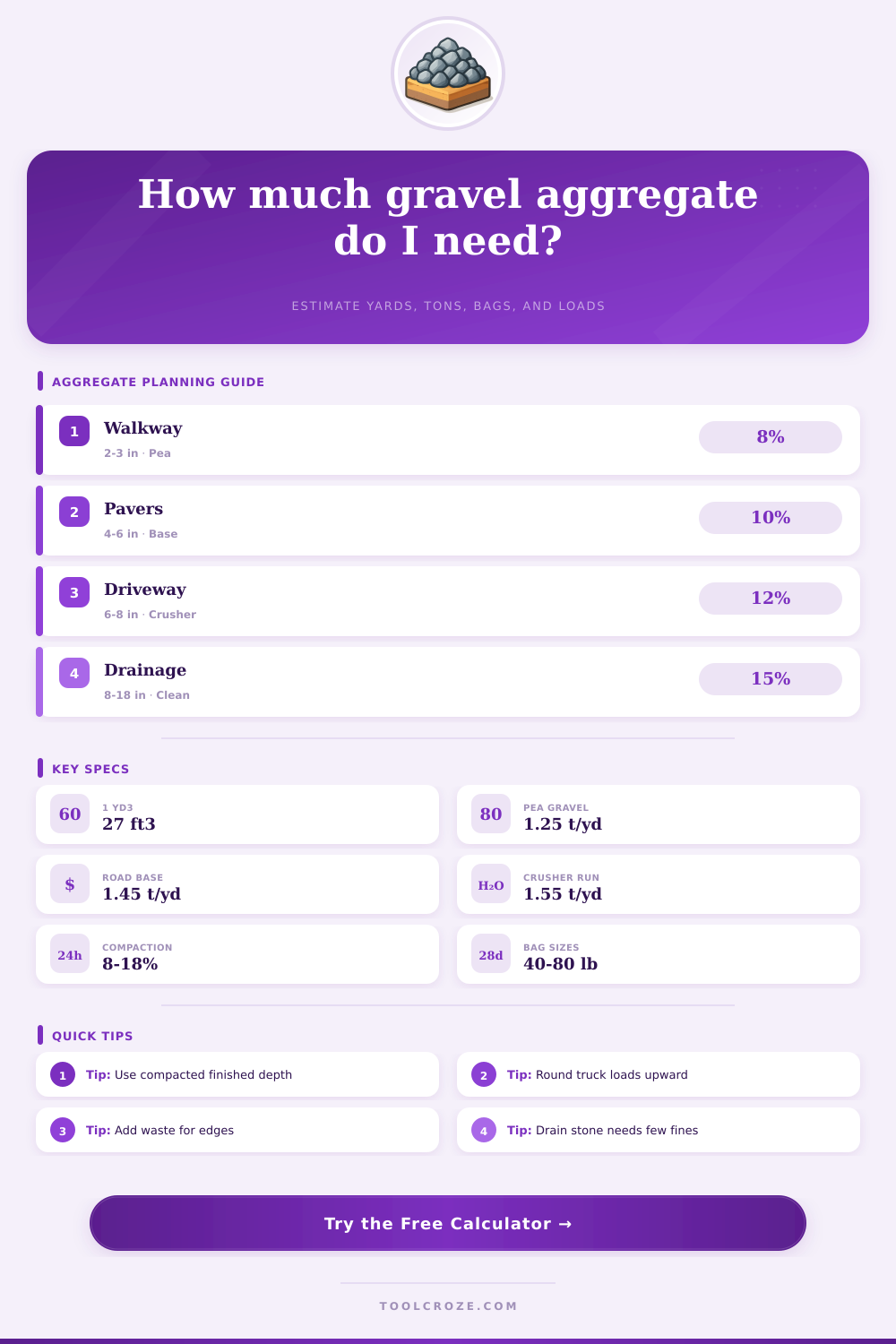
| Pea gravel | Decorative beds, walkways, drains | 1.20-1.30 tons/yd³ | Low lockup, limited compaction |
| Washed drainage stone | French drains, pipe bedding, sumps | 1.25-1.35 tons/yd³ | Void-rich, drains well, few fines |
| #57 crushed stone | Driveways, slab subbase, bedding | 1.35-1.45 tons/yd³ | Moderate interlock, clean surface |
| Road base aggregate | Roads, pads, compacted structural layers | 1.40-1.55 tons/yd³ | Good fines, strong compaction |
| Crusher run | Heavy driveway base and parking pads | 1.50-1.65 tons/yd³ | High fines, high density when compacted |
📏Depth and Layer Reference
| Project | Finished Depth | Recommended Aggregate | Common Allowance |
|---|---|---|---|
| Decorative walkway | 2-3 in compacted | Pea gravel or small clean stone | 5-8% waste, 0-5% compaction |
| Paver patio base | 4-6 in compacted | Road base or #57 under bedding layer | 10% waste, 10-15% compaction |
| Residential driveway | 6-8 in compacted | Crusher run or dense graded base | 12% waste, 15-20% compaction |
| French drain trench | 8-18 in placed depth | Washed drainage stone | 12-15% overage for trench irregularity |
| Concrete slab subbase | 4-6 in compacted | #57 stone or road base per plan | 10% waste, verify local specifications |
🛻Delivery and Bag Reference
| Order Method | Typical Capacity | Best For | Rounding Rule |
|---|---|---|---|
| Bulk tandem dump | 12-18 tons/load | Driveways, large pads, road base | Round loads up after waste |
| Small dump trailer | 2-5 tons/load | Small landscape jobs and access-limited sites | Check payload and gate clearance |
| Super sack or bulk bag | 0.5-1.5 tons/bag | Controlled placement near hardscape | Round up by delivered bag size |
| Retail bags | 40-80 lb/bag | Repairs, narrow beds, small drains | Round bags up to whole units |
🔬Gradation and Spec Notes
| Spec Term | Meaning | Calculator Impact | Field Check |
|---|---|---|---|
| Open graded | Mostly one stone size with voids | Lower density, better drainage | Water passes quickly through sample |
| Dense graded | Mix of stone and fines | Higher density and compaction allowance | Locks together after tamping |
| Minus material | All particles under stated size | Use road base or crusher run density | Contains powder or sand-sized fines |
| Washed stone | Fines removed during processing | Use lower compaction allowance | Cleaner stone surface and open voids |
💡Calculation Tips
Calculator results are planning estimates. Local aggregate gradation, moisture, subgrade softness, and delivery rules can change final order quantities.
When you are looking down into a hole, and you don’t have any idea of what size pile of stone to dump in there, you gets all panicky. Maybe you imagine the nice little mound of gravel you’re going to have. But as soon as it moves around, it’s not like that anymore, it behaves more like a liquid; it pours out and spreads fast.
Running out or having just the right amount isn’t a matter of chance; it’s basic arithmetic. The distance from what you order to what will end up being the outcome depend on understanding that. This is where most folks make their mistake. They measure their space correctly, but forget about compaction. Total work realy compresses down. In its loose form, stone lies high and fluffy. But when you drive a vehicle on it or use a roller, the pieces lock into place and bed compacts.
The Physics of Gravel
Under normal compaction, a typical driveway base settle 15-20% of its original height. So if you ordered just enough stone to cover your surface at current depth, you’ll have a thin layer that will fail during winter freezes. To fix this, the calculator automaticly factors it in. It knows your desired finished depth and works backwards from there to tell you how much loose material you need.
Not all stone is created equal: Another reason why density throws off estimates is that not all stone are created equal. The rounded, smooth nature of pea gravel allows it to compact less densely. The spaces between pebble will have air pockets that allow water to drain through. These pockets also reduce the weight per cubic yard. By contrast, crusher run has more sharp edges and fine dust that locks into place. This create a denser, heavier mix that’s different than pea gravel. You might pay too much for air (or not enough to cover your axle) if you go with an average weight without taking this into account. To illustrate the difference, the tool includes a table of references to show the differences between washed stone and dense graded road base. It matters when delivering and for structural integrity reasons as well, aside from aesthetic ones.
The content is secondary to the delivery choreography. Sixteen-ton tandem dump trucks can’t back in to my narrow driveway; that load’s a liability. Smaller trailer loads won’t tear out the foundation of my patio. Breaking up deliveries lets you see how many truckload will be needed (based off typical local capacity standards). And it calculates how many bags is needed for small repairs in the area. No need to tote those big bag up that hill on foot.
The last one has to do with moisture. Many people forget about this but moisture increase the weight. Water is heavy. If you get your material from a supplier who bases their density numbers off of wet material, plugging in that adjustment will ensure that you don’t run into any surprises when it comes time for the bill. This is a little thing but it would of kept your budget right where it should be.
That’s physics of the loose fill 101. The point is, don’t guess at planning your gravel work; plan it with respect to the physics. Allow some waste because you always want some extra on hand for setting out and for edges. However, you don’t want so much that you have to carry away leftover bags. Before the truck shows up, know what you’re measuring so you can get that balance just right…and make sure that pile doesn’t move when it hits the ground.