⚡ Generator Size Calculator — South Africa
Calculate the exact kVA generator you need for load shedding & home/business backup power
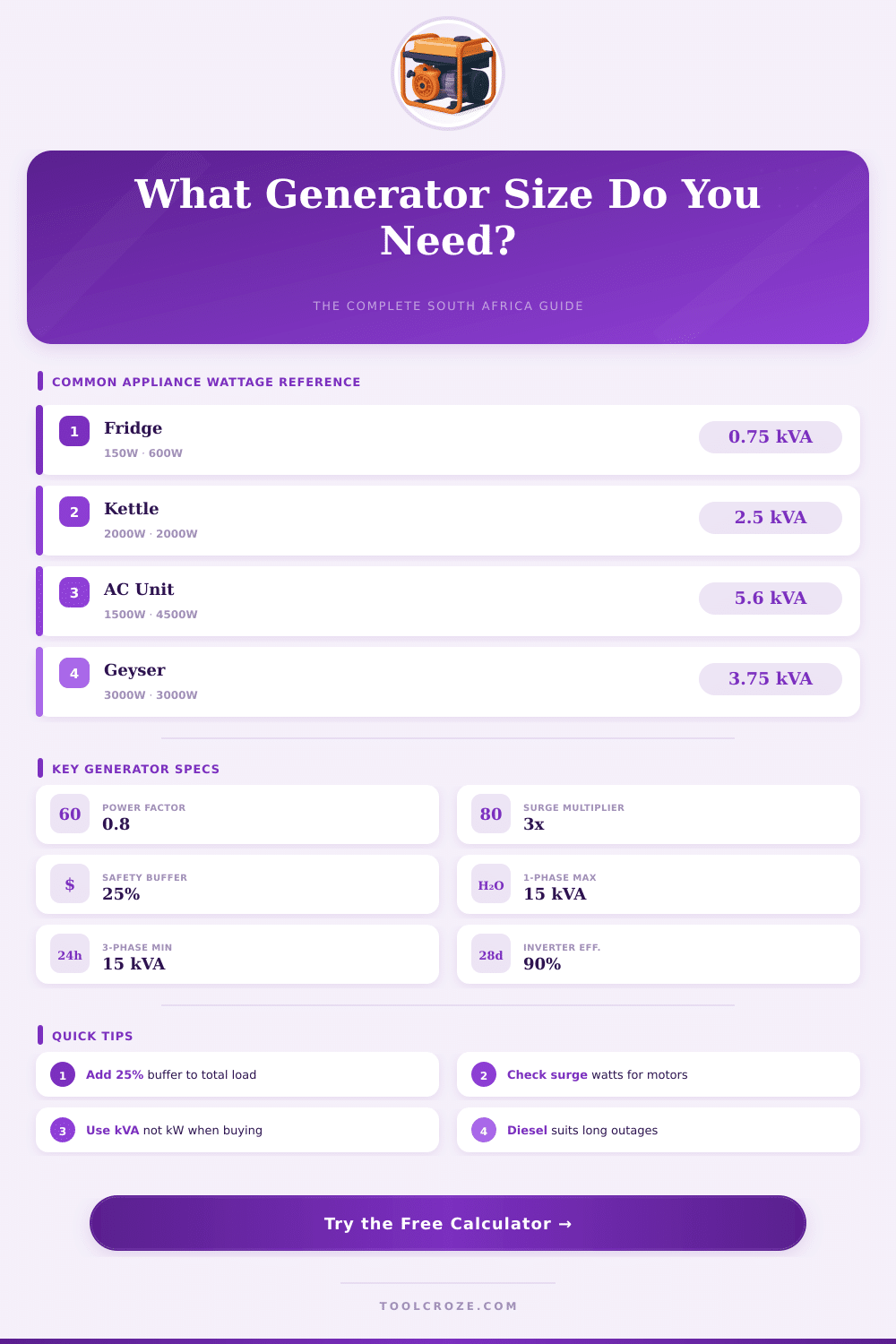
| Appliance | Qty | Running Watts (W) | Surge Factor | Running Hours/Day |
|---|
| Appliance Type | Running Watts (Typical) | Surge Factor | Surge Watts | Notes |
|---|---|---|---|---|
| Refrigerator / Fridge | 150–300W | 3x–5x | 750–1500W | Compressor startup |
| Air Conditioner (1.5kW) | 1200–1500W | 2x–4x | 2400–6000W | High surge; size carefully |
| Water / Borehole Pump | 750–2200W | 3x–7x | 2250–15400W | Highest surge of any appliance |
| Microwave Oven | 1000–1800W | 1x | Same | Resistive — no surge |
| Kettle / Toaster | 1500–2200W | 1x | Same | Resistive — no surge |
| Electric Geyser | 3000W | 1x | Same | Resistive — no surge |
| TV / DSTV Decoder | 80–200W | 1x | Same | Minimal surge |
| LED Lights (per 10) | 80–120W | 1x | Same | No surge |
| Power Tools (drill) | 600–1200W | 2x–3x | 1200–3600W | Startup surge |
| Angle Grinder | 900–2200W | 2x–3x | 1800–6600W | Heavy surge |
| Generator Size (kVA) | Approx. kW Output | Typical Use Case | What It Can Run | SA Fuel Consumption |
|---|---|---|---|---|
| 2.5 kVA | 2.0 kW | Security / Essentials | Lights, router, TV, phone charging | ~0.5 L/hr (petrol) |
| 3.5 kVA | 2.8 kW | Load Shedding Basic | Fridge, lights, TV, laptop, router | ~0.7 L/hr (petrol) |
| 5 kVA | 4.0 kW | Small Home / Cottage | Fridge, microwave, lights, TV, laptops | ~1.2 L/hr (petrol) |
| 7.5 kVA | 6.0 kW | Medium Home (3 bed) | + kettle, pool pump, washing machine | ~1.8 L/hr (diesel) |
| 10 kVA | 8.0 kW | Large Home / Small Office | + 1x AC unit, geyser (timed) | ~2.4 L/hr (diesel) |
| 15 kVA | 12.0 kW | Large Home / Restaurant | Most appliances simultaneously | ~3.5 L/hr (diesel) |
| 20 kVA | 16.0 kW | Small Business | Office equipment, AC, kitchen | ~4.5 L/hr (diesel) |
| 30 kVA | 24.0 kW | Medium Business | 3-phase loads, heavy equipment | ~7 L/hr (diesel) |
| 50 kVA | 40.0 kW | Factory / Farm | Industrial motors, borehole, HVAC | ~12 L/hr (diesel) |
| Generator Size | Fuel Type | L/hr at 75% Load | 4-Hour Stage 4 | 8-Hour Stage 6 | Approx. Tank Size |
|---|---|---|---|---|---|
| 3.5 kVA | Petrol | 0.7 L/hr | 2.8 L | 5.6 L | 15 L |
| 5 kVA | Petrol | 1.2 L/hr | 4.8 L | 9.6 L | 25 L |
| 7.5 kVA | Diesel | 1.8 L/hr | 7.2 L | 14.4 L | 40 L |
| 10 kVA | Diesel | 2.4 L/hr | 9.6 L | 19.2 L | 50 L |
| 15 kVA | Diesel | 3.5 L/hr | 14 L | 28 L | 80 L |
| 20 kVA | Diesel | 4.5 L/hr | 18 L | 36 L | 100 L |
Choosing the right size of generator can seem hard, but it depends mainly on how much power you need. Generator models have different power levels in watts. Small models work for some devices, while a standby generator for a whole home can power the whole house.
Seriously count your real needs before buying one.
How to Choose the Right Generator Size
Many folks make a mistake when they only think about the whole amount of watts and believe that one needs a huge machine. For instance, some can track their everyday use and believe that they need something very strong. But what really matters is what devices run at the same time.
The everyday total usage does not show evrything. When all power is used in a fast burst, you need a bigger generator. When the use spreads evenly through many hours, a much smaller model for less money works fine.
The best way is add the running watts of every device that you want to run together. That amount shows the real size that the generator must have. For two small fridges, a generator of 1 500 to 2 500 watts works well.
For two large modern fridges, at least 2 000 to 3 500 watts is needed, and 3 500 watts is the more reliable choice.
A generator of 2 200 watts might work just for sum case, but a unit of 3 000 watts handles the tasks much more simply. The price gap between those two is not that big. For a fan for air cooling that needs 18 amps, it is good to aim for a generator of almost 4 000 watts.
That gives space for heaters, lamps, television and internet also.
At the level of 7 500 watts, moving it gets hard. Those devices usually weigh more than 200 pounds. But that extra power lets you use a whole place with lamps, heaters and several strong tools at the same time.
A generator of 22 kW is already quite big, and for a house under around 2 100 square feet it could be too much.
When your house is fully electric with a pump, water heater, boiler and floor heaters, close circuits when they do not need help much. Switch the water heater or boiler only for a short time when needed, and later turn them again. Only the pump itself can use much energy.
A pump of 3 HP needs 5 000 watts during run, with start loads that pass 10 000 watts. A tank for warm water could be better than growing the generator only because of that.
When using a generator, always mind its limits. Never try to run several heavy devices together. Good targets are keeping the generator at 30 to 50 percent of load.
If the noise bothers you, a more quietmodel costs more, but is worth a think.