Generator Runtime Calculator
Estimate hours per tank from tank gallons, fuel type, connected watts, rated watts, load percent, burn-curve points, efficiency, reserve fuel, altitude, and ambient temperature.
▣ Generator and Load Presets
Pick a real generator/load starting point, then adjust the tank, fuel curve, reserve, altitude, and temperature to match the unit in front of you.
⚙ Runtime Inputs
▦ Generator/Load Comparison Grid
☰ Runtime Reference Tables
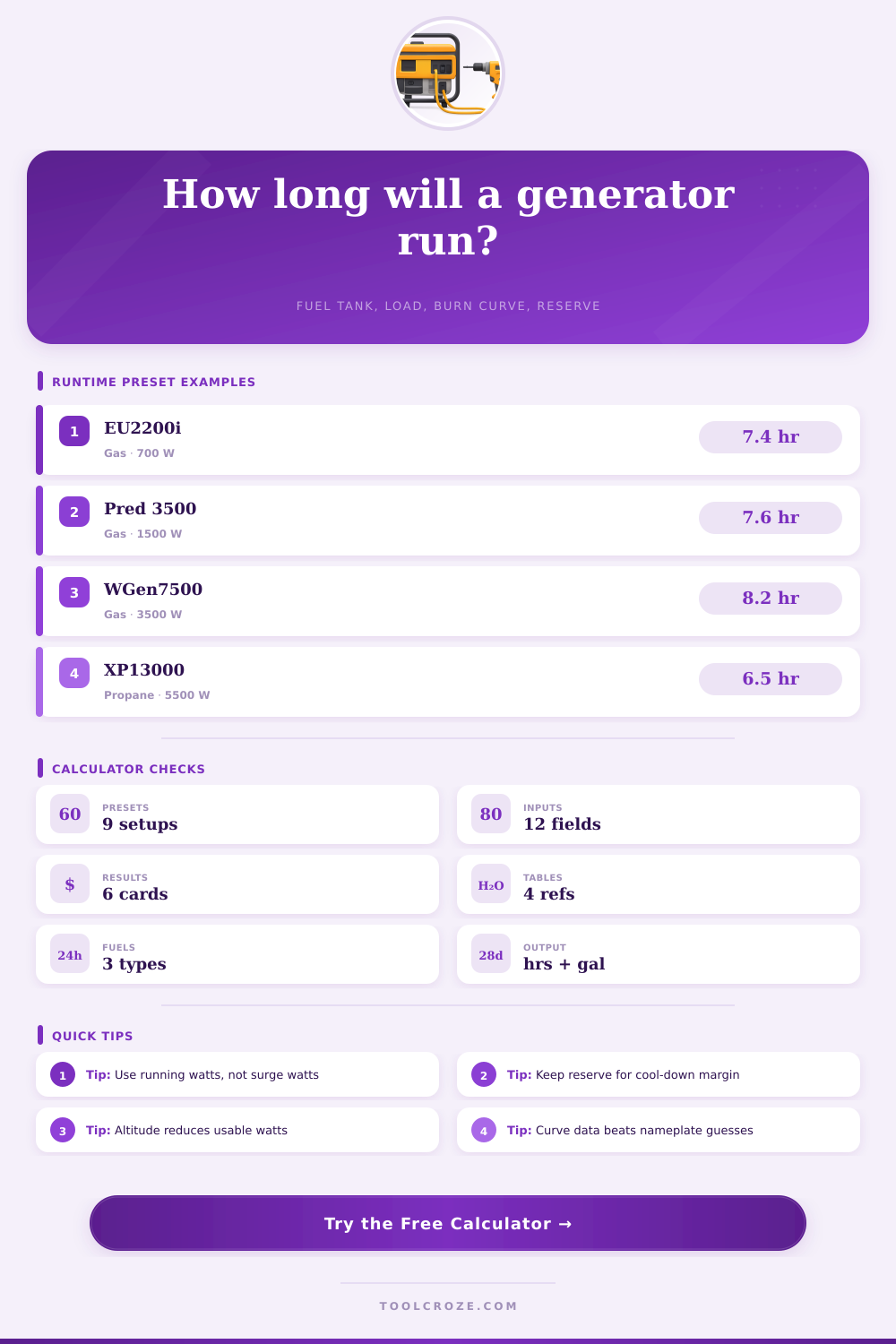
Real generator/load preset data
| Preset | Fuel basis | Tank gallons | Rated watts | Example running load |
|---|---|---|---|---|
| Honda EU2200i fridge/freezer circuit | Gasoline inverter | 0.95 gal | 1,800 W | 700 W cycling refrigeration |
| Yamaha EF2200iS camp loads | Gasoline inverter | 1.24 gal | 1,800 W | 600 W lights, fan, chargers |
| Champion 2500 dual fuel RV converter | Propane liquid gallon | 4.60 gal | 1,665 W propane | 850 W converter and small AC fan |
| Predator 3500 inverter tool circuit | Gasoline inverter | 2.64 gal | 3,000 W | 1,500 W saw, charger, light mix |
| Honda EU7000iS home essentials | Gasoline inverter | 5.10 gal | 5,500 W | 2,600 W fridge, lights, blower |
| Westinghouse WGen7500 essentials panel | Gasoline portable | 6.60 gal | 7,500 W | 3,500 W panel load |
| Generac GP6500 with well pump | Gasoline portable | 6.90 gal | 6,500 W | 2,800 W pump and circuits |
| DuroMax XP13000EH home load | Propane liquid gallon | 8.20 gal | 9,975 W propane | 5,500 W home essentials |
| Kubota GL11000 diesel jobsite | Diesel enclosed | 7.40 gal | 10,000 W | 6,000 W jobsite load |
Typical load examples for runtime planning
| Load group | Typical running watts | Runtime concern | Calculator entry note |
|---|---|---|---|
| Refrigerator and freezer circuit | 500 to 900 W average | Startup surge is short | Use measured running average when possible |
| RV converter plus lights | 600 to 1,200 W | Battery charge stage changes load | Use the higher charge-stage draw for reserve planning |
| Furnace blower and essentials | 1,200 to 2,500 W | Blower cycling lowers average | Enter continuous watts if the blower runs steadily |
| Well pump support | 2,000 to 4,000 W running | Pump surge can be large | Runtime uses running watts after the motor starts |
| Jobsite tools and charger mix | 1,500 to 6,000 W | Intermittent tool use varies sharply | Use the sustained average over the work period |
Fuel type and burn curve handling
| Fuel type | Curve multiplier | Tank unit | Typical runtime behavior |
|---|---|---|---|
| Gasoline | 1.00 x entered curve | Liquid gallons | Baseline for most portable generator ratings |
| Propane | 1.18 x entered curve | Liquid gallon equivalent | More gallons per hour because fuel energy density is lower |
| Diesel | 0.78 x entered curve | Liquid gallons | Lower gallons per kWh on many steady diesel sets |
| Low-load inverter mode | Interpolates below 25% | Same fuel unit | Good inverter generators can stretch runtime at small loads |
| Heavy load near rating | Interpolates to 100% | Same fuel unit | Burn rate climbs quickly once the engine is near full output |
Altitude, temperature, and reserve guide
| Condition | Typical factor | What changes | Runtime planning effect |
|---|---|---|---|
| Sea level, 70°F | About 100% | Rated output is close to nameplate | Load percent can use the normal running-watt rating |
| 3,000 feet, 80°F | About 89% | Engine has less oxygen per intake stroke | Same watts feel like a higher load percentage |
| 6,000 feet, 90°F | About 76% | Altitude and heat stack together | Derated load can become the limiting result |
| 10% reserve | 90% usable fuel | Tank is not planned completely empty | Runtime result stops before the tank is dry |
| 25% reserve | 75% usable fuel | More cool-down and refuel margin | Useful when loads must stay energized between refuels |
ℹ Runtime Tips
Calculating how long your generator will run is an important task, as it needs to provide power for you and your family during an outage. Many people try to calculate how long there generator will run using the printed numbers from the manufacturer. However, these numbers are not necessarily accurate for your situation.
The manufacturer calculate the runtime of the generator under ideal condition with a specific load on the generator. However, your load and your conditions may not be ideal. Therefore, you have to calculate how long your generator will run based off your specific load and your specific situation.
How to Calculate How Long Your Generator Will Run
Generators do not burn fuel at a constant rate. The amount of fuel that the generator will consume will depend on the load that is placed on the generator. If the load on the generator is low, the amount of fuel that it will use will be less.
However, the load on the generator does not necessarily create a linear burn rate for the generators fuel; the generator will always use some of that fuel to counteract the friction of the generator’s components, as well as to cool the generator. However, if the load on the generator is high, the generator will burn fuel at a much faster rate. To calculate the runtime of the generator, you can use a calculator that asks for your running watts and the engine burn points of your generator.
The runtime calculator will show how long the fuel in your generator will last until it reaches your chosen fuel reserve. A fuel reserve is the amount of fuel that you leave in your generator that is not to be used to power your primary electrical needs. You use a fuel reserve in case the generator needs to cool down or in case you need to refuel the generator.
Most people choose to use a ten percent fuel reserve in the case of short electrical outages. However, if you are running your generator at close to it’s maximum capacity, you may want to use a larger fuel reserve. The fuel reserve will be calculated as a percentage of the total amount of fuel that your generator’s tank can hold.
Thus, the generator runtime calculator will show you the runtime of your generator with the fuel that you can use for your electrical needs. Altitude and temperature can play an important role in the amount of power that your generator can produce. At high altitude and in areas that have high temperatures, your generator will not be able to produce the same amount of power as it could at sea level with a more moderate climate.
These factors will be accounted for in the generator runtime calculator using a derate factor. This factor will show the percentage of the generator’s load relative to its maximum capacity. If the percentage of the load is above 100 percent, this means that the load that you are trying to power is too much for the generator to handle at that altitude or temperature.
The type of fuel that you use can also play a role in the runtime of your generator. Gasoline has a baseline energy density. However, propane fuel requires more liquid gallon of fuel to provide the same amount of energy as gasoline.
This factor can also impact diesel fuel, as fewer gallons of diesel fuel are required to produce a certain number of kilowatt-hours of energy than gasoline when used on steady electrical loads. Each of these fuel types will have a multiplier next to each fuel type so you can quickly compare the amount of energy that they will produce. The best type of wattage to use when calculating the runtime of your generator is the sustained running wattage.
This is the value of the load that your generator creates over time. Some appliances may have a higher surge wattage than their sustained running wattage, but that wattage is only for a few seconds when the appliance is turned on. You can use reference tables to quickly determine the sustained running wattage of different groups of appliance.
A common mistake when calculating the runtime of a generator is to use the surge wattage of an appliance rather than its running wattage; however, another common mistake is to ignore the effects of altitude. Published runtime claims for generators are typically based on the assumption of a 50 percent load at sea level and with a clean carburetor. Your situation may not be this ideal.
Instead, you should use the burn points for your generator’s engine as published in the generator manual in the generator runtime calculator. Another factor that can impact the runtime of your generator is the efficiency of the fuel system. If the fuel system is inefficient due to stale fuel, old carburetors, or other issues, your generator will not deliver as much energy from each gallon of fuel as a new, well-maintained generator.
You can enter this efficiency factor into the generator runtime calculator; however, a low efficiency percentage will show the amount of time that your generator will run with less efficient fuel delivery. The goal of the generator runtime calculator will provide you with a realistic window of how long your generator will last. This information will help you to decide whether you need a larger fuel tank, whether you need to change the type of fuel that you use, or whether you can reduce the load that your generator has to create.
If the generator runtime calculator shows that your generator will not last for long, you will know that you have to change your plan for using power prior to the electrical outage. However, if the calculator indicates that your generator will last for a longer period of time, you will know that you dont need to worry about refueling the generator as often. Thus, using these numbers will allow you to plan for the electrical outage in your area instead of using estimates for how long the generator will last.