⚡ Generator Room Size Calculator
Calculate exact room dimensions, clearances, and ventilation requirements for any generator installation
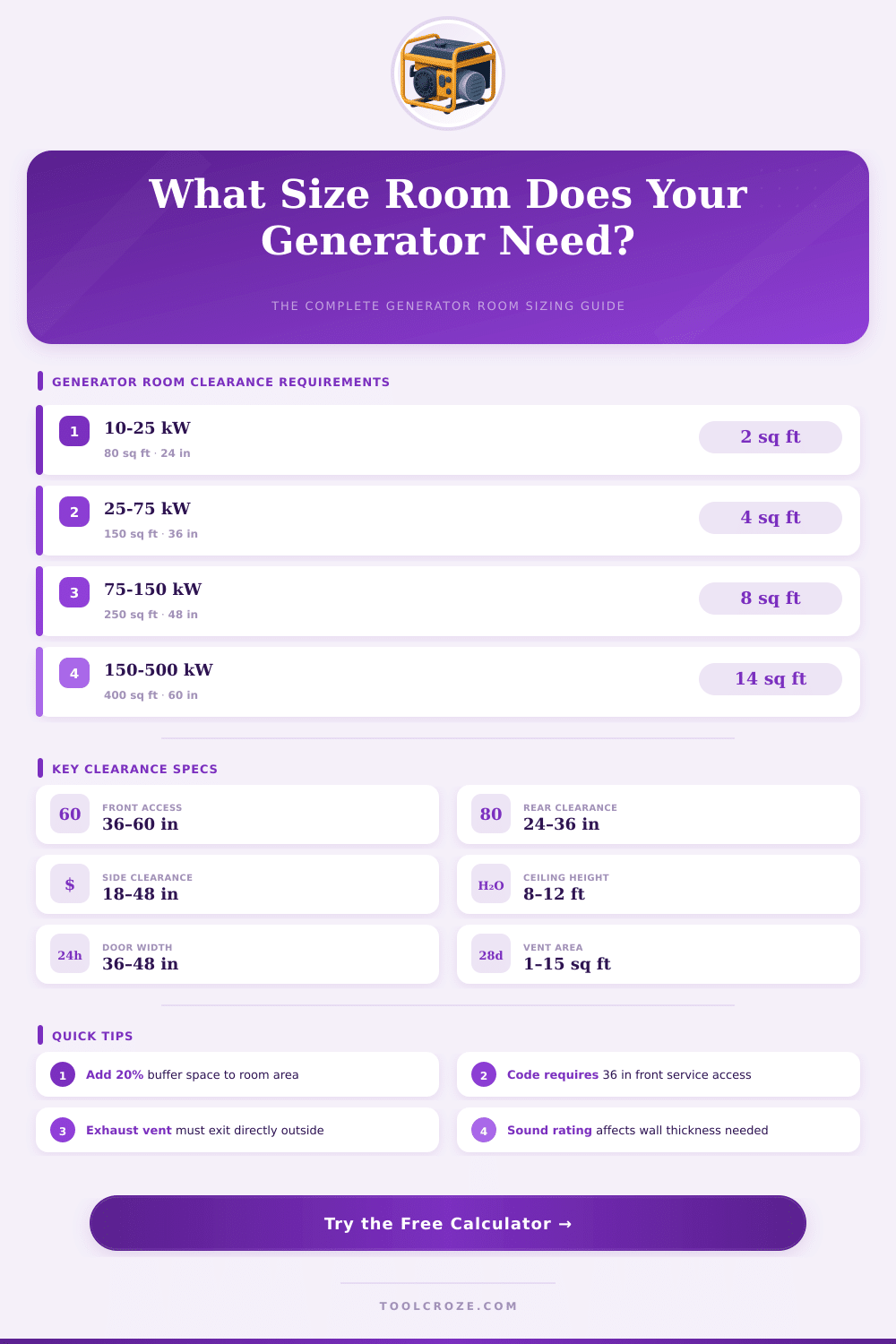
| Generator Size (kW) | Front Access (in) | Rear (in) | Each Side (in) | Ceiling Height (ft) | Door Width (in) |
|---|---|---|---|---|---|
| Under 25 kW | 36–48 | 24–30 | 18–24 | 8–9 | 36 |
| 25–75 kW | 48–60 | 30–36 | 24–36 | 9–10 | 42 |
| 75–200 kW | 60–72 | 36–42 | 36–48 | 10–12 | 48 |
| 200–500 kW | 72–96 | 42–60 | 48–60 | 12–14 | 60 |
| 500+ kW | 96+ | 60+ | 60+ | 14+ | 72+ |
| Generator (kW) | Air Flow (CFM) | Intake Vent Area (sq ft) | Exhaust Vent Area (sq ft) | Combustion Air (CFM) |
|---|---|---|---|---|
| 10–25 kW | 800–1,500 | 1.5–2.5 | 2.0–3.0 | 150–350 |
| 25–75 kW | 1,500–3,500 | 2.5–5.0 | 3.0–6.0 | 350–900 |
| 75–150 kW | 3,500–6,000 | 5.0–8.5 | 6.0–10.0 | 900–1,800 |
| 150–300 kW | 6,000–12,000 | 8.5–16.0 | 10.0–19.0 | 1,800–3,500 |
| 300–500 kW | 12,000–22,000 | 16.0–28.0 | 19.0–34.0 | 3,500–6,000 |
| 500+ kW | 22,000+ | 28.0+ | 34.0+ | 6,000+ |
| Fuel Type | Density (lb/gal) | BTU/gal or BTU/cu ft | Extra Room Req. | Fuel Storage Min. Dist. | Ventilation Factor |
|---|---|---|---|---|---|
| Diesel | 7.1 lb/gal | 137,500 BTU/gal | +10% (tank space) | 5 ft from gen | 1.0x (baseline) |
| Natural Gas | N/A (piped) | 1,020 BTU/cu ft | Minimal | N/A | 1.1x |
| Propane (LPG) | 4.2 lb/gal | 91,600 BTU/gal | +15% (tank zone) | 10 ft from building | 1.2x |
| Dual Fuel | Varies | Varies | +12% | 5 ft from gen | 1.15x |
| Application | Generator Size | Typical Room (L x W) | Min Height | Floor Area (sq ft) |
|---|---|---|---|---|
| Small Home Standby | 10–20 kW | 12 x 10 ft | 8 ft | 120 |
| Large Home / Small Office | 20–45 kW | 16 x 12 ft | 9 ft | 192 |
| Commercial Building | 45–100 kW | 22 x 14 ft | 10 ft | 308 |
| Hospital / Critical Facility | 100–250 kW | 30 x 18 ft | 12 ft | 540 |
| Industrial Plant | 250–500 kW | 40 x 22 ft | 14 ft | 880 |
| Data Center | 500–1000 kW | 55 x 28 ft | 16 ft | 1,540 |
Understand the right size for a generator room is really important. The needs of such space can range according to the kind and size of the generator used. Industrial units are usually huge and require more place than little versions.
Home rooms should have at least 12 by 10 feet. Businesses can require up to 20 by 15 feet. The ceilings must reach at least 8 feet of height and enough distance must exist for safety and care.
How Big Should a Generator Room Be
A sample from real life is a hotel with a 178 kW Cummins diesel generator in its own protected fireproof generator room of 11 by 20 feet. That space was built as part of parking. The entry and exit of the generator goes to the outside, while the room is split from the garage by 8-inch concerte walls and floor.
Experts advise that the distance between the engine and nearby wall or other device be not less than the width of the engine itself. Above, enough height must allow the easy pulling of roll heads, parts, exit tubes and other parts during service. Also plan place for a chain hoist or upper steel frames.
Keep at least 4 feet of space between generators is wise. Like this, if mechanics need to work hard on an engine, they have freedom. In one case, workers had to lay the device on the side for repair, and they had a full 12 feet of space on both banks.
The same room had high ceiling, which later meant the setting of big round gear.
The needed height of a generator room usually doubles the height of the unit itself and passes it buy at least 1.5 metres. At least 1000 millimeters of free space between the radiator face and opposite wall stops the air return. For room-specific radiators, expand the volume of the space and the allowed area of the vents clearly, also separate the entry and exit according to distance and level.
Airflow matters a lot. The room must receive a good amount of air. For one same size, different makers require different levels of flow.
Gates must be broad and able to swing, never less than 36 inches. Sliding panels help, if the generator ever needs replacing. For rooftop or underground places, first measure the gateways, hallways and elevator access.
The NEC requires at least 36 inches before electrical panels that require live control. Even so, designing a room only according to the minimal NEC rules can cause difficult layout. The guidelines range according to the voltage and fixtures, which require different margins.
Back-up generators can be placed inside or outside, butinternal ones need to meet all design demands for generator rooms.