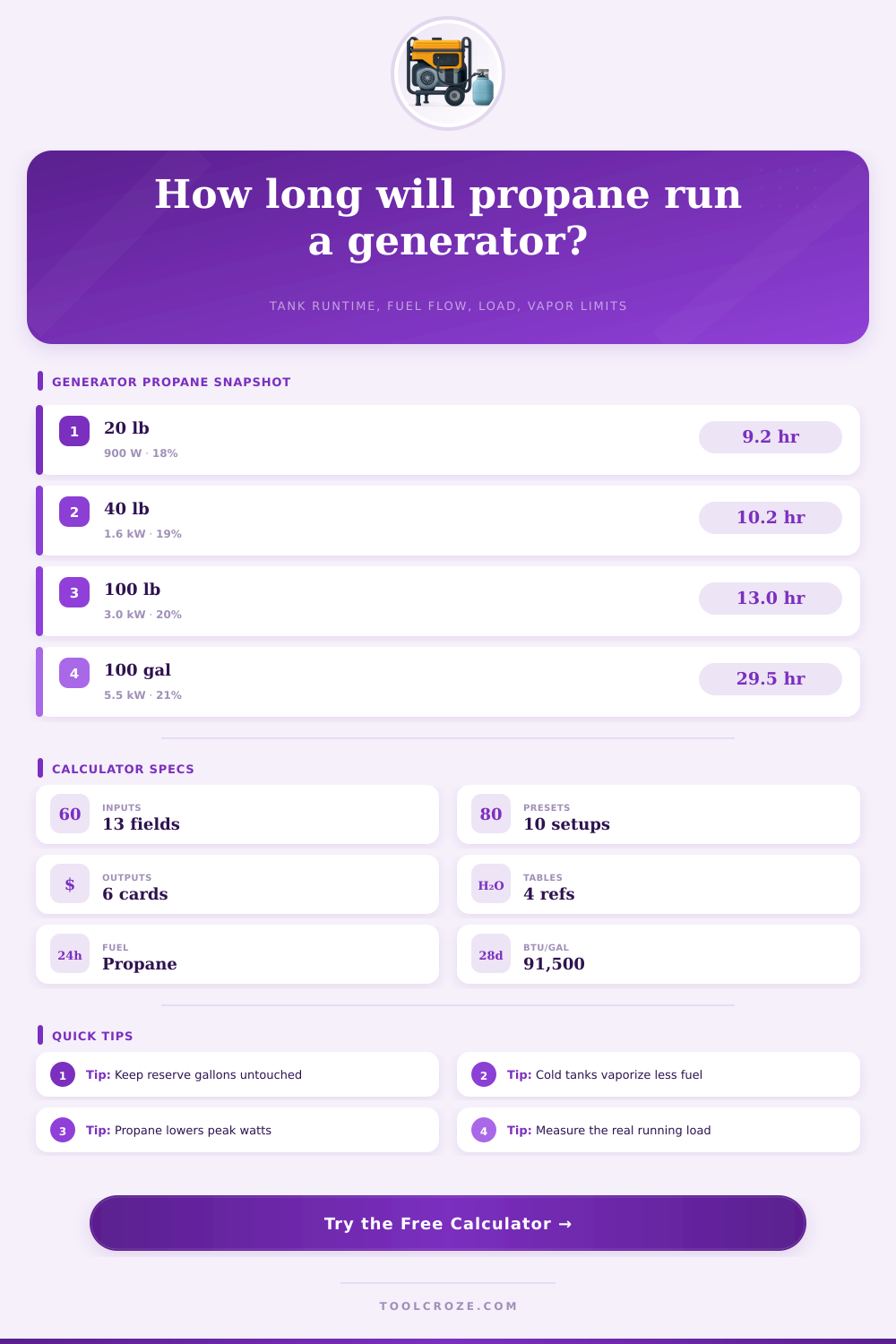
Generator Propane Runtime Calculator
Estimate how long a propane tank will run a generator from tank pounds or gallons, electrical load, BTU content, engine efficiency, reserve fuel, dual-fuel output derate, temperature, and vaporization limits.
⚡ Propane Generator Presets
Pick a common backup, RV, jobsite, inverter, or standby generator setup, then adjust the tank, load, efficiency, derates, and reserve to match the actual equipment.
📐 Tank, Load, Fuel, And Derate Inputs
Propane Generator Runtime Results
Calculation Breakdown
🔋 Propane Tank And Generator Grid
📋 Propane Runtime Reference Tables
| Tank Size | Nominal Propane | 80% Fill Minus 10% Reserve | Generator Fit |
|---|---|---|---|
| 20 lb cylinder | 4.7 gal / 20 lb | 3.4 usable gal | Small inverter, refrigerator, lights, modem |
| 40 lb cylinder | 9.4 gal / 40 lb | 6.8 usable gal | RV generator or modest portable load |
| 100 lb cylinder | 23.6 gal / 100 lb | 17.0 usable gal | Portable home backup with managed loads |
| 100 gal bulk tank | 100 gal / 424 lb | 72.0 usable gal | Small standby or long portable runtime |
| 500 gal bulk tank | 500 gal / 2,120 lb | 360 usable gal | Whole-home standby with higher vapor draw |
| Running Load | Electrical Use | Fuel At 20% Efficiency | Typical Loads |
|---|---|---|---|
| 750 W | 2,559 BTU/hr electric | 0.140 gal/hr | Refrigerator, lights, router, chargers |
| 1,500 W | 5,118 BTU/hr electric | 0.280 gal/hr | RV converter, freezer, small appliances |
| 3,000 W | 10,236 BTU/hr electric | 0.559 gal/hr | Home essentials and managed pump loads |
| 5,500 W | 18,767 BTU/hr electric | 1.026 gal/hr | Portable backup near mid to high load |
| 10,000 W | 34,121 BTU/hr electric | 1.865 gal/hr | Standby generator with several circuits |
| Tank Temperature | Temperature Factor | Vapor Behavior | Planning Note |
|---|---|---|---|
| 70°F and warmer | 100% | Strong vapor pressure | Runtime usually limited by gallons, not vapor |
| 40°F to 69°F | 80% to 95% | Normal cool-weather capacity | Small cylinders may frost under heavy load |
| 20°F to 39°F | 60% to 80% | Reduced vaporization | Use larger tanks or manifold cylinders |
| 0°F to 19°F | 40% to 60% | Low pressure margin | High generator loads may starve fuel flow |
| Below 0°F | 25% to 40% | Severe derate | Bulk tanks and correct regulators matter |
| Generator Class | Common Propane Derate | Useful Efficiency Range | Runtime Note |
|---|---|---|---|
| 2 kW inverter | 5% to 12% | 16% to 22% | Best runtime at steady modest loads |
| 3.5 kW RV generator | 8% to 15% | 15% to 21% | Air conditioner cycling changes fuel flow |
| 7.5 kW portable | 10% to 20% | 17% to 23% | Manage pumps, heaters, and starting surge |
| 12 kW standby | 5% to 15% | 19% to 25% | Needs adequate tank vapor and regulator size |
| 18 kW standby | 5% to 15% | 20% to 26% | Bulk tank sizing affects cold-weather output |
💡 Practical Propane Generator Tips
When the power go out, you must determine how long your propane supply will last. Determining how long your propane supply will last is difficult due to the various factor that will impact how long your propane supply lasts. Factors to consider include the size of your propane tank, the load of electricity that you use, the outside temperature, and the efficiency of the generator that you use in burning propane.
A generator can run for a full day on an propane tank, or a propane tank can run out in only six hour. There are various factors regarding the make and model of both the propane tank and the generator that create this varying time span of the propane tank’s runtime. Propane behave differently from the gasoline that is often used in generators.
How Long Will Your Propane Tank Last in a Power Outage
The efficiency of a generator changes with the load in electricity that the generator is using. When the generator is using more electricity, such as when powering larger appliances, the generator will use propane at a faster rate than if it were idling and using less electricity. Additionally, propane will produce less electricity than gasoline due to the dual fuel system of many generators.
Thus, the propane that is calculated for the generator will always be less than the wattage that is specified for the generator. You can make these calculations in the calculator by entering the size of your propane tank, the number of watts that you will be using, and the derate of your generator. Another factor that may impact the amount of propane that the generator uses is the temperature of the propane tank.
Propane exist as a liquid in the propane tank. However, the generator must vaporize the propane to be used. In colder weather, the vaporization of propane may not occur as quick in a small propane tank as the liquid propane can be released from the tank.
Conversely, increasing the size of the propane tank will increase the area of the propane that can vaporize. Thus, the generator may behave differently in January than it will in July due to the different temperatures. Another consideration of the propane tanks is to leave a reserve of propane in the tank.
It is common for individuals to attempt to run their propane tank until it is empty. However, there should be a small percentage of propane left in the tank as a reserve. The propane reserve is used in case that the gauge on the tank isnt accurate in the amount of propane in the tank, or if there is changes in the electrical load that the generator is using.
This percentage will be accounted for in the calculation of the usable life of the propane in the tank. Another consideration is that the electrical load that the generator uses will not necessarily be constant. It is rare for the electrical loads in an environment to remain constant.
For instance, the air conditioner or the well pump may change their load. Additionally, you can make a more accurate measurement of the electrical load with an electrical meter or by adding the wattage rating for each device in the electrical load. The efficiency of the generator may also impact how long the propane will last.
Many portable generators are between 15% and 23% efficient, while larger standby generators can be much more efficient. In some instance, it is not the propane tank that creates the stopping of the generator. Factors like the regulator, the diameter of the hose, or frost forming on the propane tank can impact the amount of propane that flows from the tank before it is empty of propane.
The propane calculator compare the amount of propane that the generator needs to the amount of propane that may vaporize from the propane tank at the given temperature. If the ratio of the two numbers create a too tight ratio, then options include buying a larger propane tank, ensuring that the propane tank is warmed, or reducing the electrical load of the generator. One additional factor to consider is the amount of hours that you plan to run the generator each day.
If you plan to run the generator for eight hours each day, it will last for more days than if it was plan to run the generator for twenty-four hours each day. The calculator will convert the number of hours that you enter into the number of days that the propane tank will last during power outage. Finally, it is recommended that you use the calculator to compare scenario rather than to find the one answer to the question of how long your propane tank will last.
By changing the electrical load, the temperature, or the reserve percentage of the propane tank, you can find the impact of that change on the runtime of the propane tank. By comparing these variable, you can determine which variables most impact the runtime of your propane tank. Thus, by changing these variables, you can form an idea of what each of your propane tank and generator model can provide during power outages.