
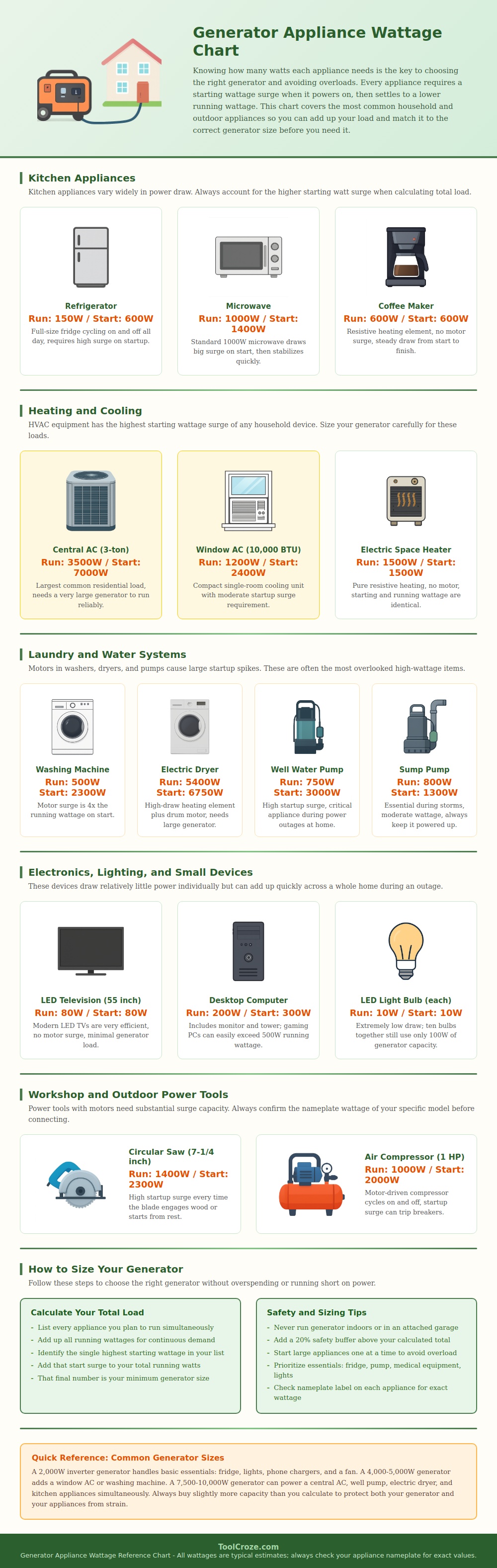
A generator will provide powers to the house when the main power supply fail. However, the generator will fail to power an appliance if you dont account for the power require to start the appliance. Even if appliances requires a significant amount of power to run, the power required to start the appliance is more higher than the power required to continue running the appliance.
This additional power requirement is known as a startup-surge. The startup surge happen when appliances like motors and compressor start to operate. If the generator cannot provide enough power to meet the startup surge of the appliances, the generator will stall.
Generator and Appliance Startup Power
Appliances with motors and compressor produce significant startup surge and is the cause of generator failure. Fridges are known to use a significant amount of power to maintain the temperature inside the refrigerator. However, the refrigerator require a significant amount of power to start the compressor that maintains the refrigeration inside the fridge.
Other appliances that use significant power to start up includes air conditioners. Air conditioners require a significant amount of power to start up the motor that circulate the air inside the house. Additionally, sump and well pumps is significant load on the generator.
These pumps create an aggressive startup surge when they have to pump water against gravity. Because of these surges, the pump require several times more power to start up than when it is running normaly. Appliances that do not have motors or compressor do not produce significant startup surge.
Appliances like space heaters use resistive power to heat the space. The space heater draw a significant amount of power once turned on. Other appliances like LED televisions and bulbs draw a low and steady amount of power.
Even if you have many small electronics in the house, you will not use much of the generators power. However, this does not prepare you for the power that motor use. When calculating the power requirements of the appliances that you would like to use in the house, you will have to calculate based off the startup surges of the appliances.
You can total the power that the appliances use when they are running. Then, add the largest startup surge from the appliance you have the most demand for. You will not start all appliances at once.
Therefore, there is no need to add the startup surges of all appliances. However, it is a good idea to add a buffer of twenty percent of power to the total power calculation for the appliances. Adding twenty percent of buffer to the total power requirement for the appliances will help to save fuel and prevent the generator from working at maximum power, which will wear on the generator over time.
You will have to decide which appliances you would like to run in the house and which appliances are necessities versus a luxury. A sump pump may be a necessity for the house to avoid flooding. However, a desktop computer is a luxury.
To manage the electrical load of the appliances, start the largest appliances one by one. Doing so will prevent the electrical generator from failing. When people understand the startup surges of appliances and know how much power the motors use, they can ensure that the generator will provide the necessary power to the house.
