Gas to Oil Ratio Calculator
Calculate small-engine oil dose from fuel volume, ratio, oil unit, reserve, batch count, container size, and measuring tolerance.
Pick a common tool setup, then adjust the fuel amount or ratio to match the engine manual.
Calculation Breakdown
| Gas:oil ratio | Oil for 1 gal gas | Oil for 5 L gas | Typical equipment note |
|---|---|---|---|
| 16:1 | 8.00 fl oz | 312.5 mL | Vintage or special manual calls only |
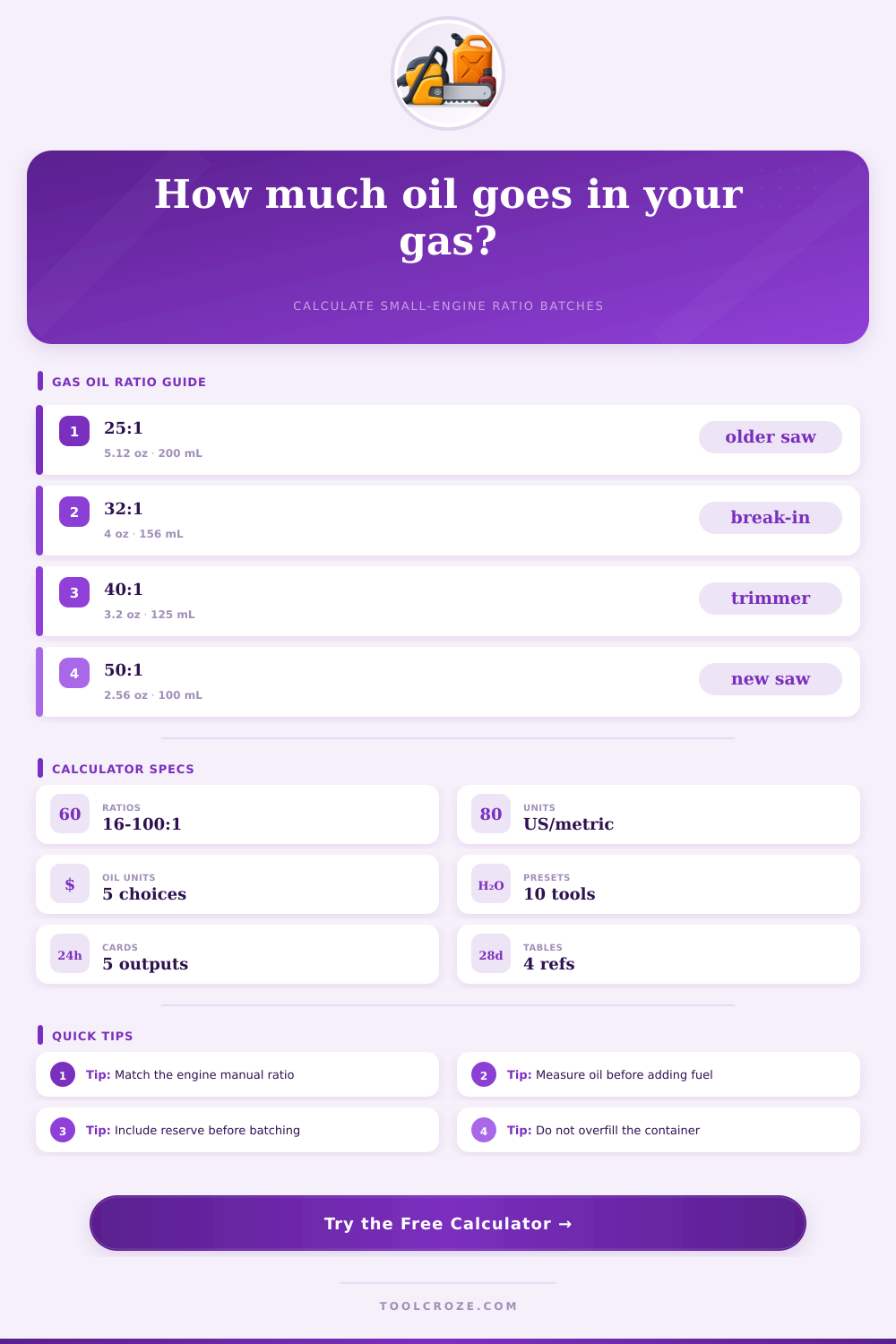
| 25:1 | 5.12 fl oz | 200.0 mL | Break-in and some older tools |
| 32:1 | 4.00 fl oz | 156.3 mL | Older saws, mini bikes, older handhelds |
| 40:1 | 3.20 fl oz | 125.0 mL | Trimmers, augers, some blowers |
| 50:1 | 2.56 fl oz | 100.0 mL | Modern saws, blowers, outboards |
| 80:1 | 1.60 fl oz | 62.5 mL | Only where the oil maker and engine allow it |
| Preset | Ratio | Fuel amount | Container check |
|---|---|---|---|
| Chainsaw 50:1 jug | 50:1 | 1.00 gal | 1.25 gal can leaves measuring space |
| String trimmer 40:1 | 40:1 | 1.00 gal | Good for a shared yard-tool batch |
| Leaf blower 50:1 | 50:1 | 0.50 gal | Smaller batch reduces stale fuel risk |
| Earth auger 40:1 | 40:1 | 2.00 L | Metric bottle marks are easy to read |
| Break-in 25:1 | 25:1 | 1.00 L | Use only when the manual calls for it |
| Unit | Equivalent | Best use | Rounding note |
|---|---|---|---|
| Fluid ounce | 29.5735 mL | US oil bottle marks | Round to 0.01 fl oz for small batches |
| Milliliter | 0.033814 fl oz | Metric syringes or bottles | Round to the nearest 1 mL when pouring |
| Tablespoon | 14.7868 mL | Emergency measuring only | Use a real measuring spoon, not tableware |
| Teaspoon | 4.9289 mL | Tiny tool tanks | Best for very small demonstration batches |
| Cup | 236.588 mL | Large shop batches | Use only when the oil amount is large enough |
| Container size | Practical fill target | Why it matters | Calculator check |
|---|---|---|---|
| 1 gal / 3.8 L | About 90% full | Allows shaking space after oil is added | Flags tight or overfull mixes |
| 1.25 gal / 4.7 L | 1 gal gas plus oil | Common safe headspace for US batches | Good default for 1 gal recipes |
| 5 L can | 4.5 L to 4.8 L | Room for oil, reserve, and mixing | Works well with metric presets |
| 2.5 gal / 9.5 L | 2 gal gas plus oil | Useful for multiple tools in season | Use batch count for repeated cans |
| 10 L can | 8 L to 9.5 L | Enough headspace for shop batches | Check stale-fuel risk before mixing |
A two-stroke engine require a specific mixture of gasoline and oil to function corectly. The ratio of the gasoline to oil in the mixture determines how well lubricated the engines will be while in operation. Too little oil in the mixture will result in the piston and crankshaft wearing down quick.
Too much oil in the mixture will cause the spark plug to fouling and the exhaust pipe to become clogged, making it impossible for the engine to run good. The user should know the exact ratio of gasoline to oil that the two-stroke engine requires. The calculator perform the mathematical calculations necessary to determine the amount of oil that should be mixed with the gasoline based off the amount of fuel that the user would like to prepare, the ratio of gasoline to oil for the two-stroke engine, and the preferred unit of measurement for the oil.
How to Mix Gasoline and Oil for a Two-Stroke Engine
A five-percent reserve allowance is built into the calculations for the gasoline and oil mixture to ensure that the user does not run out of the mixture prior to completing the required tasks. The calculator also includes a task to determine if the user intend to use a container that can hold the gasoline and oil mixture. The user must shake the mixture in the container to ensure that the gasoline and oil become well-mixed.
There must be enough extra space in the container for shaking the gasoline and oil mixtures. Different two-stroke engines requires different gasoline and oil ratios due to the difference in the duty cycles of the engines and the cooling systems of those engines. For instance, a chainsaw that is to be use in cutting wood at high speeds for long periods will require a different ratio of gasoline to oil then an older chainsaw or a chainsaw that is being used during the break-in period of the saw.
During the break-in period of a saw, a richer ratio of gasoline and oil is required to allow for the proper lubrication of the engine parts. The calculator allow the user to choose the different gasoline and oil ratios and to choose the correct units of measurement for the oil based on the oil bottle markings. The size of the container in which the gasoline and oil mixture will be prepared and the number of batches of the gasoline and oil mixture that the user would like to prepare are two factor that the calculator considers.
Should the user attempt to prepare one gallon of gasoline and oil in a container that can hold only one gallon of liquid, the gasoline and oil mixture will not have enough space to be shaken into a well-mixed state. The calculator ensure that the size of the container that the user chooses is large enough for the gasoline and oil mixture to be shaken. The calculator also calculate the number of batches of gasoline and oil that the user would like to prepare.
Any gasoline and oil mixture that is prepared in batch will increase the total amount of gasoline and oil mixture that will be prepared. The calculator will warn the user of the total amount of gasoline and oil mixture that will be prepared compared to the capacity of the container in which that mixture will be stored. Another important factor to consider is the potential for measuring error in the preparation of the gasoline and oil mixture.
Should the user make a three-percent measuring error when preparing the two-stroke engine fuel mixture, the two-stroke engine may produce smoke when the engine is operating. The calculator will display the possible range of the measurement to indicate which measuring cup or syringe the user should use to ensure that the gasoline and oil mixture is measured corectly. The gasoline and oil ratio is essential to the proper operation of the two-stroke engine.
It is up to the user to prepare the gasoline and oil mixture with accuracy according to the measurement indicated by the calculator. Once the user has prepared the gasoline and oil mixture, it should be stored in a container with a label that indicate the type of fuel mixture that is contained within the container. The gasoline and oil mixture should be used within one or two months of preparation.
Under no circumstances should this gasoline and oil mixture be left sitting in the fuel tank of the powered tool during the winter month. By following these steps, the user will not damage the two-stroke engine and will not waste the gasoline and oil that is require for the proper operation of the engine. Additionally, if the calculator calculate the amount of gasoline and oil mixture that is required for the engine, the user must ensure that he or she pours the exact amount of gasoline and oil into the engine to maintain the proper ratio of gasoline to oil.