Gas Spring Position Calculator
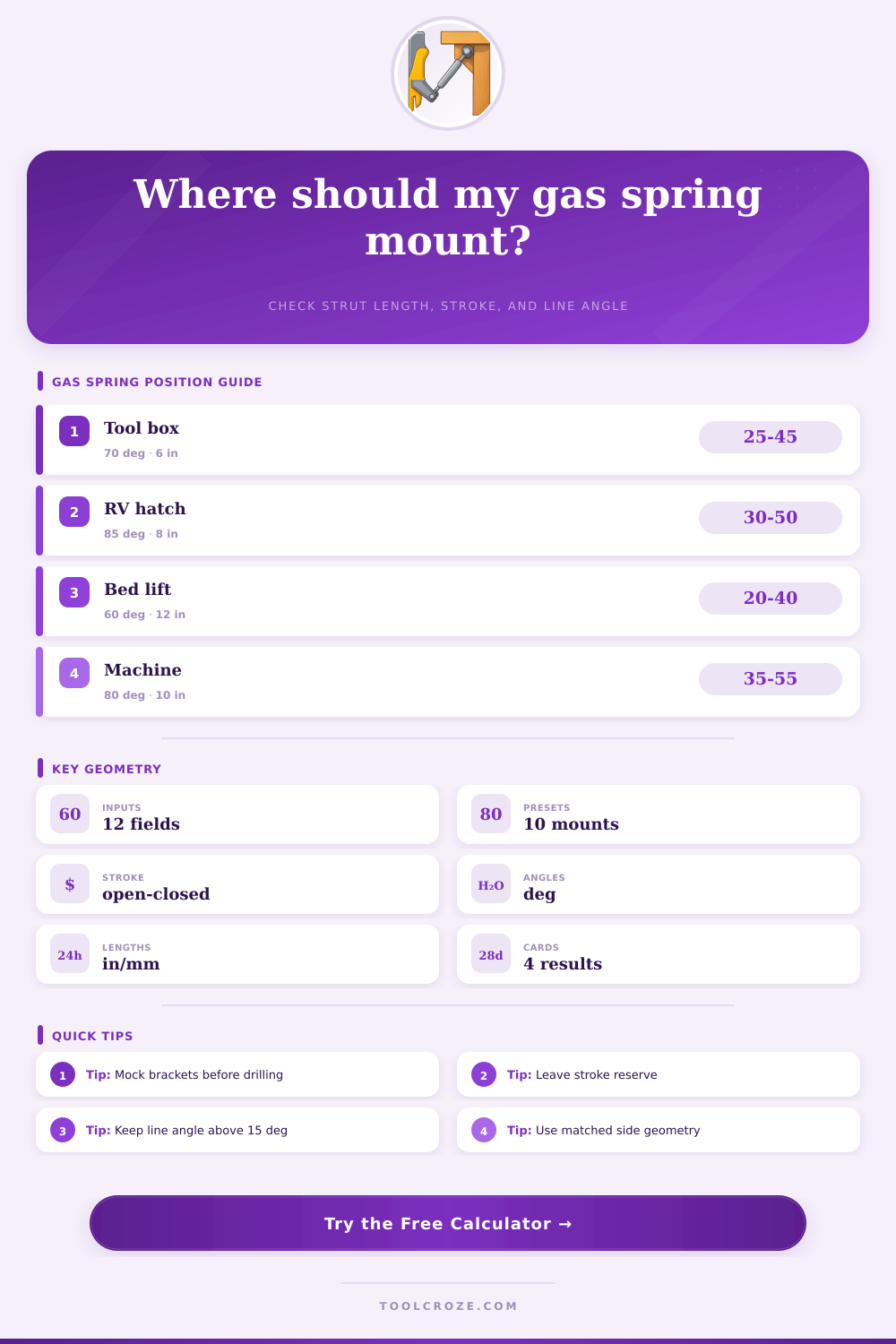
Position gas spring brackets for lids, hatches, guards, and lift panels by checking pivot geometry, closed and open angles, compressed and extended lengths, required stroke, bracket offsets, and force line angle.
Load a realistic bracket layout, then tune the lid length, pivot setback, bracket offsets, gas spring length, stroke, and opening angle.
Gas spring position results
Geometry Breakdown
| Mounting layout | Lid bracket from pivot | Body bracket offset | Use when |
|---|---|---|---|
| Compact side mount | 30% to 45% of lid length | Small forward, moderate drop | Toolboxes, cabinets, and short hatches. |
| Deep hatch mount | 35% to 55% of lid length | Moderate forward, larger drop | Boat hatches, RV doors, and service panels. |
| Bed lift mount | 35% to 50% of platform length | Forward and low on base | Large lids that need high lift assist. |
| Machine guard mount | 40% to 60% of guard length | Low body bracket with stops | Heavy covers where open holding matters. |
| Catalog size | Compressed length | Extended length | Positioning note |
|---|---|---|---|
| Short cabinet strut | 7 to 10 in | 11 to 16 in | Needs compact brackets and careful closed clearance. |
| Toolbox strut | 10 to 14 in | 16 to 22 in | Common for side lids and small access panels. |
| Hatch strut | 14 to 20 in | 22 to 32 in | Good for medium lids with open angles near 70 to 90 deg. |
| Platform strut | 18 to 28 in | 30 to 44 in | Needs strong brackets, stops, and paired side geometry. |
| Force line angle | Moment arm behavior | Typical result | Bracket adjustment |
|---|---|---|---|
| Under 15 deg | Very small leverage | High spring force needed | Lower body bracket or move lid bracket outward. |
| 15 to 30 deg | Usable but sensitive | Works for light lids | Prototype before drilling both sides. |
| 30 to 55 deg | Strong leverage range | Good open support | Check closed force so the lid still latches. |
| Over 55 deg | High side load risk | Can bind at end fittings | Check ball stud alignment and hinge stops. |
| Check | Good target | Problem sign | What to change |
|---|---|---|---|
| Closed length | Above compressed length | Strut bottoms before lid closes | Move body bracket or use shorter strut. |
| Open length | Below extended length | Strut becomes the hard stop | Use hinge stops or reduce open angle. |
| Stroke reserve | 10% to 20% | No tolerance for bracket error | Increase catalog stroke or revise offsets. |
| Open moment arm | At least 1.5 in | Force jumps very high | Lower fixed bracket or move lid bracket farther out. |
To install a gas spring so that a gas spring hold a lid in a specific position, you must determine the correct mounting locations for the brackets. The position of the body bracket and the position of the lid bracket determine the extension and compression needed from the gas spring, as well as the leverage that the gas spring has against the hinge. If the coordinates of the body and lid brackets isnt correctly set, then the gas spring may either be too weak to hold the lid when it is in an open position, or it may be too strong and make it difficult to close the lid when it is in a shut position.
In order to avoid these issues, you should use a calculator to determine the correct position (offsets) for each of the brackets instead of using a tape measure and protractor to guess the measurements. To calculate the position of the brackets, four measurements are required. Each of the measurements includes measuring the length of the lid from the hinge, the distance from the hinge to the moving mounting bracket on the lid, the forward offset of the body mounting bracket, and the drop offset of the body mounting bracket.
How to Mount a Gas Spring to Hold a Lid
These four measurements will allow for the calculation of both the distance between the endpoints of the gas spring in the open and closed positions of the lid, and for the angle between the gas spring and the radius of the lid. These two calculated values will allow for the determination of the stroke length that the gas spring should have to hold the lid in place. The angle between the gas spring and the lid is a critical measurement for the proper installation of the gas spring.
If the gas spring is installed such that it is nearly in line with the lid when the lid is in an open position, then the gas spring will have to work more hard to hold the lid in place. Furthermore, if the angle at which the gas spring emerges from the lid when it is open is less than fifteen degrees, then the length of the lid or the position of the body mounting bracket may need to be adjusted. If the angle is too steep when the lid is in a closed position, then the gas spring may make it difficult for the lid to be pulled shut or may interfere with the latch that secures the lid to the object upon which it rests.
Another important measurement of the installation of the gas spring is the stroke reserve. Stroke reserve is a percentage that takes into account potential errors in the installation of the brackets and the manufacturing of the lid. Each gas spring has a length at which it is compressed and another length at which it is extended.
However, the actual measurements of the brackets that are mounted to the object and the lid itself may not be exactly to the measurements that is depicted in the technical drawings of those objects. A five percent stroke reserve is a very small value; it is only appropriate for applications in which the lid is very precise in its positioning. A stroke reserve of ten to fifteen percent is considered standard.
A twenty percent stroke reserve is used for heavy platforms. These percentages can be entered into the calculator to determine where the gas spring should be mounted such that it does not travel beyond its physical limits. In addition to the stroke reserve, another factor in the calculation of the mounting positions for the brackets is the weight of the lid and the position of the lid’s center of gravity.
Each gas spring produces a moment that counteracts the moment created by the weight of the lid. This calculation is only an estimate; gas springs do lose some of their force as they heat up from use, and each hinge possesses a small amount of friction. If the gas spring produces a moment that is equal to one hundred twenty percent of the moment created by the lid’s weight, then the lid will not slam into the object upon which it rests; however, it may be difficult to latch the lid when it is closed.
In this situation, you can move the body mounting bracket a few millimeters to even out the moments created by the lid and the gas spring. Each of the different types of mounting styles require different placements of the mounting brackets. For instance, toolbox lids often place the mounting bracket for the lid between thirty and forty-five percent of the length of the lid.
Boat hatches and recreational vehicle cargo lids often place their mounting brackets at fifty percent of the length of the lid. Finally, platform lids and machine guard lids often have their body mounting brackets placed lower on the object, and have longer strokes in the gas spring to accommodate the increased weight of the platform or machine guard. These different mounting styles have preset settings in the calculator that allow for the determination of each of the mounting positions required for these types of gas spring installations.
Before installing the brackets into the lid and the object upon which the lid rests, the installation should be tested. One way of accomplishing this task is to prepare a mock-up of the installation for which the brackets will be manufactured and mounted. By moving the lid back and forth while it is mounted to the object, it is possible to determine whether the brackets need to be adjusted; it is also possible to determine whether the gas spring will reach the limit of its stroke.
By testing the mock-up installation, the installer can ensure that the placement of the brackets will function as desired once the brackets are manufactured and installed on the lid. If the gas spring that is to be installed uses two gas springs, then each of the brackets need to be symmetrical in their placement. If the height or forward placement of the left and right mounting brackets differ by even a quarter inch, the lid may become twisted when it is opened.
If the lid becomes twisted, one gas spring will have to bear more of the weight of the lid than does the other gas spring. Therefore, it is important to ensure the symmetry of the mounting brackets. Furthermore, symmetry will help to prevent the development of long-term wear on the hinges of the lid.
One final factor to consider is the force curve of the gas spring. Gas springs have more force when they are compressed than when they are extended. The ratio of the force of a compressed gas spring to that of an extended gas spring can range from a ratio of ten percent to fifty percent.
The force curve can be adjusted in the calculator to take into account the specific gas spring that will be installed. For instance, if the lid is delicate and made of glass, it may be better for the gas spring to have a gentler force curve to ensure in the smooth movement of the lid when it is used to lift it. The geometry of the installation of the gas spring is based on a few simple principles; two points make a line, the change in the length of that line is the stroke of the gas spring, and the angle between that line and the radius of the lid is the angle of the force curve.
The stroke and the force calculations ensure that these two variables will function properly with the actual brackets and lid. Furthermore, by moving the body mounting bracket a few inches, the installer can simultaneously adjust the angle and stroke of the gas spring. By understanding these relationship, the installer can place the brackets in the desired location.