Gas Spring Force Calculator
Estimate rated force per gas spring from lid weight, center of gravity, pivot distance, mount distance, spring angle, number of springs, friction allowance, and design margin.
Pick a common hatch or lid starting point, then replace the dimensions with your real measurements.
Gas Spring Force Results
Calculation Breakdown
| Hatch type | Typical weight | Common spring angle | Common spring count |
|---|---|---|---|
| Small cabinet lift door | 8 to 18 lb / 4 to 8 kg | 35 to 55° | 1 or 2 |
| Truck toolbox lid | 25 to 45 lb / 11 to 20 kg | 30 to 45° | 2 |
| RV baggage door | 12 to 28 lb / 5 to 13 kg | 35 to 50° | 1 or 2 |
| Boat engine hatch | 45 to 90 lb / 20 to 41 kg | 25 to 40° | 2 |
| Steel floor hatch | 90 to 180 lb / 41 to 82 kg | 25 to 35° | 2 or 4 |
| Spring angle | Sine factor | Force effect | Practical note |
|---|---|---|---|
| 15° | 0.26 | Very high force | Usually poor leverage near closed |
| 25° | 0.42 | High force | Common on tight hatches |
| 35° | 0.57 | Moderate force | Good general starting point |
| 45° | 0.71 | Lower force | Strong leverage, check packaging |
| 60° | 0.87 | Lowest force | Best leverage but may need room |
| Allowance | Typical range | Use when | Watch for |
|---|---|---|---|
| Friction allowance | 5 to 25% | Hinges, seals, misalignment | Too much makes the lid hard to close |
| Design margin | 5 to 20% | Field variation and aging | High margin can overpower latch |
| Force curve | 1.10 to 1.40 | Compressed force estimate | High curve can pop the lid open |
| Load sharing | Even geometry | Two or four spring setups | Unequal brackets twist the lid |
| Check | Good target | Problem sign | Adjustment |
|---|---|---|---|
| Moving mount distance | 30 to 60% of lid depth | Force result is extreme | Move bracket farther from hinge |
| Spring angle | 25 to 60° | Small angle needs huge force | Lower body mount or change bracket |
| Closed assist | 60 to 90% balance | Lid will not latch | Reduce force or target balance |
| Hard stop | Separate stop or hinge | Strut bottoms out | Change stroke or mount spacing |
When selecting a gas spring for your hatch or lid, understanding how the weight of that lid, its geometry, and the leverage provided to it will interact will allow you to find the best gas spring for that specific lid. If the gas spring that you choose for your lid is not the correct force for that application, your hatch may become difficult to move or may drop unexpected. To help remove the guesswork involved in gas spring selection, the calculator included with this article use your measurements to calculate the necessary gas spring force for you.
Gas springs works due to the fact that gas springs store energy due to the compressed nitrogen and gas found within the spring, and that the gas spring can later release that stored energy to move the lid. The consistent force that gas springs create allows you to hold your lid in any position between the closed and fully open position of that lid. The force required by the lid relates to the center of gravity of the lid and its relation to the hinge line; the force required doesnt necessarily relate to the weight of the lid.
How to choose the right gas spring for your lid
A heavy lid can have less force required if the center of gravity of that heavy lid is close to the hinge line of that lid. In contrast, a lighter lid will require more force if the center of gravity of that lid is further from the hinge line. To calculate the force of the gas spring, you must provide the distance from the hinge to the center of gravity of the lid to the calculator.
In most cases, the distance from the hinge to the middle of the lid is an accurate measurement of the distance from the hinge to the center of gravity. However, in instances where the lid has an even weight distribution to it (like a lid with a spare tire on it), such an adjustment will be required to ensure that the gas spring can adequately perform the desired motion of the lid. Furthermore, the geometry on which the lid will be mounted will also impact the force of the gas spring that is required for that lid to open and close.
The distance between the hinge and the moving mount point will impact the leverage of the gas spring. If the mount point for the gas spring is placed close to the hinge line of the lid, then less force will not be required to open the lid. However, if you move the mount point of the gas spring away from the hinge line, the force that is required for the gas spring will decrease.
However, moving the mount point will also impact the angle of the gas spring. The angle of the gas spring will impact the force that is required of the gas spring; the steeper the angle of the gas spring, the more force that is required to open the lid to the desired position. Other factors that may impact the movement of your lid include friction and seal drag.
Friction may exist at the hinge point of the lid, the weatherstripping on the lid, or the gas studs that attach the gas spring to the lid. Each of these moving parts will create resistance for the lid movement. An allowance for friction can be provided in the gas spring force calculation to ensure that the gas spring can provide enough force to overcome friction at these points.
If the friction allowance is set too low, the lid will be sluggishly to open. However, if the friction allowance is set too high, the gas spring may overpower the latch. Finding a balance between these two options is something that you will have to experiment with once the gas spring is installed onto the lid.
Another important consideration is the effect that the real world will have upon the hinge and lid over time. Many lids will change in their weight over time, their hinges will settle, and the temperature to which the gas spring is exposed will change the gas pressure within the spring. By providing a design margin for the gas spring, the gas spring will account for these changes.
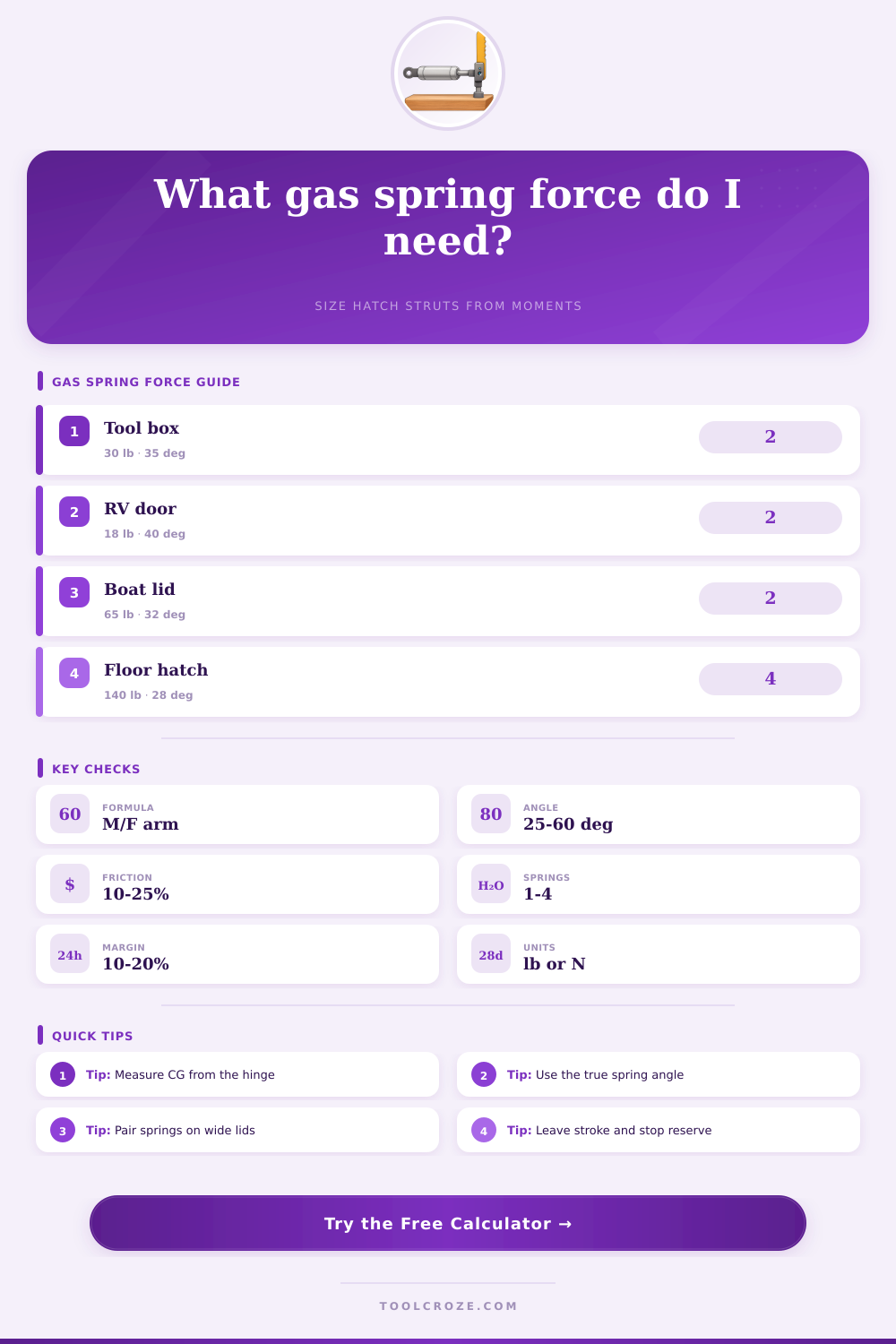
This design margin can be provided through the percentage input within the gas spring calculator. Gas springs are not universally applied to the different types of lids. For instance, toolboxes and RV doors often use two gas springs rather than one due to the wide size of those lids.
Boats tend to have hatches that are installed at a low angle relative to the remainder of the boat to provide better access to the floor, and therefore require increased force to be provided by each gas spring. Finally, floor hatches may use four gas springs to even further reduce the amount of force that is required of each gas spring. Each of these have their own patterns for providing the force, but the specific hinge and lid geometry may require some different choices for gas springs than the general rule-of-thumb guidelines suggest for those specific types of lids.
One of the most common mistakes that people make is to believe that a higher force gas spring is a better product. Gas springs that are too large can make it difficult to close the lid. Additionally, the oversized gas spring may cause stress upon the lid or the mounting hardware.
A balance between 60 and 90 percent of the force calculation is recommended for ease of lid operation; the lid should require a light push to close, but it should remain in an open position when the lid is opened. The force calculator makes it possible to set a force requirement for the gas spring to achieve this target percentage. Gas spring calculators do not account for the stroke length that the gas spring will have to travel to open or close the lid.
Therefore, a gas spring may meet the force calculation yet it may bottom out the lid. Additionally, the end fittings of the gas spring may encounter the frame of the lid when the lid is in a closed position. Therefore, it is also necessary to consider the compressed and extended length of the gas spring in relation to the size of the lid.
Additionally, it is important to consider the temperature range in which the gas spring will operate; the gas pressure will drop as the temperature drops. Therefore, a gas spring that is appropriate for use in the summer months may not provide enough strength in the winter months. Finally, it is important to test the lid once the gas spring is installed.
The lid should be lifted several times to ensure that it does not drift downward of itself or requires extra effort to move to the closed position. If such movement is encountered, you can make small adjustments to the location of the moving mount of the gas spring. These adjustments can be made based off the specific numbers provided by the gas spring calculator.
Regardless of the type of lid being considered, whether it is a truck toolbox, an RV compartment, or even a workboat hatch, the same general measurements will be required. You will have to measure the weight of the lid and its distance to its center of gravity, as will the locations and angles of each of the mounting points for the gas spring. The gas spring calculator will account for these measurements and help to calculate the force that each gas spring should generate.
With the force determined, it is possible to purchase a gas spring that meets those specifications. Thus, the force calculation removes the most variable aspect of installing gas springs, and the remaining choices can be made more easy.