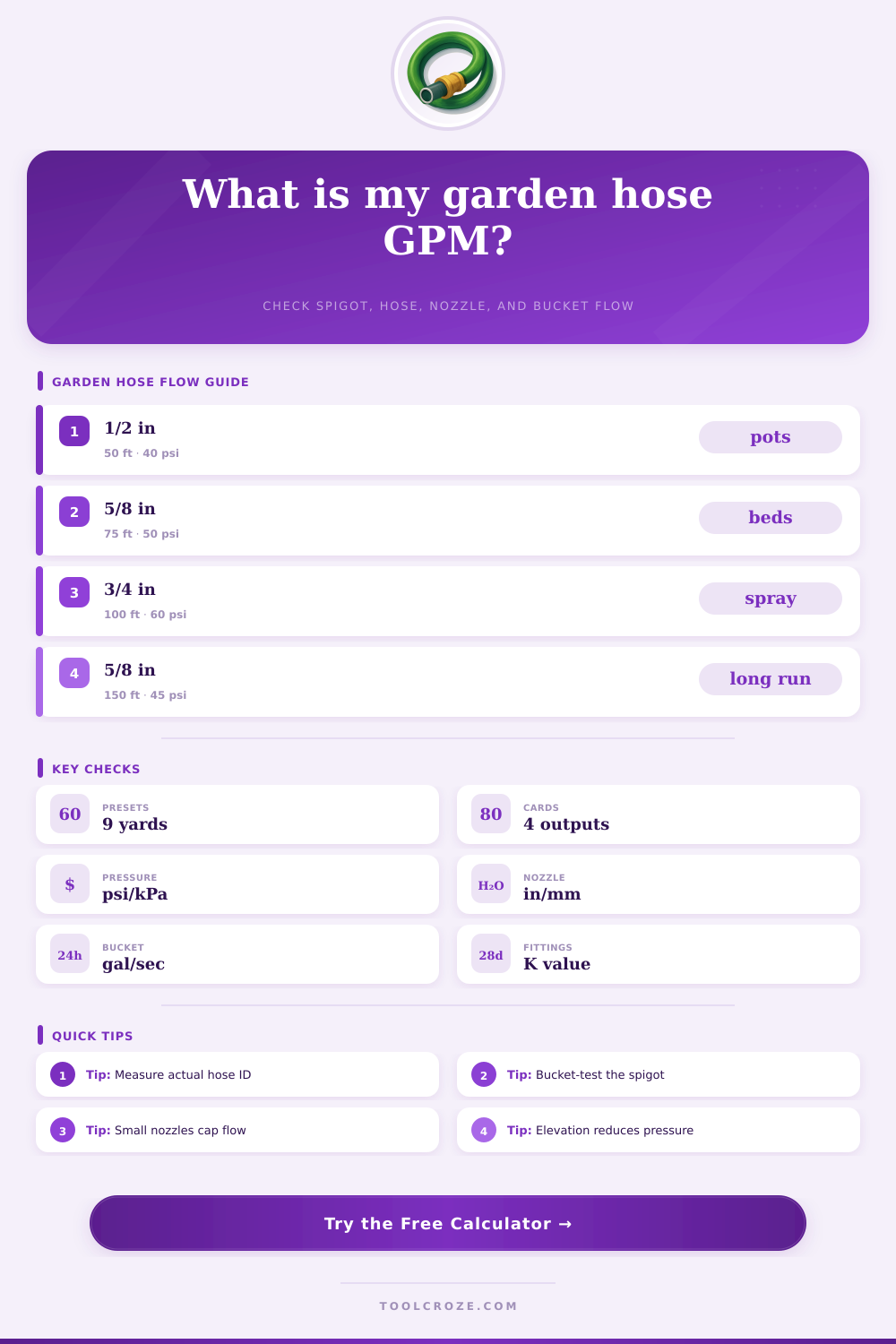
Garden Hose GPM Calculator
Estimate garden hose flow from spigot pressure, hose inside diameter, length, nozzle diameter, elevation, fittings, and an optional measured bucket check for real-yard calibration.
Pick a real yard layout, then adjust pressure, hose size, nozzle, elevation, fittings, and bucket test values for your spigot.
| Nominal Hose ID | 50 ft Open End | 100 ft Open End | Use This When |
|---|---|---|---|
| 1/2 in | 5 to 9 GPM | 3 to 6 GPM | Small patios, potted plants, and short hand watering. |
| 5/8 in | 9 to 17 GPM | 6 to 12 GPM | Most garden beds, hose-end sprayers, and normal yards. |
| 3/4 in | 14 to 24 GPM | 10 to 18 GPM | Fast filling, long runs, and higher-flow sprinklers. |
| 1 in | 24 to 40 GPM | 18 to 32 GPM | Utility filling where the spigot and fittings can supply it. |
| Setup | Typical Inputs | Expected Range | Calculation Note |
|---|---|---|---|
| Open 5/8 in hose | 45 to 60 psi, 50 ft, little elevation | 9 to 17 GPM | Hose friction usually controls flow after the spigot and couplers. |
| Spray nozzle | 5/8 in hose, 0.20 to 0.30 in opening | 3 to 10 GPM | The nozzle opening often limits flow more than the hose ID. |
| Soaker or drip feed | Low pressure, small inlet, long run | 0.5 to 4 GPM | Use the bucket check at the operating valve setting. |
| Long side-yard run | 100 to 200 ft hose with quick connects | 4 to 9 GPM | Long length and fittings can consume most available pressure. |
| Bucket Size | Fill Time | Measured Flow | Calculator Use |
|---|---|---|---|
| 2 gal | 30 sec | 4.0 GPM | Good check for watering wands and small spray nozzles. |
| 5 gal | 60 sec | 5.0 GPM | Common low to moderate hose-end watering rate. |
| 5 gal | 30 sec | 10.0 GPM | Typical strong 5/8 in hose with a fairly open outlet. |
| 5 gal | 20 sec | 15.0 GPM | High-flow open end or 3/4 in hose behavior. |
| Part | Typical K or Cd | Best Input | Use in Calculator |
|---|---|---|---|
| Open hose end | Cd 0.98 to 1.00 | Nozzle diameter equals hose ID | Good for filling cans, tubs, and basins without a sprayer. |
| Adjustable spray nozzle | Cd 0.75 to 0.85 | Measure or estimate opening | Use smaller diameter for mist or jet settings. |
| Watering wand | Cd 0.70 to 0.82 | Add extra K for valve and head | Long wand passages can add meaningful pressure loss. |
| Quick connect pair | K 0.5 to 2.0 | Count each restrictive pair | Narrow-bore quick connects can reduce GPM sharply. |
| Hose reel or backflow device | K 1.5 to 6.0 | Enter as extra K | Use bucket check if the reel cannot be bypassed. |
Water flow are measured in gallon per minute, and the gallons per minute will determine how much water come out of the garden hose. Knowing the gallons per minute is important to determine if a sprinkler will even the lawn or if a bucket will becomes full quickly. If you dont know the gallons per minute that your garden hose can output, you may waste your time or you may fail to complete your gardening task prior to the sun setting.
Garden hoses does not all work in the same way. Due to various factor, there will be a loss in the water pressure from the garden hose compared to the spigot where the hose are attached. Water pressure losses can occur due to the friction in the hose, changes in elevation to the hose, the couplers on the hose, and even the nozzle place onto the end of the hose.
How Much Water Comes From Your Garden Hose
All of these factor will lead to the reduction of the gallons per minute that would otherwise come from the spigot. The diameter of the garden hose have a significant effect on the gallons per minute of the water flow from the hose. A half-inch hose will allow for less gallons per minute to exit the hose than a five-eighths inch hose.
Many garden hoses are labeled as having a five-eighth inch diameter. However, many garden hoses has a smaller internal diameter due to the thickness of the hoses wall. Thus, it is important to estimate the internal diameter of the hose to obtain an accurat measurement of the gallons per minute that the hose can output.
The length of the hose will also have two effect upon the gallons per minute of the hose. First, as the length of the hose increase, the water pressure will decrease. Additionally, if the elevation of the hose outlet is higher than the elevation of the spigot, the pressure will continue to decrease.
However, if the outlet is lower than the spigot, the water pressure will slightly increase. Each fitting on the hose will reduce the water flow from the hose. Fittings such as quick-connect pair, shutoff valves, and backflow preventer will all reduce the flow of water from the hose.
Thus, if many fitting are placed onto the garden hose, the flow of water will decrease. A calculator is available that allows people to enter the number of coupler onto the hose to calculate the total reduction in flow. Another means of measuring the gallons per minute of the hose is by performing a bucket test.
To perform such a test, the hose must fill a container of a known volume, and the time it take to fill the container can be measured. The gallons per minute calculated from such a test may not be the same as calculated with the calculation method described in this passage. The reason for these differences is because all garden hose have different diameters.
Additionally, the water pressure from the spigot can change at various time of the day. If the gallons per minute calculated by the bucket test is within fifteen percent of the calculated gallons per minute, then the calculated value is considered to be reliable. However, if the numbers is different from the bucket test value, the bucket test will provide the value that is used.
The choice of nozzle for the garden hose will change the amount of water that comes out of the hose. A nozzle that allows for a wide fan of water will allow for more gallons per minute than a nozzle that reduce the area of water that emerges from the nozzle. Additionally, watering wand and soaker hoses will create resistance within the hose such that the gallons per minute will reduce.
Thus, it is important to choose the proper nozzle and hose accessory for the gardening task to be performed. Various environmental factor can impact the gallons per minute of water that comes out of the garden hose. Factors such as the amount of time the hose was exposed to sunlight will change the diameter of the hose due to the flexibility of the rubber of the hose.
Additionally, the quick-connect fitting may have debris that enter the hose. Finally, the water pressure from the spigot can change according to other appliance in the house that are using water. Thus, a real-world allowance factor of up to twenty percent can adjust a calculator for these environmental factor.
By measuring the garden hose and measuring the flow of water from the hose, gardeners can control their water usage. For instance, a garden hose that outputs five gallon of water per minute will take ten minute to fill a fifty gallon container. However, a garden hose that outputs ten gallon of water per minute will fill the same container in five minute.
Thus, by knowing the gallons per minute of the garden hose in the garden, the gardener will save time and water.