Garage BTU Calculator
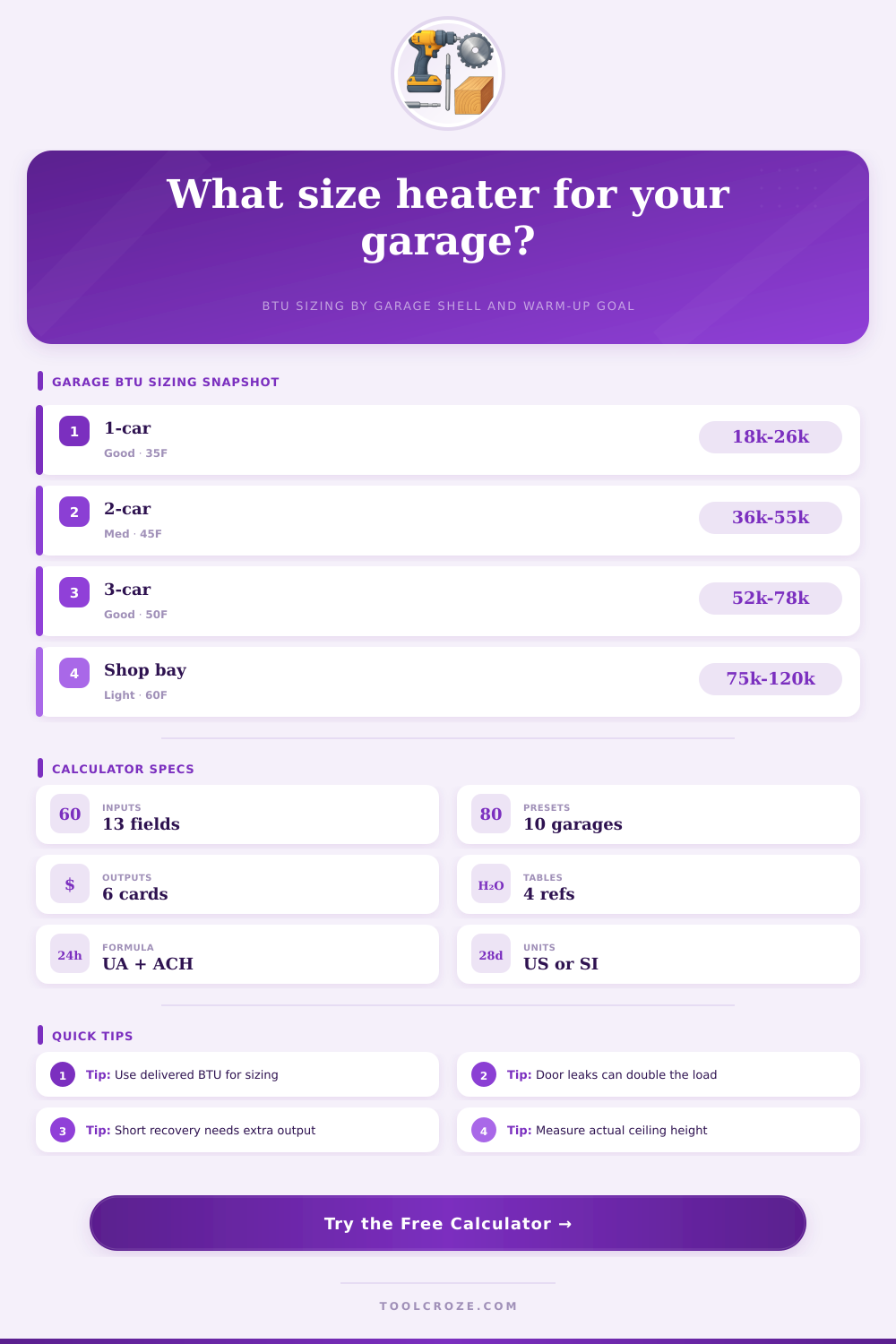
Estimate delivered heater output for an attached or detached garage using dimensions, insulation, design temperature rise, door area, air leakage, heater efficiency, and warm-up recovery time.
🔧 Garage Presets
Choose a real garage profile, then adjust the numbers to match the actual bay, ceiling height, and door condition.
📐 Garage Inputs
📊 Results
Garage Heater Sizing Summary
🏗 Building and Heater Comparison
📋 Reference Tables
| Garage condition | Effective U-factor | Typical leakage | BTU tendency |
|---|---|---|---|
| Bare studs or metal shell | 0.230 | 1.8 to 2.8 ACH | Very high |
| Light insulated, many gaps | 0.135 | 1.1 to 1.8 ACH | High |
| Moderate R-11/R-19 mix | 0.082 | 0.7 to 1.1 ACH | Medium |
| Good R-13/R-30 mix | 0.052 | 0.35 to 0.7 ACH | Low |
| Excellent air-sealed shell | 0.036 | 0.25 to 0.45 ACH | Very low |
| Outdoor design temp | Target garage temp | Temperature rise | Common use |
|---|---|---|---|
| 30°F | 55°F | 25°F | Mild freeze protection |
| 15°F | 60°F | 45°F | General winter work |
| 0°F | 60°F | 60°F | Cold climate garage |
| -10°F | 65°F | 75°F | Fast warm workshop |
| Door or ceiling factor | Input effect | Typical range | Calculation note |
|---|---|---|---|
| Single-layer door | Higher door U-factor | 0.75 to 1.10 | Adds shell load |
| Insulated door | Lower door U-factor | 0.16 to 0.28 | Reduces losses |
| High ceiling | More air volume | 10 to 14 ft | Raises ACH and recovery |
| Door opened often | Added leakage penalty | 3 to 15 min/hr | Raises CFM load |
| Heater type | Output sizing | Best garage fit | Watch point |
|---|---|---|---|
| Vented gas unit | Input x efficiency | Detached and large bays | Vent and clearance ratings |
| Electric resistance | kW x 3412 BTU/hr | Small tight garages | Circuit capacity |
| Cold-climate heat pump | Rated low-temp BTU/hr | Insulated attached garage | Capacity drops in cold air |
| Infrared tube or panel | Delivered radiant output | Work benches and high bays | Mounting height and clearances |
💡 Practical Notes
When choosing a garage heater, you must understand how much heat the specific garage you are considering require. Many different factor has to be accounted for in order to determine the heating requirement of a specific garage. Even though a garage may feel warmly to the individuals who use that garage during the mild weather of spring and summer, during the winter months the garage can become cold due to the way that heat dissipates from the garage through its walls, doors, and ceilings.
A sizing tool can help to determine the heat requirement for a specific garage. This sizing tool is useful in that it can convert the different measurements of the garage to a single number that represents the BTU requirement of that garage. Such a tool will ask for the length, the width, and the height of the garage.
How to Size a Garage Heater
These three measurements will determine both the volume and the surface area of the garage. You must enter the height of the ceiling into the sizing tool as well. The taller the ceiling of the garage, the more air that must be heated.
Additionally, warm air rise, so more BTUs is required to warm a large garage with a high ceiling. Enter the area of the garage door separately into the sizing tool. The area of the garage door is important in that larger doors allow for more heat loss from the garage.
The type of garage door also matters; an insulated garage door will lose less heat than a thin garage door. In addition to the size and type of garage door, two additional factors that affects how warm a garage can remain are its insulation levels and the degree to which air leaks out of the structure. Even if the walls of a garage contain high insulation values, the warm air can still leave the structure through air leaks around the walls.
The sizing tool will ask for a leakage setting for the garage; this setting accounts for the air leaks around the structure and ensures that the BTU calculation based on the garage are accurate. The attachment of the garage to the main living structure also have an impact on the temperature of the garage. If the garage is attached to the house, it will tend to remain warmer due to the shared wall with the heated main building of the structure.
The temperature rise and the recovery time for the garage are additional settings within the sizing tool that determine the BTU requirements. The temperature rise setting controls how warm the garage should become; some garage heaters will only warm the space enough to prevent the contents of the garage from freezing, while other type of heaters will warm the space to allow individuals to perform work within the garage. The recovery time setting controls how quickly the garage should reach the desired temperature.
The shorter the recovery time that is selected, the higher the BTU output that will be required of the heater to heat the garage to the desired temperature within that time period. You must also enter the number of minutes that the garage door remains open into the sizing tool. If the garage door is open to the outside air, cold air will enter the garage; the entering of this cold air will increase the BTU load that must be placed into the garage to maintain a comfortable temperature.
When you have entered all of the measurements of the garage and the settings within the sizing tool, the tool will provide three different measurements of the BTU requirements of the garage. These include the delivered BTU, the heater input, and the load per square foot. The delivered BTU rating is the most important measurement of heat output of the garage heater.
This is the amount of heat that actualy will leave the heater and warm the garage. It is important to not rely upon this number alone; instead, it is also essential to consider the heater input. The heater input measure the BTU output of the garage heater.
However, it does not account for the efficiency of the heater; if the garage heater is of low efficiency, the BTU output will always be higher than the delivered BTU. Based on the measurements determined through the sizing tool, you can consider three different types of heaters for purchase. If the garage to be heated is both large in size and detached from the main living structure of the home, a gas heater may be the best option.
These types of heaters provide high BTU outputs and have fast recovery times to allow for rapid warming of the large area of a detached garage. For attached, small garages, you may use an electric heater or heat pump. These types of heaters are easier to install in the small area of the attached garage.
Radiant garage heaters are used in structures with high ceilings; these types of heaters warm the individuals within the garage instead of heating the air within the structure. Each of these heaters have specific requirements for venting and electrical capacity. In addition to the sizing tool that calculates the BTU requirements for the garage, reference tables list the U-factors and the range of leakage for different structures.
Using these tables, individuals can ensure that the measurements that are entered into the sizing tool are correct and reflect the actual measurements of the garage. Additionally, a safety note is provided at the bottom of the sizing tool tables that discusses the requirements of combustion air, venting, and electrical ratings of the specific types of heaters that is available for purchase. Most individuals will choose a heater that is slightly larger than the BTU calculations for that garage.
By choosing a heater with a higher BTU output than that which is required for the garage, the heater will not have to run constantly in order to heat that garage to the desired temperature. The BTU requirement that is calculated will allow the garage heater to heat the garage to the desired temperature and satisfy the desired recovery times for the temperature of the garage without breaking down the heater or heating the garage for more money than is required to heat that specific garage. You should of checked the garage’s size first.
It is much better to be prepared than to recieve a heater that isnt big enough. To be honest, people dont realize how much heat is lost thru the doors. Youll want to make sure you’re looking at the right measurements to avoid a modulern mistake.
It’s a lot of work but it is worth it.