
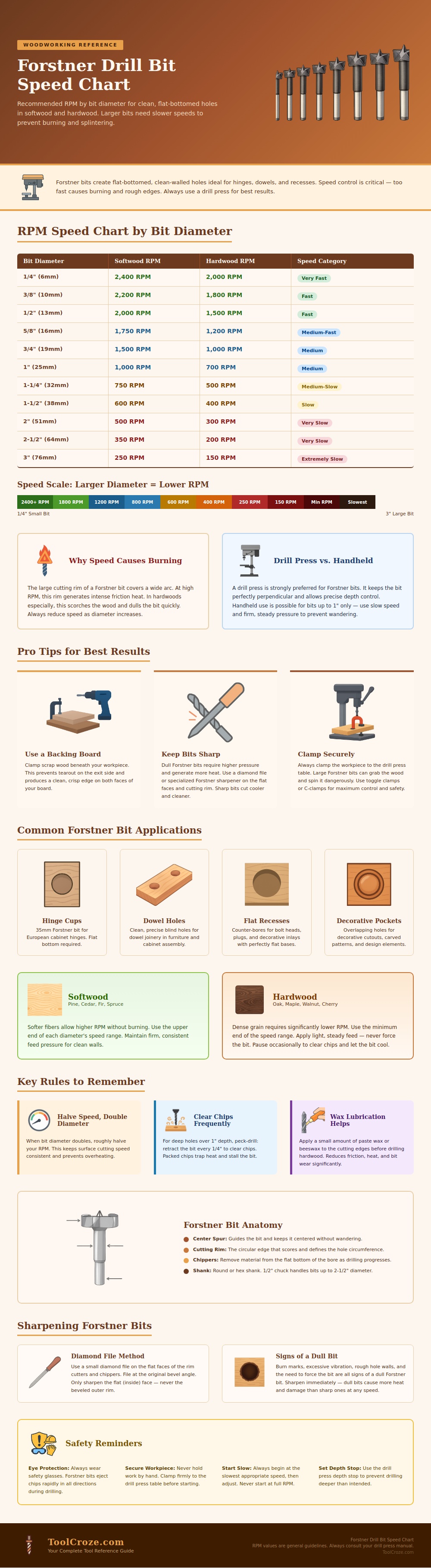
Forstner bits are made for use at very low speeds. They cut more slowly than many other bits. Compared to a spade bit, they are faster, but less than normal drill bits.
Because of their small size and weight, Forstner bits need even lower speed than a spade bit of same size. Turn them too quickly easily dull the bit. When drilling makes dust instead of chips, the speed is too high.
How Fast to Use Forstner Bits
The knives should remove big chips, as if planing the inside of a hole.
The right speed depends on the size of the bit and of the wood. For example in hardwood you use 700 rpm for bits of 1/4 to 3/8 inches, 500 rpm for 1/2 to 1 inch, and 250 rpm for 1-1/8 to 2 inches. In softwood like pine you can go much more quickly.
Charts show that for bits of 3/4 to 1 inch the speed reaches 1500 rpm in softwood and 500 rpm in hardwood. For big Forstner bits need 300 rpm or even less. Some people succeed with 650 rpm for 2½-inch bits.
The bigger the bit, the more slowly you must turn.
To find the highest right speed for any bit, do some trying. For example start at quite a low speed, as 800 rpm for 1 to 1-3/8-inch bits or 600 rpm for bigger. If it makes chips, all is well.
Then you can raise the speed by one step and try again. Variable speed in the drill helps, because it matters to start slowly and work like this. Remove chips often and pause.
Don’t use too much pressure, or the bit will overheat. For holes bigger than 3/4 inch the drilling goes extremely slowly. Even with good pressure it can take five minutes for only 1/4 inch deep.
Forstner bits you favor for clean, flat-bottom holes and overlapping cuts. At the center they have a small point, that acts as a pivot for the whole body of the bit. Usually you use a drill with pressure for such bits.
Hold it at low speed for good control. At first be gentle and don’t right away press the bit. Back the bit out and remove chips often.
