⚙️ Flat Belt Length Calculator
Calculate exact flat belt length for open or crossed drive configurations — with pulley diameters, center distance & wrap angles
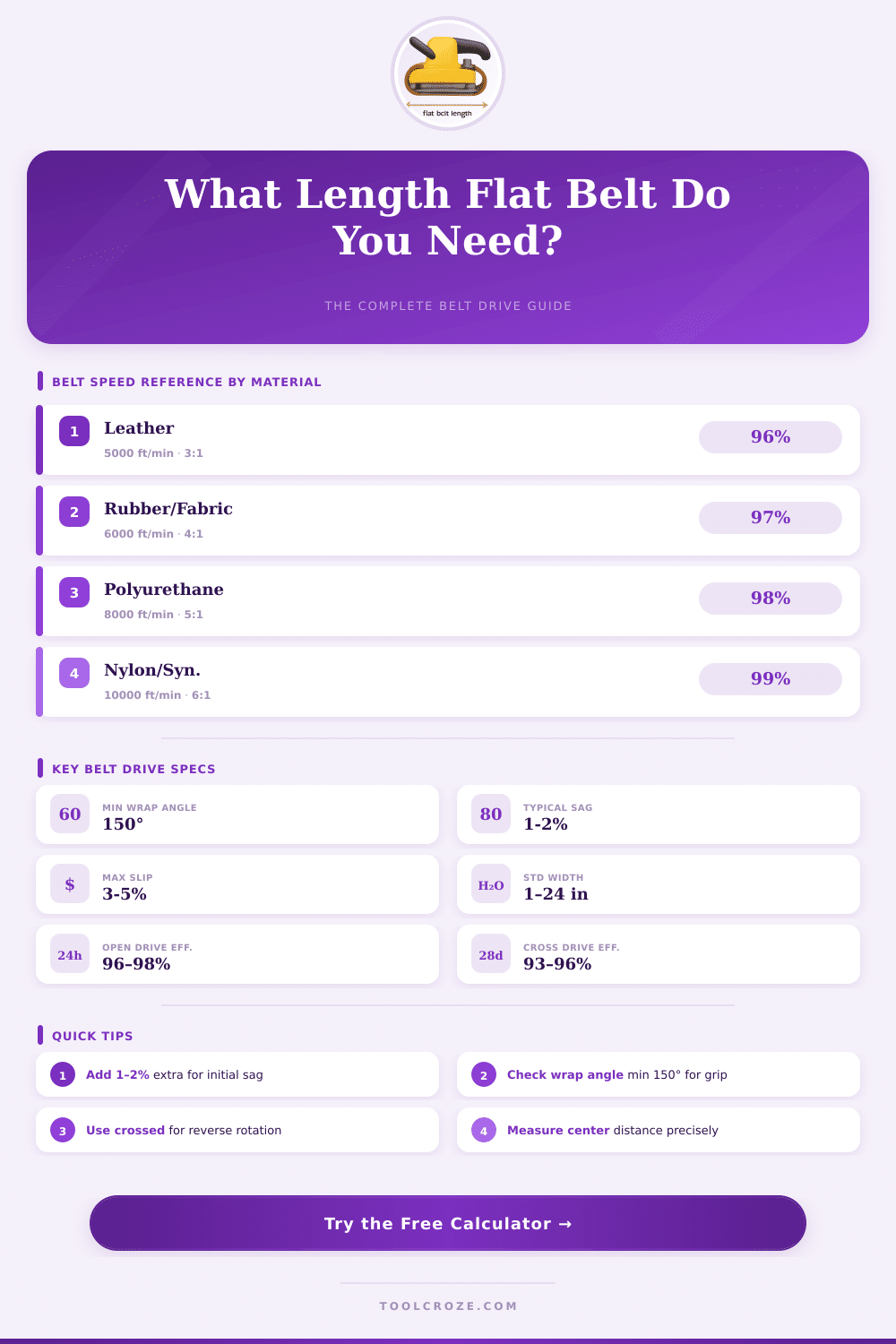
| Material | Max Belt Speed | Tension Ratio | Efficiency | Coeff. of Friction | Typical Thickness |
|---|---|---|---|---|---|
| Leather (oak-tanned) | 5000 ft/min | 3:1 | 95–97% | 0.3–0.5 | 3/16–1/4 in |
| Rubber/Fabric Ply | 6000 ft/min | 4:1 | 96–98% | 0.35–0.45 | 3/16–1/2 in |
| Polyurethane | 8000 ft/min | 5:1 | 97–99% | 0.4–0.6 | 1/8–3/8 in |
| Nylon/Synthetic | 10000 ft/min | 6:1 | 98–99% | 0.4–0.55 | 1/8–1/4 in |
| Canvas/Cotton | 4000 ft/min | 2.5:1 | 93–96% | 0.25–0.40 | 1/4–3/8 in |
| Steel Band | 12000 ft/min | 8:1 | 99% | 0.1–0.2 | 0.01–0.05 in |
| Kevlar Reinforced | 9000 ft/min | 7:1 | 98–99% | 0.45–0.60 | 3/16–5/16 in |
| Urethane Round | 6500 ft/min | 4.5:1 | 96–98% | 0.35–0.50 | 3/16–5/8 in dia |
| Belt Width | Typical Application | Max HP @ 1000 ft/min | Max HP @ 4000 ft/min | Min Pulley Dia |
|---|---|---|---|---|
| 1 in (25 mm) | Light machinery, sewing | 0.5 HP | 1.5 HP | 2 in |
| 2 in (50 mm) | Drill press, small lathes | 1 HP | 3 HP | 3 in |
| 3 in (75 mm) | Band saws, grinders | 1.5 HP | 5 HP | 4 in |
| 4 in (100 mm) | Lathes, milling machines | 2 HP | 7 HP | 5 in |
| 6 in (150 mm) | Industrial machinery | 4 HP | 12 HP | 7 in |
| 8 in (200 mm) | Compressors, generators | 6 HP | 18 HP | 9 in |
| 12 in (300 mm) | Conveyors, heavy industry | 10 HP | 30 HP | 12 in |
| 18 in (450 mm) | Heavy conveyors | 18 HP | 55 HP | 18 in |
| Speed Ratio | Driver 6 in @ 1750 RPM | Driver 8 in @ 1750 RPM | Driver 10 in @ 1750 RPM | Belt Speed (ft/min) |
|---|---|---|---|---|
| 1:1 (same speed) | 1750 RPM out | 1750 RPM out | 1750 RPM out | 2749–4581 |
| 2:1 (speed down) | 875 RPM out | 875 RPM out | 875 RPM out | 2749–4581 |
| 3:1 (speed down) | 583 RPM out | 583 RPM out | 583 RPM out | 2749–4581 |
| 1:2 (speed up) | 3500 RPM out | 3500 RPM out | 3500 RPM out | 2749–4581 |
| 1:3 (speed up) | 5250 RPM out | 5250 RPM out | 5250 RPM out | 2749–4581 |
| Application | Driver Dia | Driven Dia | Center Dist | Approx Belt Length |
|---|---|---|---|---|
| Drill Press (bench) | 2–5 in (stepped) | 2–5 in (stepped) | 10–14 in | 40–50 in |
| Lathe Headstock | 4–6 in | 8–12 in | 18–30 in | 60–90 in |
| Band Saw | 6 in | 6 in | 12–18 in | 45–55 in |
| Air Compressor | 4–6 in | 10–14 in | 18–24 in | 65–90 in |
| Small Conveyor | 4 in | 4 in | 36–60 in | 85–140 in |
| Generator Drive | 6–8 in | 8–12 in | 20–30 in | 75–110 in |
| Grain Mill | 8 in | 20 in | 24–36 in | 110–140 in |
| Heavy Conveyor | 12 in | 12 in | 120–240 in | 265–510 in |
The length of a flat belt is very important during the setup of machines with pulleys. To reach the right measure, everything stays easily working and one escapes accidents like skating or slipping of bits. There are calculators that find the distance between the centres of two pulleys, if one already knows their diameters.
The length of the belt itself is found by measuring the distance between the pulleys and adding the wrap around those.
How to Measure and Fit a Flat Belt
The formula for counting belt length includes the radius of the pulleys and the length of the curved parts. Simply it matches twice pi times the radius of the pulley, plus twice the curve length. Both diameters, of the small and the big pulley, play a role in that.
The whole length results from the sum of the contact curved parts and the distances between the pulleys that stay beltless.
Flat belts come in various sizes. One finds them in lengths like 700 mm, 1005 mm or 1400 mm, while the widths range between 15 mm and 30 mm. Certain types, for example the T150, are endless, so they lack any joint.
These usually have rubber cover and appear black in colour.
A bit surprising is the difference between flat belts and V-belts. V-belts grip tightly in their v-form and stay stable even when a bit loosened. For flat belts one needs to exactly keep the tension to hand over power.
Hence the length must be very precise, down to eighth or twelfth of an inch. A too loose flat belt slips, especially under big loads.
A wider flat belt usually requires bigger length. A wider belt depends more on its own wait, which helps to sink to give good contact with the pulleys. And a longer belt more commonly sinks in the middle.
Also the distance of the counter shaft to the machine matters, though not nearly as much as the radius of the pulleys.
During the rating of belt length, one commonly first counts roughly, later picks the most nearby available size and adapts by changing one pulley so that everything works. Best is to choose a bit shorter than the middle spot of change. A new belt tightens over time, so one avoids needing extra move of the adjuster later.
Right initial tension is key for smooth running. In systems with a tension pulley, that sitting on the light side pushes the belt. Without such device, one cares about the needed tension by shortening the belt to factory short length.
Some users remove the belt from the pulleys, when the machine rests. Others shorten it by removing pairs of inches, when it loosens over time. Having a backup belt beside oneself helps toquickly swap a broken bit easily.