Mortar Calculator for Flagstone Patio
Estimate mortar for irregular flagstone patios with separate setting bed, slurry bond coat, pointing joint, void, waste, and cement-to-sand mix calculations.
📌Flagstone Patio Presets
⚙Patio And Mortar Inputs
Flagstone Mortar Estimate
🧱Stone And Mix Spec Grid
📊Flagstone Bed Reference
| Patio Condition | Typical Bed | Void Factor | Notes |
|---|---|---|---|
| Calibrated bluestone on slab | 0.75 to 1 in | 6% to 10% | Flatter backs, tighter control, lower bedding allowance. |
| Thermal flagstone over mortar bed | 1 to 1.25 in | 8% to 14% | Good default for patios with moderate lippage adjustment. |
| Natural cleft irregular pieces | 1.25 to 1.75 in | 12% to 20% | Use more allowance for uneven backs and deep pockets. |
| Fieldstone or random rubble | 1.5 to 2 in | 18% to 30% | Large thickness variation can dominate mortar demand. |
📏Joint Width And Pointing Table
| Joint Style | Average Width | Depth Range | Use In Calculator |
|---|---|---|---|
| Tight sawn or gauged flagstone | 0.25 to 0.38 in | 0.5 to 0.75 in | Low pointing volume; coverage often above 88%. |
| Standard irregular patio joint | 0.5 to 0.75 in | 0.75 to 1.25 in | Common setting for natural cleft patio layouts. |
| Wide rustic garden joint | 0.75 to 1.25 in | 1 to 1.5 in | Use lower stone coverage and higher joint depth. |
| Repointing existing flagstone | Match opening | Actual raked depth | Set bed thickness to slurry only if stones stay in place. |
⚒Mortar Mix Reference
| Mix | Best Fit | Cement Share | Sand Share |
|---|---|---|---|
| 1:3 cement to sand | Dense bedding or stronger pointing | 25% | 75% |
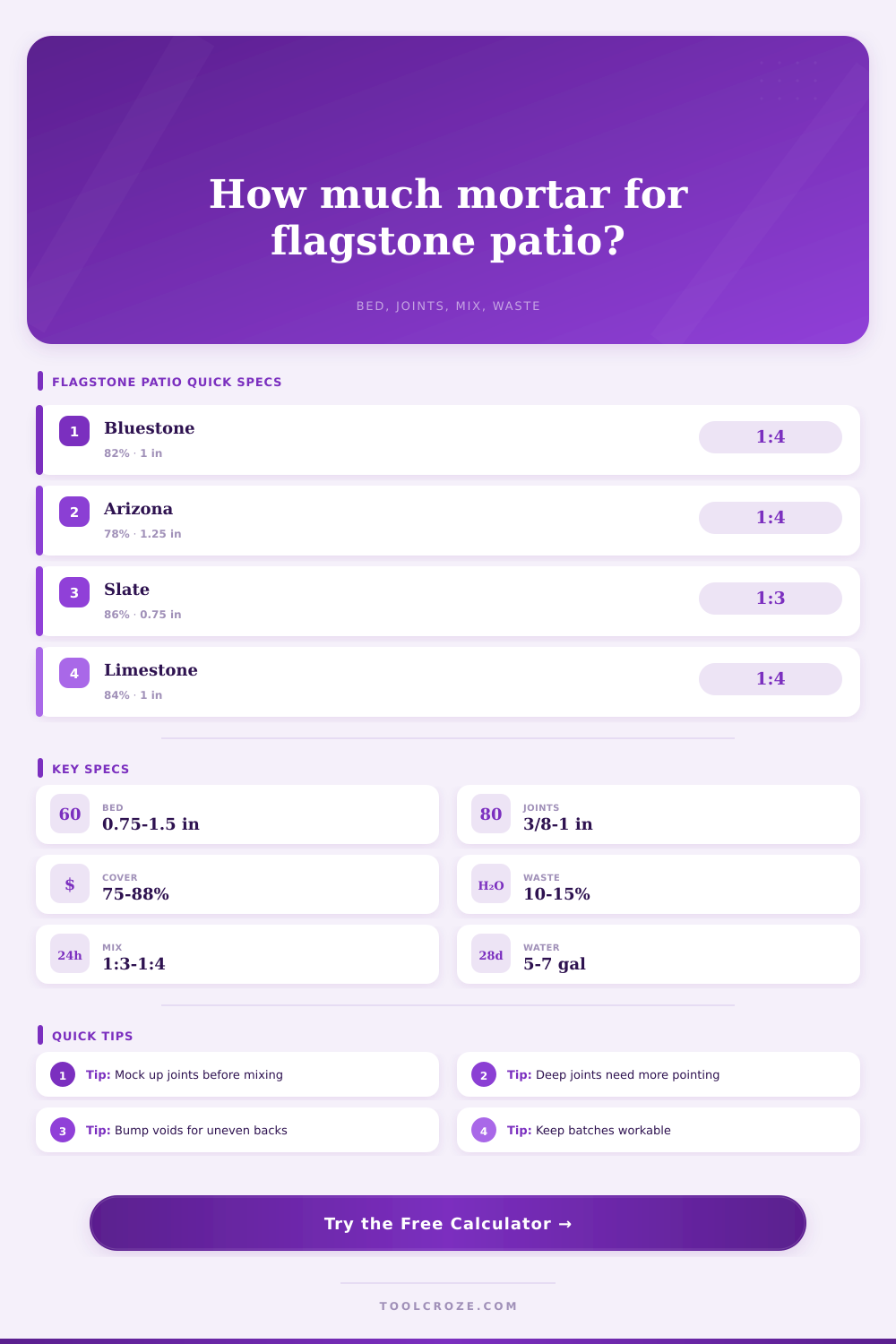
| 1:4 cement to sand | General flagstone patio setting bed | 20% | 80% |
| 1:5 cement to sand | Softer pointing for lighter duty patios | 17% | 83% |
| Type S or Type N mortar | Bagged masonry mortar with known yield | Use bag yield | Use bag yield |
🗂Real Patio Preset Details
| Preset | Area | Stone Size | Joint / Bed |
|---|---|---|---|
| Bluestone Terrace | 180 ft² | 2.2 ft² | 0.75 in joint, 1 in bed |
| Arizona Flagstone Walkout | 260 ft² | 2.8 ft² | 1 in joint, 1.25 in bed |
| Fieldstone Fire Pit Ring | 145 ft² | 1.4 ft² | 1.1 in joint, 1.5 in bed |
| Quartzite Pool Apron | 320 ft² | 3 ft² | 0.6 in joint, 1 in bed |
💡Mortar Estimating Tips
Imagine this: You envision a flagstone patio as a rustic, elegant space where all stones is irregularly shaped and fit together like a puzzle. Hardly ever do we think about how much mortar will be needed to ensure level surfaces on top.
Flagstone isn’t forgiving… Natural stone varies in thickness by inches across a single piece. Natural stone doesn’t interlock with precision like manufactured pavers does. One wrong move in bedding plans mean water collects in dips and creates tripping hazards. This leads to weekend regret when you could of gotten the math right before mixing first batch.
How to Calculate Mortar for Your Patio
The trick isn’t simply filling in spaces around rocks but making a structural bed capable of bearing their weight as well as spreading load down into the subbase. Once you know what type of stone you’re working with (and plug it into the calculator above), the only thing left is entering length, width, depth (or thickness) of the patio. This eliminates guessing at cubic footage.
Knowing how those numbers work lets you sidestep some common missteps. Most folks gets tripped up when trying to enter stone coverage percentage. If your stone is tightly sawn together, it may cover ninety percent of surface. But if it’s laid in a more rustic garden style, using generous joints, it’ll only cover seventy-five percent or less. Twenty-five percent! All that empty joint space must be filled with pointing mortar.
Next, consider bed depth. A mechanically cut, calibrated bluestone may require only a half-inch to an inch of bed because it will be the same thickness throughout. In contrast, natural cleft flagstone can have such a pronounced belly that you’re better off with deeper bed just to fill those voids beneath the low side and make whole thing level. That’s where the irregularity factor comes into play on the tool. Bump up the percentage if your stone twists or cups. A little change in the input makes a big change in the output.
Success depends a lot on what kind of mix you use, too… And for patio beds, the standard workhorse are a one-to-four cement-to-sand mix. It is rich enough to hold the stone in position, yet still loose enough to flex during freeze-thaw cycles without cracking. Depending on whether you plan to point the joints, you may want to lean on the rich side (or go all-out with a premixed Type N mortar) for improved workability.
The calculator separates out final number into both joint mortar and bed mortar. That’s good advice; though the joints is just aesthetics, the bed is structural. You don’t want to scrimp on the bed. But feel free to get flexible with pointing mix.
Mortar lets water through, so it’s important that your subbase can sheds water. A poorly-draining subbase will trap water under your patio… Leading to shifting and heaving over time. And poor water management is the silent killer of flagstone patios: mortar is permeable. Too-thick beds will trap water, and if ground slopes toward your house, you’ll be creating more problems then you solve.
Follow the provided void allowance tables as a starting place, not the absolute truth. They are based off the type of stone. Adjust your waste factor up by increasing bedding thickness if your soil has high clay content to ensure you get a proper slope in the bed.
At the end of the day though, the calculator provides you with a target. It is a target for how many wheelbarrows to load up and how many bags to buy. It doesn’t provide you with knowledge on what to do when it’s a hot summer afternoon, or the immediacy of next downpour. For that you need experience.
However, having numbers in hand prior to starting will keep you organized, so no last minute run to the hardware store at 5pm because you just ran out of mix mid-way through the seating area. Let the stone do the rest, plan for the voids and respect the bed.