🚲 Fixie Gear Ratio Calculator
Calculate gear ratio, gear inches, meters of development, speed & skid patches for your fixed-gear bike
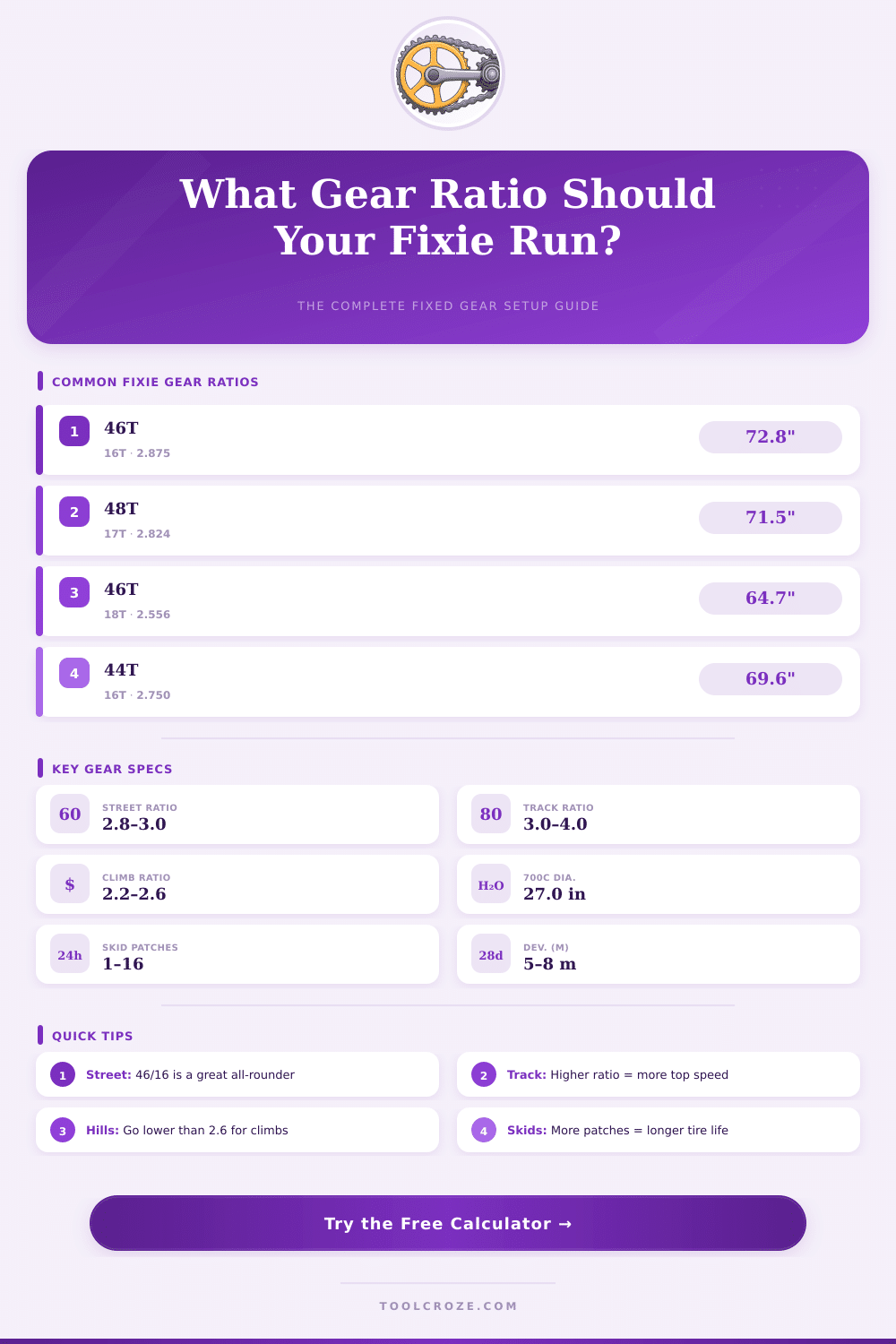
| Chainring / Cog | Gear Ratio | Gear Inches | Meters Dev. | Speed @90rpm (kph) | Skid Patches (1-leg) | Best For |
|---|---|---|---|---|---|---|
| 44 / 16 | 2.75 | 69.6" | 5.50m | 29.7 | 11 | City / Beginner |
| 44 / 18 | 2.44 | 61.9" | 4.89m | 26.4 | 2 | Hilly Terrain |
| 46 / 16 | 2.875 | 72.8" | 5.75m | 31.0 | 6 | All-Rounder |
| 46 / 17 | 2.706 | 68.5" | 5.41m | 29.2 | 17 | Commute |
| 46 / 18 | 2.556 | 64.7" | 5.11m | 27.6 | 9 | Hilly Commute |
| 48 / 16 | 3.0 | 75.9" | 6.00m | 32.4 | 3 | Aggressive Street |
| 48 / 17 | 2.824 | 71.5" | 5.65m | 30.5 | 17 | Street Cruiser |
| 48 / 18 | 2.667 | 67.5" | 5.33m | 28.8 | 6 | Distance |
| 49 / 14 | 3.5 | 88.6" | 7.00m | 37.8 | 7 | Velodrome |
| 52 / 15 | 3.467 | 87.7" | 6.93m | 37.4 | 4 | Track Sprint |
| 42 / 16 | 2.625 | 66.4" | 5.25m | 28.4 | 8 | Hilly / Touring |
| 40 / 18 | 2.222 | 56.2" | 4.44m | 24.0 | 1 | Steep Hills |
| Wheel Size | ISO / ETRTO | Diameter (in) | Diameter (mm) | Circumference (mm) | Common Use |
|---|---|---|---|---|---|
| 700c (29er) | 622 | 27.0" | 686mm | 2155mm | Road, Fixed, 29er MTB |
| 27.5" / 650b | 584 | 27.5" | 699mm | 2194mm | MTB, Some City |
| 26" MTB | 559 | 26.0" | 660mm | 2073mm | MTB, BMX-style |
| 24" | 507 | 24.0" | 610mm | 1916mm | Smaller Riders |
| 20" BMX | 406 | 20.0" | 508mm | 1597mm | BMX / Trick |
| Chainring | Cog | GCD | Patches (1-Leg) | Patches (Ambidextrous) | Tire Life Rating |
|---|---|---|---|---|---|
| 46 | 16 | 2 | 8 | 16 | Good |
| 46 | 17 | 1 | 17 | 17 | Excellent |
| 46 | 18 | 2 | 9 | 18 | Very Good |
| 48 | 16 | 16 | 1 | 3 | Poor |
| 48 | 17 | 1 | 17 | 17 | Excellent |
| 44 | 16 | 4 | 11 | 11 | Very Good |
| 42 | 16 | 2 | 8 | 16 | Good |
| 49 | 14 | 7 | 7 | 7 | Moderate |
| 52 | 15 | 1 | 15 | 15 | Very Good |
| 40 | 18 | 2 | 1 | 2 | Very Poor |
| Cadence (RPM) | Speed (mph) | Speed (km/h) | Effort Level | Typical Rider |
|---|---|---|---|---|
| 60 | 12.9 | 20.7 | Easy | Leisure Cruise |
| 70 | 15.0 | 24.2 | Moderate | City Commute |
| 80 | 17.2 | 27.6 | Moderate–Hard | Active Commuter |
| 90 | 19.3 | 31.0 | Hard | Experienced Rider |
| 100 | 21.4 | 34.5 | Very Hard | Strong Cyclist |
| 110 | 23.6 | 37.9 | Sprint | Racer / Track |
| 120 | 25.7 | 41.4 | Max Sprint | Competitive Track |
| 130 | 27.9 | 44.8 | Elite | Pro Track Sprinter |
The gear ratio simply explains the relation between the number of teeth on the front chainring (that is the front part of the system) and those on the back cog. The calculation is not difficult, just divide the teeth of the front chainring by those of the back, and you get your ratio. For instance with 48-tooth front chainring with 16-tooth back, you get 3.00.
One commonly writes that also as 48:16, what is other usual notation.
How to Choose the Right Gear Ratio for Your Fixie
Consider the gear ratio as the transmission of your bike. If you pick a bigger chainring in the front or smaller in the back, each pedal turn will cover more distance. The tradeoff is, that it needs more force, especially when hills appear.
Lower gear ratios make pedaling easier, but limit your maximum speed and help more on rough roads.
When you ride on flat terrain, many riders find that something between 2.6 and 3.0 works well. At 90 turns per minute on the bottom limit, you will reach around 30 km/h. If you push to the upper end, that gets close to 34 km/h.
A ratio of 2.3:1 is considered a bit low in the fixie world, but it still works well for flat city roads. The most common mistake is starting with something too high and soon regretting that.
The combination 48/17 hits almost the ideal spot for around 90% of the fixie bikes that ship, for commuting, group rides ore simply short rides. The 48/16 setup shows everywhere in cities on flat areas, because it gives control through backpedaling and does not punish you on hills. Other option is 42/15, that gives 2.8.
It works for commutes without hills, although it can become hard on very windy days.
gear inches offer a fresh view on that. Multiply 27 inches by the teeth of your front chainring, then divide by those of the back. And most riders start around 70 gear inches.
The sweet spot happens at around 75 inches, where some find their perfect fit. For hills, something at 67 inches maybe will feel more comfortable. Flat city riding could lead you to 76.
Riding uphill on a fixie differs from that on a bike with gears. In hilly areas, 47×16 well handles some sloping roads. A rider chose 52/17 because the higher ratio less strains the pedaling during downhills, although he lives in a hilly area.
On the other end, 38×18 is among the easiest, a combination that helps on mountainous roads without destroying the legs. What ratio best works partly depends on your wanted speed and natural pedal rhythm.
On a fairly flat road with 40-tooth front chainring, match it with a back between 15 and 18 teeth depending on your legstrength and preferences about pace. Whatever ratio you choose, your body will adapt after some kilometers.