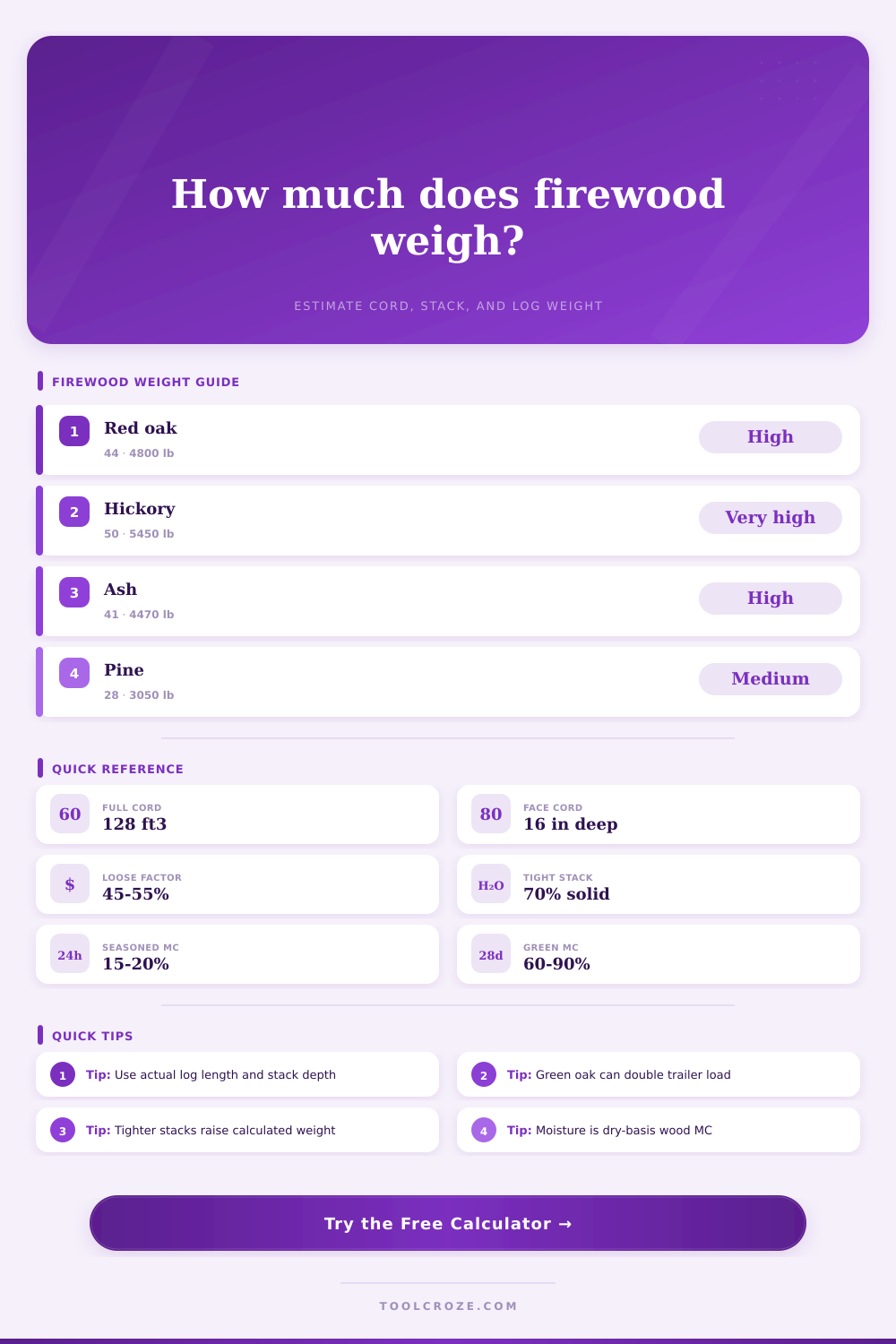
Firewood Weight Calculator
Estimate firewood weight for a full cord, face cord, pickup load, loose pile, custom stack, or single log using species density, moisture content, stacking factor, and bark allowance.
Firewood weight estimate
| Wood species | Oven-dry density | Typical 20% MC cord | Weight profile |
|---|---|---|---|
| Hickory | 50 lb/ft³ | About 5,450 lb | Very heavy hardwood |
| White oak | 47 lb/ft³ | About 5,115 lb | Heavy hardwood |
| Red oak | 44 lb/ft³ | About 4,790 lb | Heavy hardwood |
| Sugar maple | 44 lb/ft³ | About 4,790 lb | Heavy hardwood |
| White ash | 41 lb/ft³ | About 4,460 lb | Medium-heavy hardwood |
| Yellow birch | 40 lb/ft³ | About 4,355 lb | Medium-heavy hardwood |
| Black cherry | 35 lb/ft³ | About 3,810 lb | Medium hardwood |
| Southern pine | 28 lb/ft³ | About 3,050 lb | Light softwood |
| Firewood measure | Outside volume | Default solid factor | Use in calculator |
|---|---|---|---|
| Full cord | 128 ft³ stacked | 68% | Use cord quantity |
| Half cord | 64 ft³ stacked | 68% | Enter 0.5 cords |
| Face cord, 16 in logs | 42.7 ft³ stacked | 68% | 8 ft × 4 ft × 16 in |
| Loose thrown pickup | Bed volume varies | 48% | Use loose pile mode |
| Single round log | Cylinder volume | 100% | Use diameter and length |
| Moisture condition | Dry-basis MC | Total weight factor | Planning note |
|---|---|---|---|
| Kiln-dried indoor wood | 6% to 12% | 1.06 to 1.12 | Lightest handling range |
| Well-seasoned firewood | 15% to 20% | 1.15 to 1.20 | Common ready-to-burn range |
| Partly seasoned split wood | 25% to 40% | 1.25 to 1.40 | Noticeably heavier |
| Green hardwood | 60% to 90% | 1.60 to 1.90 | Can overload small haulers |
| Rain-soaked surface wood | Add 3% to 10% | Allowance dependent | Use bark allowance field |
| Hauling setup | Payload planning range | Common firewood fit | Weight caution |
|---|---|---|---|
| Small utility cart | 400 to 800 lb | Bundle or short rack | Avoid green hardwood piles |
| Half-ton pickup | 1,000 to 1,800 lb | Partial face cord | Check actual door sticker |
| Utility trailer | 1,500 to 3,500 lb | Face cord to partial cord | Axle rating controls load |
| Dump trailer | 5,000 to 10,000 lb | Full cord or more | Green oak may be near limit |
Each November, when you’re looking at that meager pile of wood next to your house and thinking “Hmmm, not enough to get me through winter,” you face this dilemma: if you head out to a firewood stand or perhaps a yard sale, you find a giant pile of oak. It is perfect for heating yourself through the cold months. Except…you don’t know if you can fits it into your truck.
Firewood weight is important, not just for its heating properties, but for logistical reasons. While a full cord of hickory or oak might heat your home, it also could weighs so much that you require a tow truck instead of being able to haul it yourself. A cord of hickory and a cord of pine both occupy the same amount of room in your barn or truck bed…but one is going to be lighter then the other. That is where the calculator comes into play. By defining what “Cord” means to you, we can help you calculate weight of whatever you are purchasing.
Why Firewood Weight Matters
“Cord” is a vague word and many don’t realize that there is actualy a definition for a legal cord. One-hundred twenty-eight cubic feet of stacked firewood equals a legal cord. That represents volume and not mass. Mass changes based off the amount of air in the wood versus solid wood. For example, a loose pile in the back of a trailer would be maybe 50% solid wood. A nice clean stack with good raking might be 70-80%. That is where stacking factor comes into play. The calculator corrects for that so you can determine whether the wood will exceed weight of your driveway, or even make it through your garage door.
The starting point is species choice; however, there’s a big difference between dry and fresh wood, with the fresh wood weighing almost twice as much in water as it do in fiber. Green hardwood can even hold nearly as much water by weight as it does fiber! Because of this, the initial weight of a piece of oak can be different than its final weight as dry firewood. Cutting up early and making lots of split reduces excess weight, which would of otherwise depend on how moist it is when stacked up. If you have to purchase your wood already split or buy kiln dried wood, then using moisture input will allow you to account for this variable. If you’ve found some wet wood on the ground, splitting it early and stacking it high will help remove the moisture. A load that appears lighter may end up feeling a lot heavier if it rains before you get it inside.
The numbers gets complicated by other factors such as bark and other debris. Depending on the species of the tree, the bark adds weight that changes in density compared to the heartwood, but it also takes up space (bulk). Near your max load, that variation becomes significant; even a few inches of snow, mud, or bark on the pile can change the overall payload just enough to make a difference.
Looking at the comparison charts (at standard moisture content), you’ll have an idea of what you’re hauling, lighter or heavier stuff, and what species compares favorably to others. Hickory‘s a hot-burning, dense wood that’s good and bad for trailers. Efficient, yet potentially dangerous if the wood remains green. Pine is lighter to tow, burns quickly, but reloads often.
When you learn to understand these variables, you also adjust your approach to buying and storing firewood. Instead of viewing it in terms of piles, you view it in terms of cubic feet, moisture percentages and density factors. In other words, instead of worrying about having enough heat this winter, you have an inventory issue that’s within your control. It becomes a matter of planning, selecting the correct vehicle, and not getting stuck on the side of the road trying to push a truck whose tires are buried in snow after overloading it with wet ash.
Once you stop assuming that all wood weigh the same, the math is easy. Running the numbers helps you know if something will fit into your vehicle before you begin loading. Do you really know how much the load weighs? Why does it weigh as much as it do? Knowing this information could keep your truck’s suspension intact, or at least keep you sane come cold weather time. Your heat source needs to be not just warm but manageable. How do you know? Good firewood is the variety you can haul home in one shot.