Firewood Face Cord Calculator
Convert a measured firewood stack into face cords, full cord equivalent, solid wood volume, thrown-pile volume, and estimated weight by species.
⚙Real Stack Presets
📏Stack Measurements
Firewood Stack Results
🧮Species and Stacking Grid
🪵Reference Tables
| Common stack | Dimensions | Stacked volume | Full cord equivalent |
|---|---|---|---|
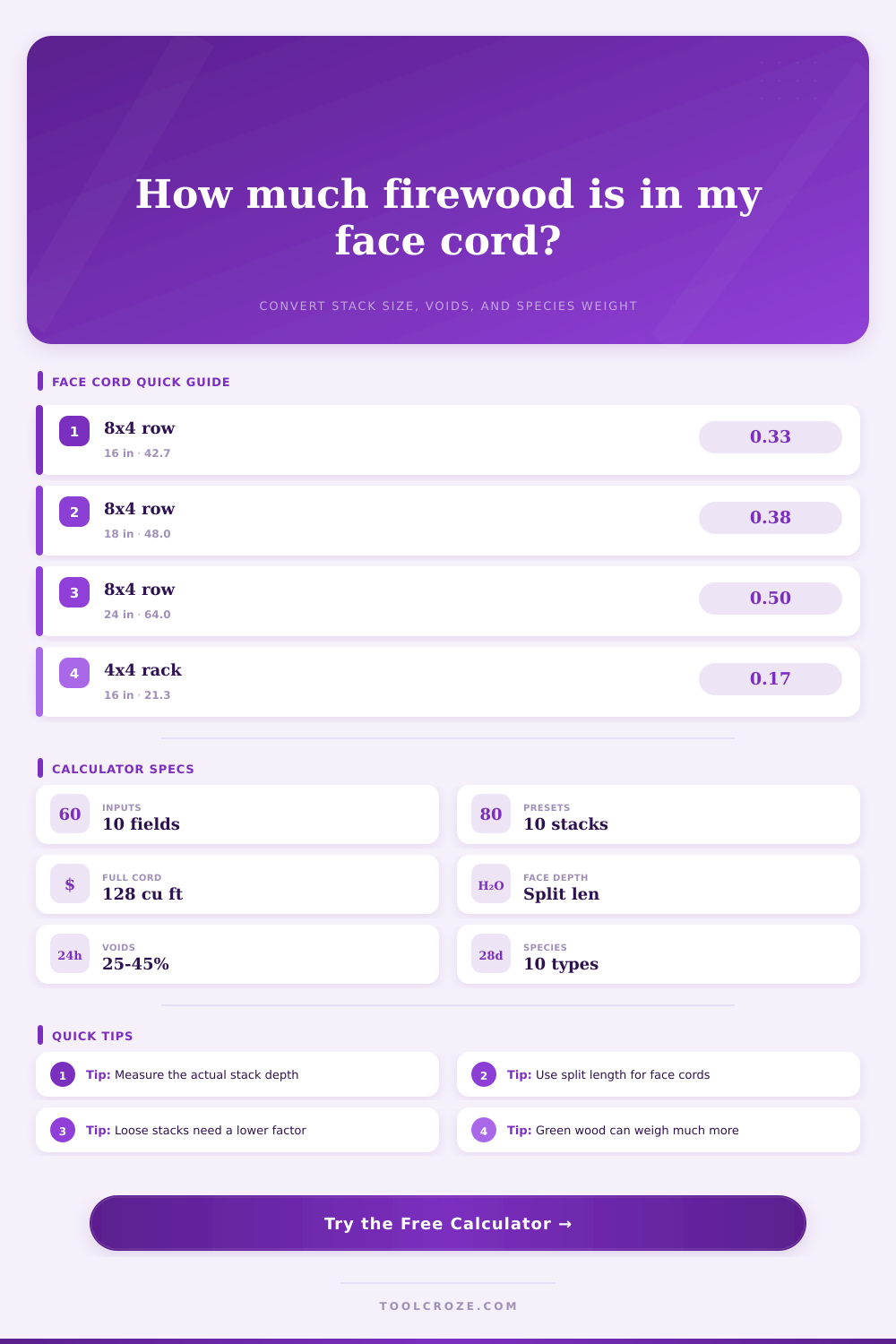
| Standard face cord | 8 ft x 4 ft x 16 in | 42.7 cu ft | 0.333 cord |
| Half face cord rack | 4 ft x 4 ft x 16 in | 21.3 cu ft | 0.167 cord |
| Long boiler wood row | 8 ft x 4 ft x 24 in | 64.0 cu ft | 0.500 cord |
| Campwood short row | 8 ft x 4 ft x 12 in | 32.0 cu ft | 0.250 cord |
| Double woodshed bay | 8 ft x 4 ft x 32 in | 85.3 cu ft | 0.667 cord |
| Species | Seasoned full cord weight | Relative density | Best calculator use |
|---|---|---|---|
| Hickory | 4,320 lb | Very high | Dense hardwood stacks |
| White oak | 4,000 lb | Very high | Heavy mixed hardwood |
| Sugar maple | 3,680 lb | High | Maple or hardwood racks |
| Ash | 3,520 lb | High | Common seasoned hardwood |
| Black cherry | 2,920 lb | Medium | Moderate hardwood loads |
| White pine | 2,280 lb | Low | Softwood stacks |
| Stacking condition | Tightness factor | Typical voids | When to choose it |
|---|---|---|---|
| Very tight cribbed ends | 1.03 | 25% to 31% | Uniform splits with squared rows |
| Neat hand-stacked row | 1.00 | 30% to 36% | Most measured face cords |
| Average mixed row | 0.96 | 34% to 40% | Mixed diameter and some gaps |
| Loose uneven row | 0.91 | 38% to 45% | Quick outdoor stacking |
| Messy quick stack | 0.84 | 42% to 50% | Rough rows before re-stacking |
| Thrown adjustment | Multiplier | 128 stacked cu ft becomes | Use case |
|---|---|---|---|
| Compact dumped pile | 1.18x | 151 loose cu ft | Short drop into tight bin |
| Average thrown pile | 1.25x | 160 loose cu ft | Typical trailer or pickup pile |
| Loose pickup pile | 1.32x | 169 loose cu ft | Irregular split lengths |
| Very loose tossed pile | 1.40x | 179 loose cu ft | Big splits and many gaps |
✅Calculation Tips
Winter brings us all to a familiar predicament: purchasing firewood. The confusion usually stems from difference between a face cord and a full cord. We stare down a pile of oak in our driveway, which looks like plenty, while the wood-seller swears he’s given us a fraction of our money’s worth. The source of confusion is always that we’re dealing with either a full or a face cord; a pair of terms that snarl up just about every novice who buys a load of wood.
A full cord represent industry-standard amount (128 cubic feet) stacked as rectangular block 4 feet high, 4 feet wide, and 8 feet long. There’s no set standard for a face cord. This typically means just the width of that block (the “face”) times its depth, depending on how long individual pieces are cut. This creates some ambiguity that requires calculation.
How to Calculate Your Firewood
To simplify things, tool takes your individual measurements and adjusts them for real world stacked-wood reality. It factors in what we call void space, which is air between the irregular logs. A typical person imagines a stack of wood as a solid block; they don’t realize that approximately thirty to forty percent of every neat pile are air. To find the true volume of wood fiber you are carrying around, it take out empty spaces. Then it converts that volume into pounds.
This depends on species. For example, a cord of hickory weigh quite a bit more then a cord of pine. To recieve a decent estimate, be sure you know what goes into form fields. Measuring your stack (height and length) is typically straightforward with a tape; the tricky part are measuring depth. For example, if purchasing an eighteen-inch split face cord, you’d enter in “eighteen” as the depth, which will normalize calculation against the traditional definition of a sixteen-inch deep face cord so you can price shop accordingly. Sometimes it turn out that a longer split provides extra wood per linear foot; the math does the trick here to adjust for benefit.
Another factor affecting results is closeness of stack. A neat stack, cribbed against each other, with squared off ends will hold more wood than a loose leaning pile thrown in the back of a pickup truck. To reflect this, tool has multipliers for such factors, recognizing that a messy pile contain less actual fuel and more air. That’s especially helpful if you’re trying to calculate how many firewood load fit on a trailer, or how much wood will go into your woodshed.
Green wood, by the way, also weigh more than seasoned wood. So moisture input helps further improve weight estimate. With high moisture content, you’re essentially hauling water as well as fuel, that cuts down on heating efficiency and increases time it takes to season the stack.
One more factor is species density. Denser species such as hardwoods (e.g., maple, oak) burns longer and hotter than softwoods (e.g., pine), which are light in weight and burn quickly. The calculator has standard weights for most commonly burned species so you know roughly how much weight you are dealing with. This gives you enough info to determine whether you should of hire machinery help or if you can haul it yourself. Knowing this also allow you to estimate how big a pile can fit on your rack or in your storage area. A denser species may need bigger, stronger rack.
This means eliminating guesswork with a purchase that relies heavily off visual estimates. You provide exact measurements, choose your conditions, and instantly know exactly what you’re purchasing; its actual volume, estimated weight, and how it compares to a standard cord. No more paying too much for air, and no need to worry about whether or not this will last all winter. The next time you consider a stack of firewood, you’ll have the eyes to see past the confusion and into the structure. To realize that spaces matter as much as logs, and that actual worth is measured not by their thickness, but their length. The warmth in the pile isn’t something guessed anymore; now it’s measurable.