Firewood Burn Time Calculator
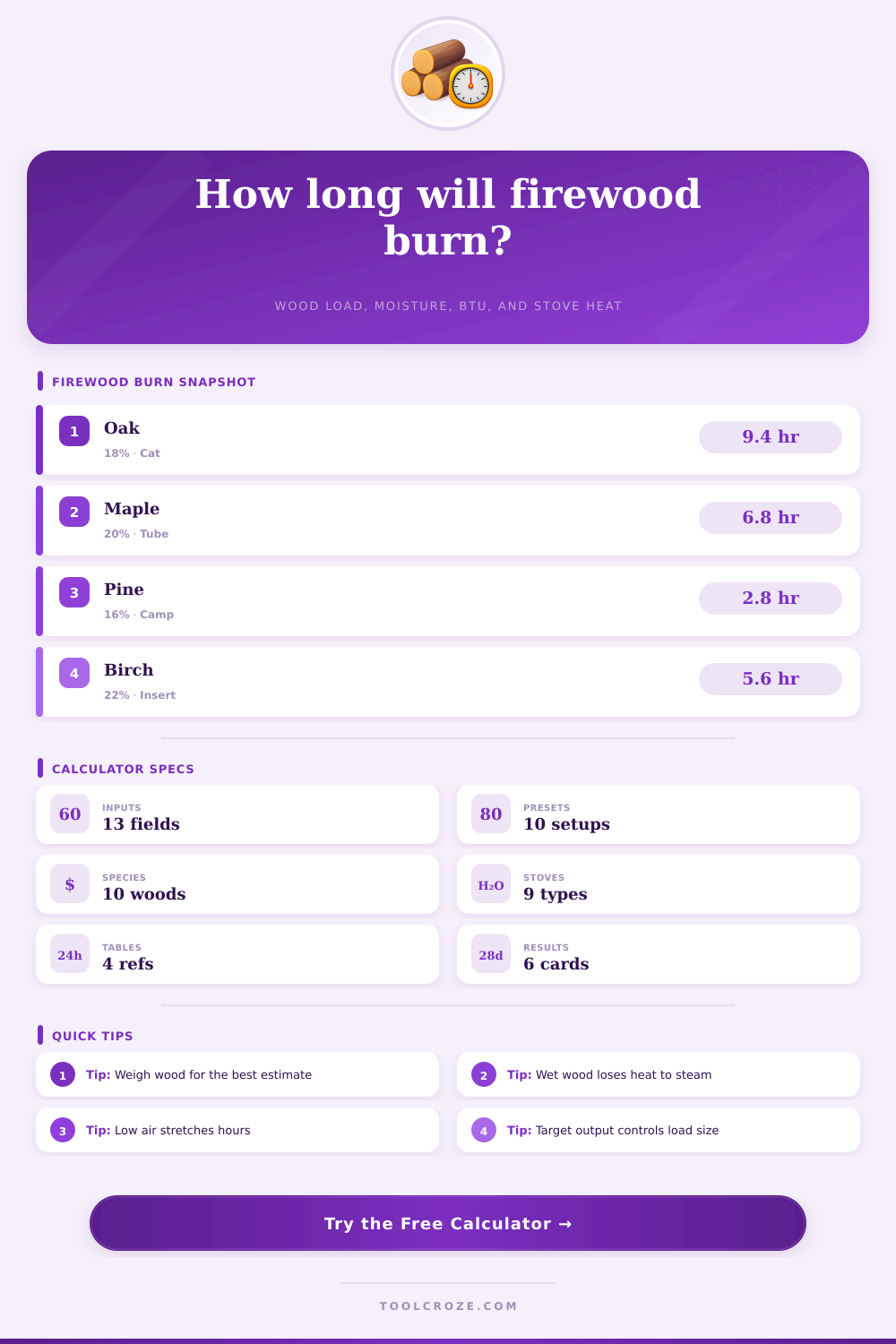
Estimate firewood burn time from wood weight or volume, species BTU, moisture content, appliance efficiency, burn rate, load size, air setting, and target heat output.
🔥 Stove And Fireplace Presets
Choose a realistic wood heat setup, then adjust the load weight, wood species, moisture, stove efficiency, air setting, and heat target to match the actual fire.
⚙ Firewood Burn Inputs
▦ Species And Stove Comparison Grid
🪵 Selected Firewood Properties
☰ Firewood Reference Tables
| Species | Approx. Million BTU/Cord | Dry Density | Burn Character |
|---|---|---|---|
| Hickory | 27 to 29 | Very high | Long, hot coals for overnight or furnace loads |
| White oak | 26 to 29 | Very high | Long burn, strong coal bed, needs good seasoning |
| Red oak | 24 to 26 | High | Reliable long-burn hardwood when dry |
| Sugar maple | 23 to 25 | High | Steady heat with moderate coaling |
| White ash | 22 to 24 | Medium high | Easy lighting hardwood with predictable output |
| White pine | 14 to 16 | Low | Fast, bright fire; good shoulder-season or camp load |
| Appliance Type | Typical Efficiency | Burn Time Behavior | Best Calculator Use |
|---|---|---|---|
| EPA catalytic stove | 72% to 82% | Slow low-air burns with long shoulder heat | Overnight hardwood loads |
| EPA tube stove | 65% to 78% | Strong secondary burn, medium load timing | Evening heat and normal reload cycles |
| Fireplace insert | 55% to 72% | Good room heat but shorter than deep firebox stoves | Room heating with mixed hardwood |
| Open fireplace | 10% to 25% | Large flame, high flue loss, short useful heat | Ambience fires and rough heat estimates |
| Masonry heater | 70% to 85% | Fast hot charge, slow release from mass | Batch-burn stored heat planning |
| Wood furnace or boiler | 60% to 80% | High output with larger batch loads | Whole-building heat demand checks |
| Moisture Content | Effective Energy | Burn Time Effect | Planning Note |
|---|---|---|---|
| 12% to 16% | Excellent | Clean, predictable burn | Very dry wood may burn faster with high air |
| 17% to 20% | Good | Normal stove performance | Common target for seasoned cordwood |
| 21% to 25% | Reduced | Slower ignition, lower delivered output | Increase load or accept lower average BTU/hr |
| 26% to 35% | Poor | Heat is spent evaporating water | Expect smoke, weak secondary burn, and short useful heat |
| 36% plus | Very poor | Long smolder, low room heat | Not a normal heating-fuel target |
| Air Setting | Burn Rate Factor | Average Output | Use Case |
|---|---|---|---|
| Low overnight | 0.58 x | Lower but longer | Dense hardwood, established coal bed |
| Medium heat | 1.00 x | Balanced heat and time | Normal reload timing and room heating |
| High output | 1.45 x | High heat, shorter duration | Cold starts, recovery heat, high demand |
| Reload/startup | 1.85 x | Very high early heat | Short phase, not a full-cycle setting |
💡 Firewood Burn Time Tips
To calculate the burn time of a wood stove or fireplace, there is a number of factors that need to be considered. Should the cook not calculate the burn time of the wood within the stove or fireplace correctly, the fire may either not reach the desired temperature within the room, or the fire may burn for too long at a temperature that is too low to reach the desired temperature within the room. Several factors can be considered to provide a more accurate calculation of the burn time of the wood within the stove or fireplace, such as the weight of the wood, the moisture content of the wood, the type of appliance that will be used to burn the wood, the air settings for the appliance, and the species of the wood that will be burned.
One of the more important factors to consider is the weight of the wood that will be burned within the stove or fireplace. The energy that are contained within the wood is actualy contained within the dry matter of the wood itself, not within the air that exists between the individual pieces of wood. Thus, two stacks of wood of the same volume may contain different amounts of weight, and the weight of the wood will impact the amount of energy that that load of wood releases.
How to Work Out How Long Firewood Will Burn
In addition to the weight of the wood, another important factor is the moisture content of the wood. Each pound of water that is contained within the wood will require energy to be turned into steam prior to the wood can release any of it’s heat energy. Thus, the more moisture that is contained within the wood, the less energy that load of wood can release.
The type of appliance that will be used to burn the wood will also impact the burn time of that wood. For instance, catalytic stoves can allow for longer burn times for a load of wood due to the fact that the catalytic stove burns with lower air settings then other types of stoves. An open fireplace will allow most of the heat from the burning wood to be released up the chimney, while a catalytic stove will release less of the heat from the stove.
Thus, an individual should use the correct appliance settings within a burn time calculator for best results. In addition to wood type, air settings will impact burn time. If the user opens air settings for a wood stove to allow more air to enter the stove, the burn rate of the wood will increase, as will the heat output of the burning stove.
However, the load of wood will be used up at a faster rate. Decreasing the air settings within a wood stove will increase the burn time for that load of wood, but the average heat output of the stove will decrease. Thus, an individual must consider these two variables together.
The type of wood that is to be burned can also impact the burn time within the stove. Different species of wood has different densities. Dense woods will burn for longer periods of time than softer woods, and will produce more heat within that longer burn time.
Thus, tables of the density of different types of wood can be utilized to calculate how much of each type of wood will be needed to reach the desired heat output. Individuals may make some mistakes when calculating burn time. For instance, some may weigh the wood immediately after splitting the wood, but the moisture content of the wood will change with time of year and weight will change.
Additionally, volume measurements can be disregarded, as the wood may not be packed equally within the stove. However, if an individual measured the moisture content of the wood and the weight of each load of wood that is to be burned within the stove or fireplace, that individual can accurately determine into what type of wood stove or fireplace the individual can best load the wood to reach the desired heat output.