
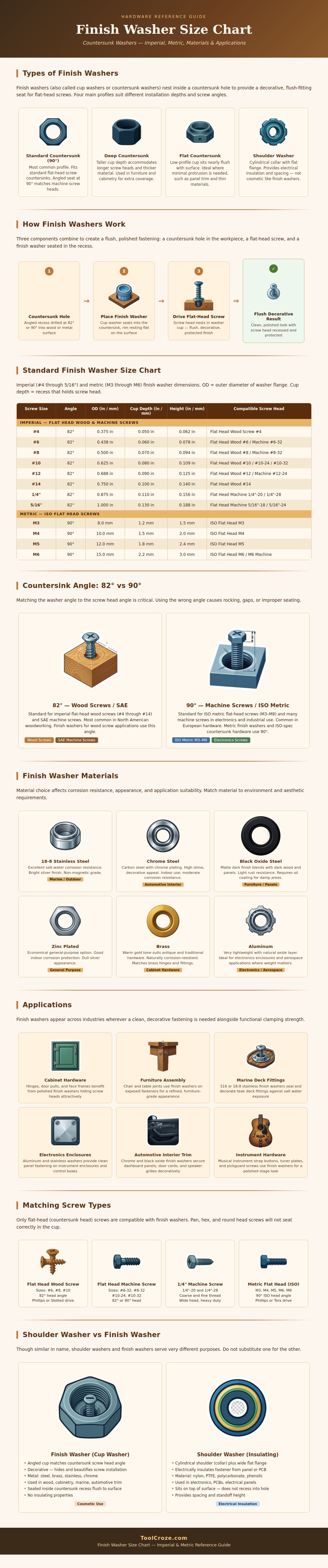
Screws practically dissapears on a panel or cabinet… Giving it a polished appearance. That’s not an accident. It’s due to a little cupped washer that allows a flat-head screw to lie flush against its surface. A proper finish washer turn an otherwise noticeable fastener into something you barely notice. An improper washer render the entire join sloppy.
But there’s a pattern here (see chart above). Outer diameter relates to cup depth which in turn lines up with screw size. Once you learn that pattern, you won’t guess again. For instance, a #8 screw require a washer with sufficient cup space so the screw head nest inside without bottoming out. Use a screw that is a half inch or larger (#12 or quarter-inch fastener), which requires a deep cup and a wide flange. The same holds true for metric sizes. However, the angle changes from the 82-degree angle common on most North American wood screws to 90 degrees.
How to Pick the Right Finish Washer
It isn’t cosmetic to match the angle. If it doesn’t, screw will rock or sit at an angle on washer, regardless of how hard you try to tighten it. Similarly, material selection depend on the application. Stainless resists the effects off salt and moisture and doesn’t stain adjacent wood surfaces. Brass provides warm color that complements traditional pull and hinge hardware. Black Oxide blend into dark finishes. Chrome/Zinc presents a brighter, more mechanical look.
They are all in the chart because each address a different challenge. Though a chrome finish may look nice for a time on an outdoor deck fitting, the plating will fail sooner or later. Stainless prevents that disappointment right from the start. The installation is simple after prepping the hole. Countersink with an angle matching the washer. Drop in the washer. Drive in the screw.
The washer distribute some of the load. It prevents the screw head from marking the surface. It gives a clean recessed effect, looking like it was meant to be that way. Sometimes people will leave out the washer thinking the countersink by itself does all the work. It might work in places where fastener remains unseen. Anytime the fastener shows, the washer is more better difference between just okay and really nice.
Confusion strikes when you get to shoulder washers. On appearance alone, it looks like a shoulder washer but it’s not. A shoulder washer space or insulates two piece. It goes on top. A finish washer recesses into whatever it is that you’re trying to hide it from and make your screw look good. Normally using a shoulder in place of a finish will result in a screw that doesn’t work electrically or a piece that don’t look right.
“Knowing which joints need that additional step is the trick. That’s where it makes a big difference on the body of an instrument or a speaker grille. You might not of want to bother with it on the back side of a cabinet against a wall.”
That attention to detail pay off. It helps get details right where people see them without overbuilding each joint.
