Fillet Weld Weight Calculator
Estimate fillet weld volume, deposited weld metal, filler issue weight, effective throat, arc time, and pass length from leg size, weld length, convexity factor, density, deposition efficiency, and pass count.
| Equal leg size | Theoretical throat | Steel weight per foot | Common planning use |
|---|---|---|---|
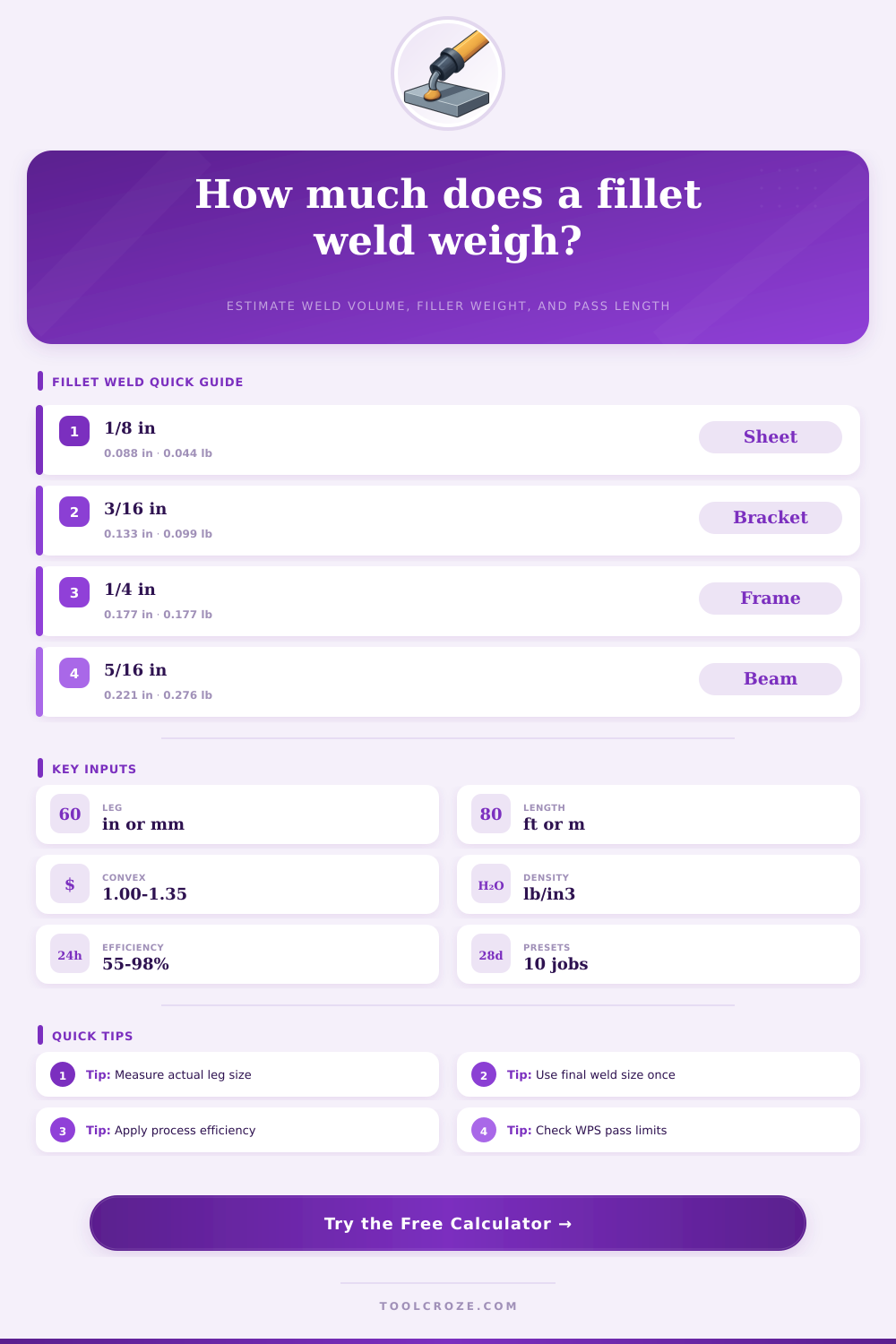
| 1/8 in or 3 mm | 0.088 in or 2.1 mm | 0.027 lb/ft or 0.040 kg/m | Sheet tabs, light covers, small brackets |
| 3/16 in or 5 mm | 0.133 in or 3.5 mm | 0.060 lb/ft or 0.089 kg/m | Angle brackets, light frames, guards |
| 1/4 in or 6 mm | 0.177 in or 4.2 mm | 0.106 lb/ft or 0.158 kg/m | General frames, clips, base plates |
| 5/16 in or 8 mm | 0.221 in or 5.7 mm | 0.166 lb/ft or 0.247 kg/m | Stiffeners, beam clips, machinery pads |
| 3/8 in or 10 mm | 0.265 in or 7.1 mm | 0.239 lb/ft or 0.356 kg/m | Heavy lugs, repair pads, built-up parts |
| Material or process | Typical value | Calculator field | Planning note |
|---|---|---|---|
| Carbon steel weld metal | 0.283 lb/in³ or 7.83 g/cm³ | Density | Good default for ER70S, E7018, and many structural welds. |
| Stainless steel weld metal | 0.289 lb/in³ or 8.00 g/cm³ | Density | Use alloy data for high nickel or duplex filler when available. |
| Aluminum weld metal | 0.098 lb/in³ or 2.70 g/cm³ | Density | Much lighter weld weight for the same fillet geometry. |
| GMAW or SAW | 88% to 98% | Efficiency | High transfer efficiency when settings and fit-up are stable. |
| SMAW stick electrode | 55% to 70% | Efficiency | Stub loss, slag, and coating make issued electrode weight higher. |
| FCAW wire | 75% to 88% | Efficiency | Flux and slag reduce deposited metal per pound of electrode. |
| Profile condition | Factor range | Weight effect | When to use it |
|---|---|---|---|
| Concave or undersize average | 0.85 to 0.98 | Less metal than triangle | Use only when measured legs and profile support it. |
| Flat theoretical fillet | 1.00 | Base triangle weight | Best for drawing takeoff and neutral estimates. |
| Slight convexity | 1.05 to 1.12 | Small increase | Common for many shop fillets with visible reinforcement. |
| Heavy convex bead | 1.15 to 1.30 | Large increase | Use for slow travel, large caps, or oversized welds. |
| Oversize repair build-up | 1.30 to 1.60 | Very high increase | Separate passes or measure actual bead cross-section. |
| Scenario | Pass input | Travel speed cue | Calculator caution |
|---|---|---|---|
| Final weld size takeoff | 1 pass | Use average final seam speed | Do not multiply final cross-section by actual bead count. |
| Repeated identical stringers | Actual count | Use stringer speed | Passes multiply total weld length and weight. |
| Multi-pass fillet with different beads | Run separate estimates | Use each pass speed | Root, fill, and cap areas often differ. |
| Short stitch welds | Segment count | Lower operating factor | Starts, stops, and crater fill raise allowance. |
| Automation or long seam | Programmed path | Higher operating factor | Confirm travel speed and wire data from logs. |
Fillet welds is often used in fabrication due to the fact that fillet welds are fast to apply, and they are often strong enough for the application. However, the drawings for the welded joint does not indicate the amount of metal that will be used in creating the fillet weld. The leg size that is marked on the drawing does not indicate how much wire or rod the welder will consume to form the fillet weld.
A fillet weld weight calculator can be used to calculate the difference between the theoretical weight of the triangle that is formed by the fillet weld and the actual weight of the weld bead. The fillet weld include two legs in right angles to each other. These two legs form a triangle, the area of which is calculated as half of the product of the length of each leg.
How to Calculate Fillet Weld Weight and Time
The weld bead typically has a crown in the center of the weld. This crown increases the area of the weld, and the area of the weld is calculated by using a factor for convexity in the range of 1.05 to 1.20. A fillet weld weight calculator allow the user to enter the leg sizes of the weld and the profile of the weld to calculate the area of the weld.
Additionally, the calculator allows the user to enter whether the legs of the fillet weld are equal or not equal to each other, which may reflect the thickness of each of the metal member that are to be welded together. The area of the fillet weld can be converted to the weight of the weld by multiplying the area by the density of the metal that is to be welded. For carbon steel, the density is near 0.283 pounds per cubic inch.
Stainless steel has a higher density than carbon steel, and aluminum has a lower density than carbon steel. Thus, the weight of an aluminum fillet weld will be less than the weight of a steel fillet weld of the same leg size. The user can enter the density of the metal into the fillet weld weight calculator, and changing the metal will automatically update the density of the metal in the calculator.
This prevents the user from using the density value of one metal in another metal, which would result in ordering the wrong amount of filler metal for the weld. The weight of the filler metal that the fillet weld weight calculator calculates is the weight of the metal that is deposited into the weld. The welding process will consume more actual metal than the amount of metal that is deposited into the weld.
The welding process consumes the metal due to the inefficiency of processes like stick welding (SMAW), which loses 30 to 45% of the welding electrode metal to slag, spatter, and stub ends of electrodes. Gas metal arc welding (GMAW) has a much higher deposition efficiency, losing less than 10% of the metal of the welding rod to these issue. Flux-cored welding is in between GMAW and SMAW in terms of the efficiency with which the metal is deposited into the weld.
Thus, the user can enter the filler metal efficiency into the calculator to determine the total weight of metal that should of been ordered for the project. The calculations of the fillet weld calculator can be used to calculate the total amount of metal required for welds that require more than one pass. Thus, the weld calculator allow for the entry of the number of passes that are to be made into the weld.
Additionally, the calculator keeps the number of passes separate from the number of segments of weld passes made into the joint. This allows the user to determine if the additional metal is due to additional passes into the same seam, or if the metal is required to make additional weld segment. The length of the weld can be used to calculate the amount of time that will be required for welding the joint.
You can multiply the length of the weld by the operating factor for the welding process. Operating factors range from 35% for manual welding jobs to over 60% for automated welding cell. Manual welding cells must spend much of the working shift fitting the joint together, tack welding the joint, and repositioning the work piece to position the welds correctly along the joint.
Thus, the user enters the operating factor into the weld calculator to calculate the total time that will be required to weld the joint. The calculations of the weld calculator can include the time and labor required to make starts, stops, and rework of the weld. These error in welding will require additional metal to be consumed by the welding operation to correct the weld.
The amount of metal that is consumed during starts, stops, and rework is typically around 10% of the metal for clean production of the weld. However, 20% or more of the metal may be consumed if the welds are being prepared in the field. The user can enter the amount of metal that is consumed in these situations into the calculator.
Tables is provided on the calculator to assist the welder to make sure that the calculations of the weld calculator are accurate. The tables indicate the theoretical weight of the weld and the throat of the weld given each leg size of the fillet weld. Additionally, the tables list the densities of the metals and efficiencies of the welding processes.
These tables can be used to ensure that the calculations performed by the weld calculator are within normal limits for the joint that is to be welded. Although the weld calculator provides a good estimate of the amount of metal that will be consumed during the welding process, the actual metal that will be used will be affected by additional variables of the welding process. The gap between the metals that are to be welded may require adjustments to the size of the fillet weld.
Additionally, the interpass temperature between weld passes may require adjustments to the number of passes that is required to complete the weld. The skill of the welder may also affect the convexity of the weld and the travel speed at which the welder moves the welding rod along the joint. The calculations of the weld calculator will provide the welder with an indication of the metal that will be used for the weld.
However, the actual metal that is consumed by the welding process is subject to the control and skill of the welder. Thus, while the weld calculator provides the welder with a solid estimate of the amount of metal that will be consumed during welding, the welder will still have to adjust for the variables of the welding operation. The weld calculator is most useful in that it allows the welder to compare the metal consumption requirement of different welding processes.
For instance, increasing the leg size of the fillet weld from 1/4-inch to 5/16-inch will increase the amount of metal required for that weld by more than 50%. Additionally, it is possible to use the weld calculator to determine the amount of additional metal that will be consumed by SMAW processes compared to GMAW processes for the same weld size. Beyond making estimate of the metal that will be consumed during welding, the weld calculator can also be used to calculate the amount of time that will be required to perform the welding.
Thus, the welder will have to enter the leg sizes of the weld, the number of pass, and the number of segments into the calculation to determine how long the welding operation will take. Additionally, the welder will have to enter the operating factor for the welding process into the calculation. The weld calculations will determine the amount of metal that will be consumed by the welder in performing the weld.
The weld calculations will determine the amount of time that will be required for completing that weld. Thus, the weld calculator help the welder to estimate the time and labor that will be required for performing the weld.