Fiberglass Roof Calculator
Estimate GRP roof area, slope correction, chopped strand mat, resin wet-out, trims, upstands, outlet details, topcoat, catalyst, waste allowance, and staged batch planning.
Calculation Breakdown
| Roof System | Typical Mat | Resin Planning | Use Case |
|---|---|---|---|
| Light duty roof | One 450 gsm layer | 1.4 to 1.8 kg/m² | Small canopy, porch, low traffic roof |
| Standard GRP roof | Two 450 gsm layers | 2.0 to 2.5 kg/m² | Garage, extension, utility flat roof |
| Heavy duty roof | Two 600 gsm layers | 2.6 to 3.2 kg/m² | Walk-on balcony or higher wear surface |
| Overlay refurbishment | One or two 450 gsm layers | 1.6 to 2.5 kg/m² | Prepared existing GRP or compatible deck |
| Detail patch | Local strips and patches | 1.8 to 3.0 kg/m² | Kerbs, outlets, cracks, and corners |
| Reinforcement | Imperial Weight | Metric Weight | Typical Roof Role |
|---|---|---|---|
| Light CSM | 9 oz/yd² | 300 gsm | Detail strips and small repairs |
| Standard CSM | 13.3 oz/yd² | 450 gsm | Main GRP roof laminate layer |
| Heavy CSM | 17.7 oz/yd² | 600 gsm | High wear roof zones and balconies |
| Detail bandage | 4 to 8 in wide | 100 to 200 mm | Trim joints, corners, outlets, kerbs |
| Woven tape | 6 to 12 oz/yd² | 200 to 400 gsm | Reinforced seams and local transitions |
| Trim / Detail | Count Method | Bandage Allowance | Planning Note |
|---|---|---|---|
| Drip edge trim | Linear edge length | 4 to 6 in strip | Round up to full trim sticks |
| Wall fillet / angle trim | Upstand perimeter | 6 to 8 in strip | Include corners and laps |
| Raised kerb | Kerb perimeter x height | Two local patches | Add to vertical layup area |
| Outlet bowl | Each outlet | 1 to 2 sq ft | Use pre-cut detail patches |
| Expansion / joint detail | Total joint length | Project specified | Follow system detail requirements |
| Roof Preset | Size Reference | Layer Start | Waste Start |
|---|---|---|---|
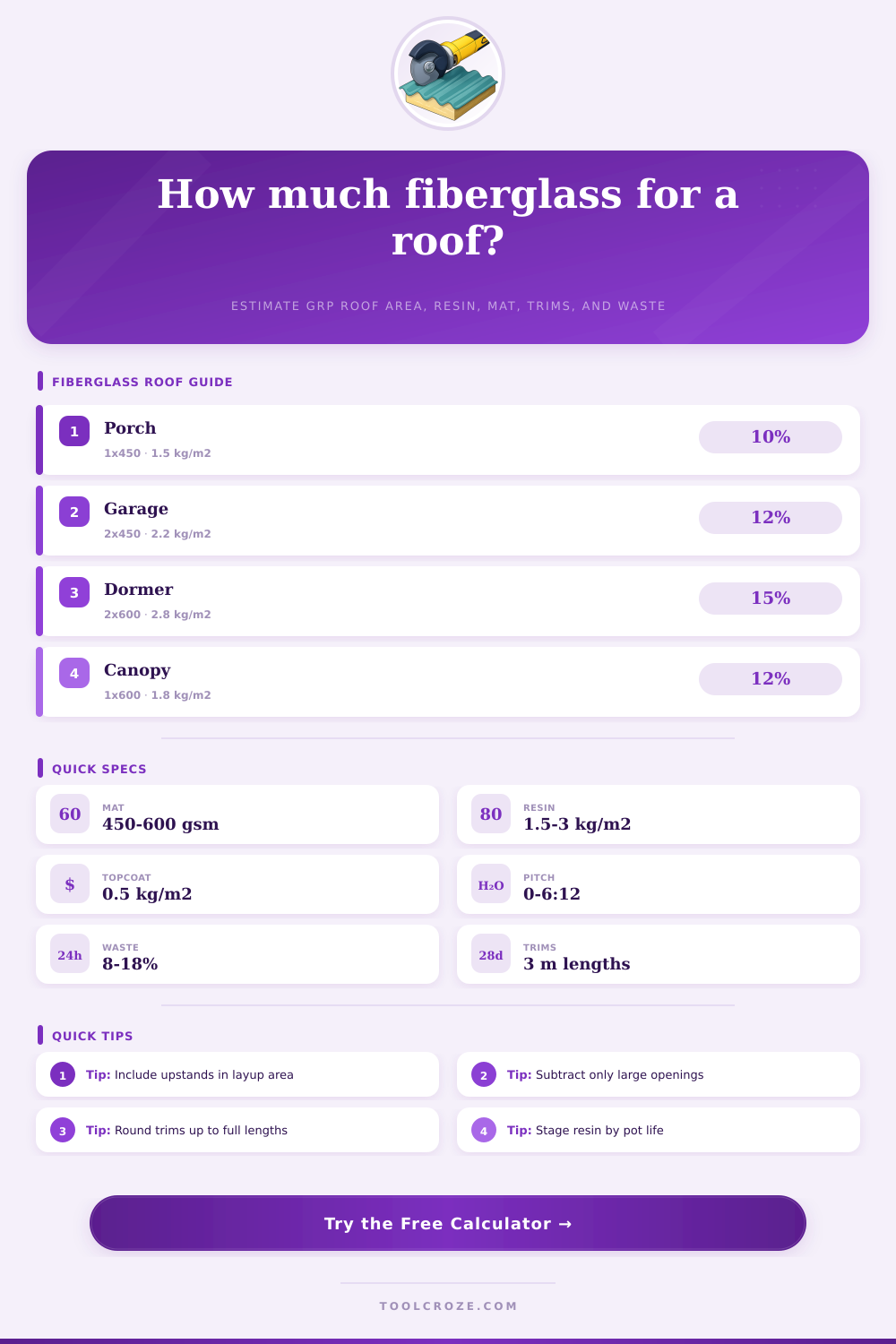
| Porch warm deck | 8 ft x 5 ft | One 450 gsm | 10% |
| Single garage | 20 ft x 12 ft | Two 450 gsm | 12% |
| Dormer roof | 12 ft x 8 ft | Two 450 gsm | 15% |
| Balcony deck | 14 ft x 10 ft | Two 600 gsm | 15% |
| Metric extension | 6 m x 3.6 m | Two 450 gsm | 12% |
When calculating the amount of chopped strand mat and resin needed to pour a fiberglass roof, it is essential to ensures that you dont run out of materials during installation. If you run out of resin, it will harden due to the chemical reaction between the resin and the catalyst. You will also waste money if you purchases too much resin as the resin that you buy cannot be returned.
You must account for many factor to ensure you have the correct amount of chopped strand mat and resin for your project. The first factor to consider is the size of your roof. When measuring the area of your roof, most people makes the mistake of only measuring the footprint of the building.
How to Calculate Chopped Strand Mat and Resin for a Fiberglass Roof
Your measurements should also include the eaves and end overhangs that extend from the building. Additionally, if your roof has a pitch to it, it will have more area then a flat roof of the same footprint. The pitch of the roof will increase the amount of chopped strand mat and resin that you need to purchase for your project.
Another factor to consider is the number of layers of chopped strand mat your roof will require. If your roof is a light duty roof, it may only require one layer of 450 gsm chopped strand mat. However, if your roof is a heavy duty roof, such as a walk-on balcony, you may need two layers of 600 gsm mat.
You must use the correct amount of resin when mixing chopped strand mat with resin. If you use too little resin, your chopped strand mat will harden and form air bubbles and dry spots on your roof. Air bubbles and dry spots will cause your roof to leak.
Additionally, if you use too much resin, you will increase the weight of the roof that your building structure must supports. The details of your roof will require additional chopped strand mat and resin. If your building has upstands and bandages, these area will require additional chopped strand mat to be included in your calculations.
Your calculations should take into account the perimeter of the walls of the building and the width of the bandages. If you do not include the upstands and bandages in your calculation of the area of chopped strand mat and resin you need, you will not have enough materials to complete your detailing work for the roof. There will always be waste when installing chopped strand mat, as you cannot precisely cut the chopped strand mat to the required measurements.
There will be overlaps at the seams of the chopped strand mat, as well as offcuts of the mats when cutting them to the size of your building. The more complex the shape and design of your roof, the more waste chop strand mat will create. For instance, complex roofs may require twenty percent of the chopped strand mat to be wasted during installation.
To account for this, you will have to buy extra chopped strand mat for your project. The last factor to consider is the topcoat that you will use for your fiberglass roof. The topcoat will be a UV-resistant skin that will cover your fiberglass roof, but it will have a different coverage rate than the resin used for laminating the fiberglass roof.
You will need to calculate the catalyst for the topcoat separately from the catalyst needed for the resin and chopped strand mat. Without the topcoat, the fiberglass roof will break down due to the suns UV rays within a few years. Therefore, the topcoat is a necessity for all fiberglass roofs.
The chemical reaction of the resin will cause the resin to harden in the bucket. To manage this, you will need to plan the batches of resin you will mix. If you mix too much resin at once, it will harden before you can pour it onto the roof.
To avoid this problem, you will have to break up the total amount of resin into smaller batches that you will mix and pour onto the building. Using a chopped strand mat and resin calculator will tell you how much chopped strand mat, resin, and catalyst you will need for your project. Using a chopped strand mat and resin calculator allows you to input the size of your roof and the system you will use for your roofing project.
Additionally, a chopped strand mat and resin calculator will convert your measurements from imperial to metric or from metric to imperial. The shopping list that a chopped strand mat and resin calculator will produce will show you how much chopped strand mat, resin, and catalyst to purchase for your project. By calculating the slope of your roof, the upstands and bandages and the amount of chopped strand mat that will be wasted during installation, you will know the total amount of chopped strand mat and resin you need to purchase to complete your fiberglass roof.