🧪 Fiberglass Resin Calculator | Layup Planner
Estimate fiberglass resin, catalyst, and hardener for cloth, mat, and infusion jobs before you mix. Plan overlap, waste, and batch size with less guesswork.
📌Preset Layups
⚙Calculator Setup
📊Results
🧵Fiber Reference Cards
📖Reference Tables
| Fabric | Areal Weight | Resin Factor | Best Use |
|---|---|---|---|
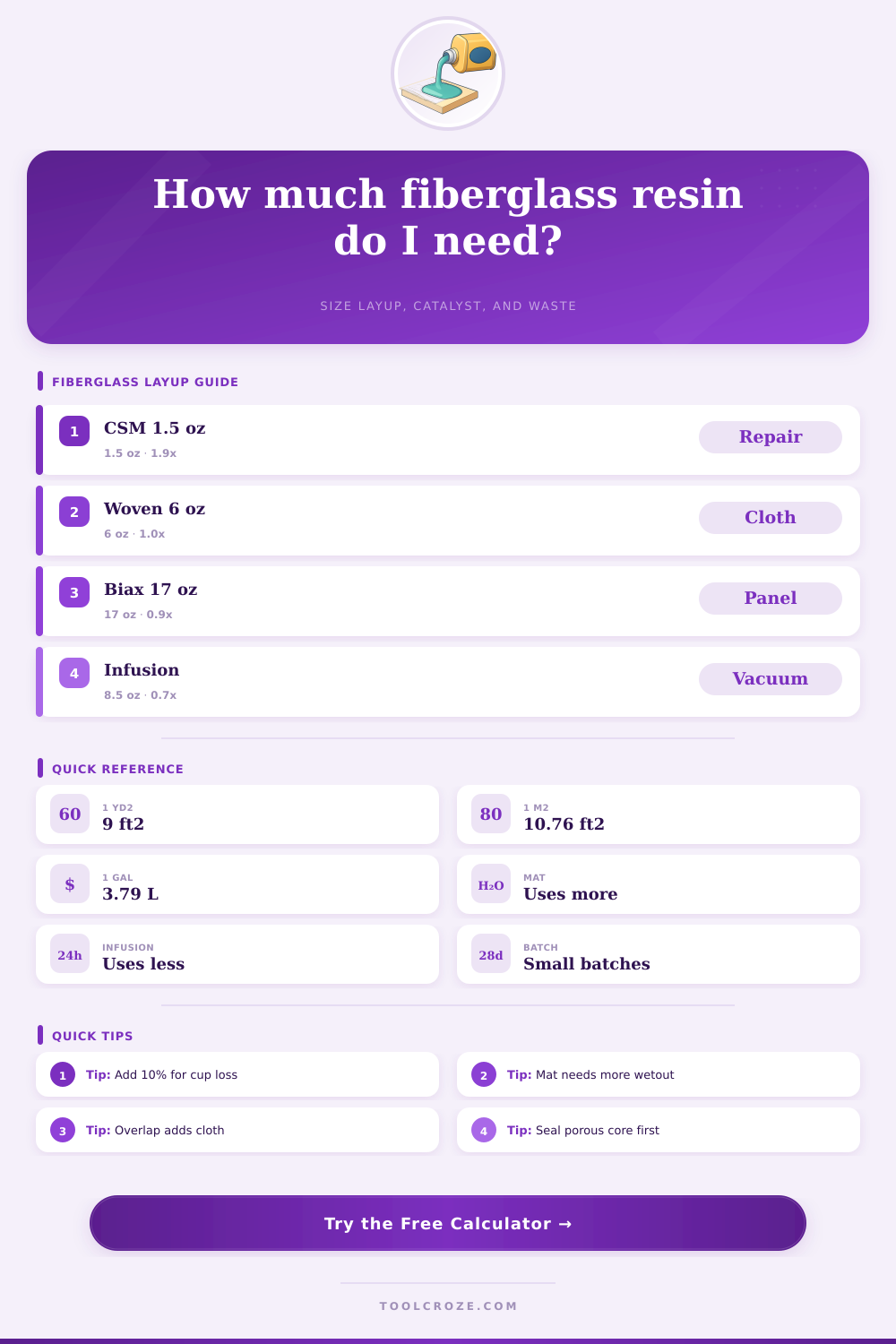
| Chopped Strand Mat | 1.5-3 oz/yd2 | 1.8-2.0x | Repair and skin coats |
| Woven Cloth | 6-10 oz/yd2 | 0.95-1.1x | General laminate panels |
| Biaxial Cloth | 17-24 oz/yd2 | 0.85-1.0x | Structure and stiffness |
| Woven Roving | 24 oz/yd2 | 0.9-1.05x | Heavy skins and tabs |
| Infusion Fabric | 8-10 oz/yd2 | 0.65-0.8x | Vacuum infusion jobs |
| Surfacing Veil | 0.5-1 oz/yd2 | 0.35-0.5x | Finish layer and print control |
| System | Mix Rule | Pot Life | Common Use |
|---|---|---|---|
| Polyester / MEKP | 1.0-2.5% | 12-25 min | Boat repairs, general skins |
| Vinyl Ester / MEKP | 1.0-2.0% | 15-30 min | Corrosion resistant laminates |
| Epoxy 2:1 | A:B = 2:1 | 25-40 min | Strong bond and repairs |
| Epoxy 3:1 | A:B = 3:1 | 30-50 min | Longer open time |
| Infusion Epoxy | A:B = 2:1 | 45-70 min | Low viscosity flow setups |
| Temperature | MEKP Rate | Epoxy Mix | Batch Note |
|---|---|---|---|
| 65-70 F | 2.0-2.5% | Longer pot life | Good for larger rollers |
| 70-75 F | 1.5-2.0% | Standard cure | Balanced shop condition |
| 75-80 F | 1.25-1.5% | Normal pot life | Mix in smaller cups |
| 80-85 F | 1.0-1.25% | Shorter pot life | Split into tiny batches |
| 85 F+ | Do not over-catalyze | Fast reaction | Watch exotherm closely |
💡Tips
Use this calculator to plan fiberglass resin, hardener, and catalyst quantities from fabric weight, layup method, and surface condition. It helps keep batches small, even, and predictable.
To calculate the amount of resin that are required for a fiberglass part, a person must take into consideration that using an incorrect amount of resin will lead to the structural failure of that part. Using too much resin for a fiberglass part will make the part heavily and brittle, and may lead to the fiberglass matrices within the part delaminating. Using too little resin for a fiberglass part will cause the fiberglass cloth to dry spots, which will lead to those dry spots cracking when the fiberglass part is flexed.
Thus, a person must understand how to use the resin to fabric ratios for a particular repair job. The different types of fiberglass reinforcements will require different amount of resin to be effective. For instance, chopped strand mat fiberglass reinforcement contains a fuzzy binder that holds the fiberglass together, which absorbs almost twice the weight of resin than chopped strand mat reinforcement.
How Much Resin Do You Need for a Fiberglass Part
Woven cloth fiberglass reinforcement contains a tight weave that holds the fiberglass together, which requires a lower resin to fabric ratio than chopped strand mat reinforcement. A person must account for these different types of reinforcement for a fiberglass part, as the type of fiberglass reinforcement will determine how much resin that fiberglass reinforcement will absorb. The method in which a person apply the resin will change the amount of resin requirements for the fiberglass part.
For instance, hand layup requires more resin than methods like vacuum infusion, because applying resin by hand squeezes out more resin. Vacuum infusion uses a vacuum to pull the resin through the fiberglass reinforcement, and uses approximately 30% less resin then hand layup. Additionally, a person must also consider the type of surface that is being repaired.
Surfaces like wood and foam are porous and will absorb the resin like a sponge. When a person applies resin to wood or foam, the wood or foam will absorb 10 to 15% more resin than a non-porous surface will absorb. Thus, a person can apply a skin coat of resin to the surface of the wood or foam repair first, which will seal the wood or foam and prevent it from absorbing resin.
The temperature of the environment in which a person is working also plays a role in how much catalyst is required for the resin. In a cool environment, such as a 65-degree garage, a small amount of catalyst is all that is required to initiate the curing of the resin. However, if the environment is warm, such as an 85-degree space, the same amount of catalyst will cause the resin to heat up rapid; this is referred to as an exotherm.
To avoid this rapid heating of the resin, a person should only mix batches of resin of 50% gallon or less; smaller batches of resin require less time to set, and are thus more easily managed during repair operations. Another factor that impacts the creation of a fiberglass part is the amount of catalyst that is measured for use with the resin. For instance, if the person is using polyester resin, a person will have to use a catalyst like MEKP.
The person must measure the MEKP by the weight of the resin that is to be used, as using an incorrect amount of MEKP will lead to the resin either curing too soft or cracking. To successfully create a fiberglass part, steps must be followed to prepare the resin to be used. For example, the first step is to calculate the total area of the fiberglass reinforcement that is to be used.
The next step is to determine the weight of the fiberglass reinforcement that will be required per square feet of the total area. The third step will be to calculate the resin-to-fabric ratio of the fiberglass reinforcement being used; chopped strand mat will have a different resin-to-fabric ratio than woven cloth fiberglass reinforcement. The fourth step is to add an allowance for waste, resin may drip off the fiberglass reinforcement or be lost when rolling the fiberglass reinforcement…
To the total amount of resin that is calculated. The fifth step is to account for the porosity of the surface that is to be repaired. Finally, the resin will have to be mixed into small batch.
Safety measures are necessary to utilize both the resin and catalyst. For example, a person must wear gloves and goggles when handling the resin, as the resin can cause irritation to the eyes and skin. Additionally, the area in which the fiberglass part is being created must have proper ventilation; the fumes that are released from the resin can be harmful to those who breathe into them.
Finally, the catalyst, MEKP, must be kept away from both metal shavings and rags, as MEKP will react spontaneous with those materials when the two agents come into contact with each other.