Fiberglass Laminate Thickness Calculator
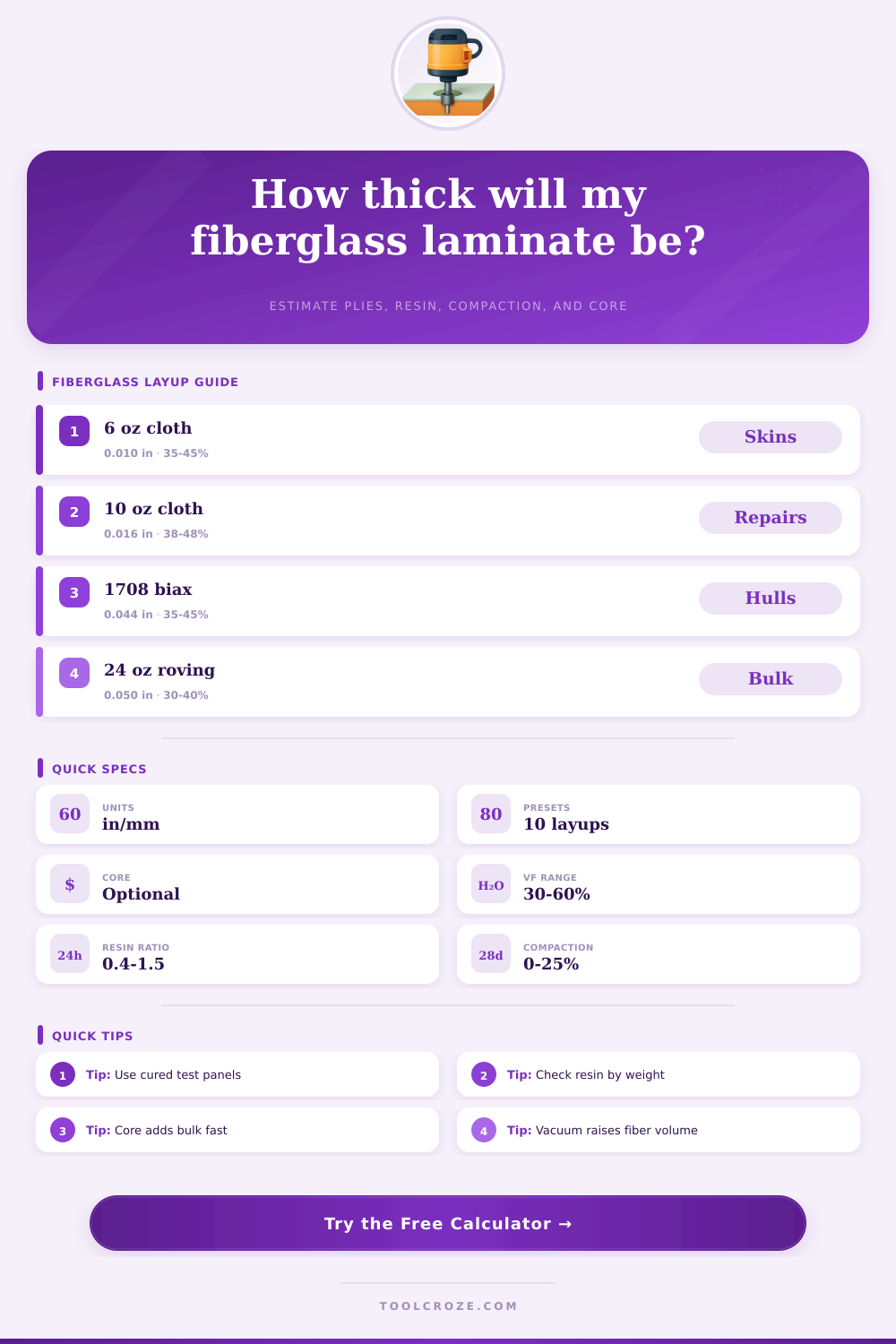
Estimate cured fiberglass laminate thickness from fabric weight, ply count, resin-to-fiber ratio, fiber volume fraction, compaction, area, and optional core thickness.
Choose a common fiberglass schedule to load fabric weight, plies, resin ratio, target fiber volume, compaction, core layer, and panel area.
Laminate estimate
Calculation breakdown
| Reinforcement | Typical weight | Approx. cured ply | Common use |
|---|---|---|---|
| Light E-glass cloth | 4 oz/yd² / 136 gsm | 0.006-0.008 in | Surfboards, cedar strip skins, fairing veil backup. |
| General cloth | 6 oz/yd² / 203 gsm | 0.009-0.012 in | Repairs, small boats, paddle craft, light panels. |
| Medium cloth | 10 oz/yd² / 339 gsm | 0.014-0.020 in | General hand layups, decks, hatches, panels. |
| 1208 biaxial | 18 oz/yd² / 610 gsm | 0.030-0.040 in | Sandwich skins and directional reinforcement. |
| 1708 biaxial | 25 oz/yd² / 848 gsm | 0.040-0.055 in | Hull skins, transoms, tabbing, structural build-up. |
| Woven roving | 18-24 oz/yd² | 0.035-0.060 in | Fast bulk in non-cosmetic structural laminates. |
| Process | Typical Vf | Resin ratio clue | Thickness note |
|---|---|---|---|
| Wet hand layup | 30-40% | 1.0-1.5 resin/fiber | Thicker and resin-rich unless rolled well. |
| Squeegee hand layup | 35-45% | 0.75-1.1 resin/fiber | Good baseline for cloth and biaxial fabrics. |
| Vacuum bagged wet layup | 45-55% | 0.45-0.75 resin/fiber | Compaction reduces thickness and excess resin. |
| Resin infusion | 50-60% | 0.35-0.60 resin/fiber | Most consistent for production sandwich panels. |
| Chopped strand mat | 25-35% | 1.4-2.2 resin/fiber | Bulky mat consumes resin and cures thicker. |
| Core material | Common thickness | Bond allowance | Use case |
|---|---|---|---|
| PVC / SAN foam | 1/4-1 in | 8-20 mil per side | Light panels, decks, hatches, cabin parts. |
| End-grain balsa | 3/8-3/4 in | 10-25 mil per side | Boat decks and stiff sandwich structures. |
| Honeycomb | 1/4-1 in | Film or paste bond | High stiffness panels with careful edge closeout. |
| Marine plywood | 1/4-1.5 in | Thickened resin bed | Transoms, floors, bulkheads, backing plates. |
The balance between fiberglass cloth and epoxy resin are essential in the fiberglass composite construction processes. The amount of fiberglass cloth and the amount of epoxy resin that a person uses will have a direct effect on the strength of the final product and the weight of that final product. If a person use too much epoxy resin, the final product will be heavily and brittle.
If a person uses too little epoxy resin, the fiberglass cloth will have dry spot within the laminate. Therefore, a person must understand the relationship between these two component of fiberglass composites in order to create a successful laminate. The fiberglass cloth will provide the structural strength of the laminate, while the epoxy resin will help to distribute the load between each individual glass fiber within the laminate.
How to Balance Fiberglass Cloth and Epoxy Resin
The fiber volume of a fiberglass composite material is a metric that describe the ratio of fiberglass cloth to epoxy resin. For example, the weight of the fabric is the dry weight of the fiberglass cloth per square yard of material. The fiberglass cloth and the epoxy resin will fill a specific volume of the composite material.
A high fiber volume will indicate that there is a high amount of fiberglass cloth to epoxy resin by weight, and that result in the creation of a dense and strong laminate. A low fiber volume will indicate that there is a high amount of epoxy resin to fiberglass cloth by weight, and that will result in a laminate that is mostly comprised of plastic. Compaction is the process of compressing the fiberglass cloth and the epoxy resin.
One way to compact the fiberglass and resin is by using a hand-layup process, wherein a person spreads the epoxy resin with a brush. The result of using this process will be a thicker laminate. Alternatively, vacuum bagging can be used to compact the fiberglass cloth plies against each other with vacuum pressure, as well as to remove excess epoxy resin from the laminate.
By vacuum bagging the laminate, the resulting laminate will be thinner than one produced through hand layup processes and the same amount of fiberglass cloth. Sandwich panels are structures that incorporate a core material in order to provide increased stiffness to the structure without significantly increase the weight of that structure. Sandwich panels include two thin layers of fiberglass cloth, as well as a core material such as PVC foam or balsa wood.
The core material does not provide much strength to the sandwich panel by itself, but it prevents the two layers of fiberglass cloth from being forced together. The bond line is the thin layer of epoxy resin that adhere the two layers of fiberglass to the core material. In sandwich panels, the thickness of the core and the thickness of the bond line must be accounted for in the determination of the total thickness of the sandwich panel.
The style of fiberglass cloth can impact the way that the fiberglass cloth handle loads and consumes epoxy resin. Plain weave cloth is a type of fiberglass cloth that is useful in creating fiberglass composites with desired cosmetic finish. Plain weave cloth, however, does not provide much structural strength to a laminate.
Biaxial fabric is a type of fiberglass cloth wherein the glass fiber are stitched in specific directions during the manufacturing of the fabric. Biaxial fabric can handle more load in the direction of the specific stitching than plain weave cloth. Biaxial fabric, however, is bulkier than plain weave cloth, and consumes epoxy resin in a different way than plain weave cloth.
The viscosity of the epoxy resin will impact the way that the epoxy resin penetrates the fiberglass cloth. Thin epoxy resin will penetrate the fiberglass cloth easy; thick epoxy resin may trap air within the fiberglass cloth. Because the viscosity of epoxy resin can vary, it is necessary to create a test coupon.
A test coupon is a small sample of the laminate that a person will create with the intended schedule of fiberglass cloth and epoxy resin. The coupon can be cured, and the resulting laminate measured with calipers. By measuring the coupon, a person can ensure that the actual thickness of the laminate is the same than the calculated thickness of the laminate prior to creating the fiberglass composite structure.