
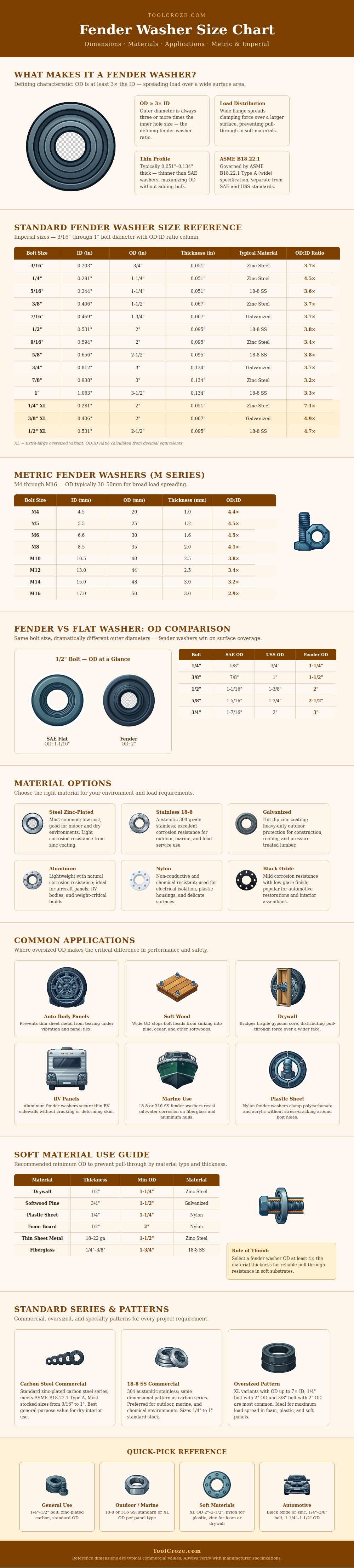
So what’s it do? Well, if you’re bolting through thin sheet metal or drywall, the fastener is holding that load and if the material tears out around your hole, you’re screwed (no pun intended). But a fender washer distribute more of the clamp force across a greater surface area then a standard flat washer would. Even under vibration or tension on a joint it holds the material together.
Here’s what that looks like in action from the chart: The reason is most folks grab whatever comes out of the drawer, and that’s usually wrong. You typically have a stock SAE washer with a tight fit against shank of the bolt. It is fine if you’re bolting down some steel plate. But it is terrible on something like a soft surface.
Why Use Fender Washers
The key difference between a fender washer and all the other flat washers are its minimum outer diameter, which is at least 3x as large as the hole. If you know the ratio, then picking the appropriate size become a matter of matching your material rather than making blind guesses at big box store.
It’s actualy thinner than you think. Because it’s thin, an additional thick fender washer doesn’t increase your stack height. For anyone doing auto body work, the goal with a washer is to get it flush on curved sheet metal. Otherwise you risk leaving gaps for water intrusion down the road. Same goes for fastening sheets of polycarbonate and aluminum RV paneling. The washer provide support but keeps the fastener out of the way when space are limited.
The material used is dependent off the setting. For interior / dry applications, go with zinc-plated steel (low cost). When it’s exposed to weather, road salt, or moisture, use stainless steel. Outdoor applications works well with galvanized versions which provide increased zinc coating for deck or other pressure-treated lumber. Nylon and aluminum performs specific functions if weight or electrical isolation are important considerations. None of these affect the fundamental geometry, only the longevity of the joint.
Ultimately your choice boils down to what’s on top of it. If it’s softwood, plastic, or even foam board, they’ll distort where small contact area touches them. When there’s any sort of load, the nut or bolt head will simply pull right through a too-narrow washer. Note how rapidly the outer diameter increase as bolt size increases in the chart above. That provides a real-world indicator of whether the washer you’ve selected is big enough.
For when even standard washers aren’t large enough, there are oversized versions. Looking at material before bolt size saves most hassle. Then the chart rapidly removes all but the few possibilities based off the surface being mounted. This turns what was often a loose or broken joint into a secure mount. It also avoids the need for different hardware just to get it to fit. You made a good choice based on what’s going on below the surface and connection stays tight for years.
