🌳 Fence Stain Coverage Calculator
Calculate exactly how many gallons of stain your fence project needs — by style, wood type, and condition.
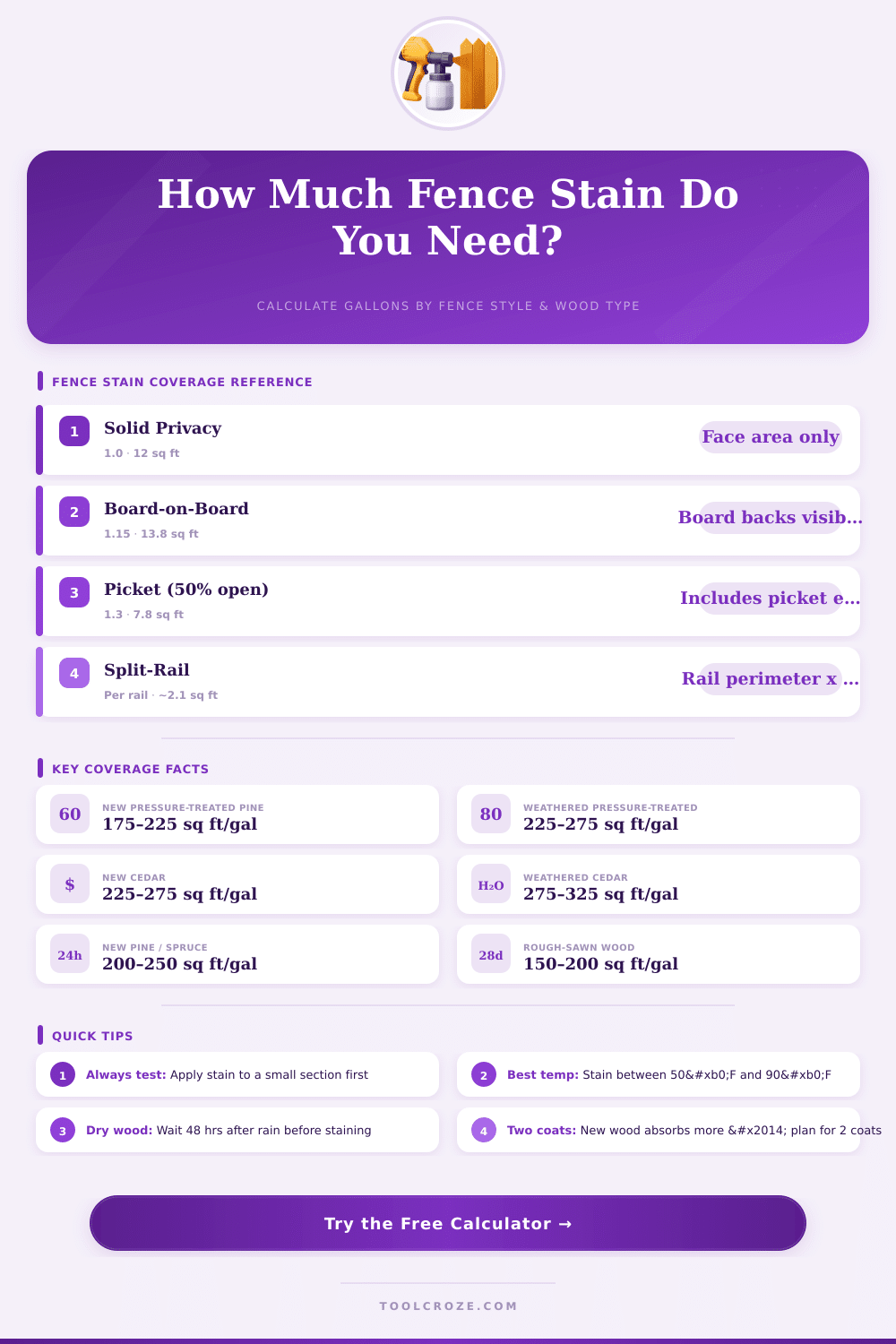
| Fence Style | Exposure Factor | Sq Ft / Lin Ft (6ft high) | Both Sides Note |
|---|---|---|---|
| Solid Privacy | ×1.0 | 12 sq ft | Full 24 sq ft both sides |
| Board-on-Board | ×1.15 | 13.8 sq ft | Board backs add surface |
| Picket (50% open) | ×1.3 | ~7.8 sq ft face | Edges of each picket add area |
| Split-Rail (2 rail) | Per rail circ. | ~2.1 sq ft/lf each rail | Rail perimeter × length |
| Rough-Sawn / Dog-Ear | ×1.05 | 12.6 sq ft | Rough texture adds absorption |
| Wood Type & Condition | Coverage (sq ft/gal) | Absorption | Notes |
|---|---|---|---|
| New Pressure-Treated Pine | 175–225 | Very High | Most porous, absorbs aggressively |
| Weathered Pressure-Treated | 225–275 | High | Surface closed over time |
| New Cedar | 225–275 | Moderate–High | Natural oils slow penetration |
| Weathered Cedar | 275–325 | Moderate | Oils diminished, stain spreads more |
| New Pine / Spruce | 200–250 | High | Soft grain absorbs steadily |
| Rough-Sawn Wood | 150–200 | Very High | Large surface area from saw marks |
| Stain Type | Wood Grain Visible | UV Protection | Fence Life Expectancy |
|---|---|---|---|
| Transparent | Fully visible | Low | 1–2 years (fence exposure) |
| Semi-Transparent | Mostly visible | Moderate | 2–4 years |
| Semi-Solid | Slightly visible | Good | 3–5 years |
| Solid Color Stain | Not visible | Excellent | 4–6 years |
| Stain Type | Reapplication Interval | Indicator |
|---|---|---|
| Transparent | Every 1–2 years | Color fading, water no longer beads |
| Semi-Transparent | Every 2–3 years | Dull appearance, gray weathering |
| Semi-Solid | Every 3–4 years | Surface peeling, color loss |
| Solid Color Stain | Every 4–5 years | Cracking, peeling from top coat |
Count how many Fence Stain for fence you really need, is not easy task, it depends much on what you work with. Maybe it is wooden materials, naturally. The current state of that wood plays a role.
Also the size of the fence itself affects the cause. Here the spot: bare wood grips Fence Stain like a sponge compared to wood that already was stained before. Hence gallons bid like this wide range, from 150 to 400 square feet each gallon.
How Much Fence Stain Do You Need?
The soaking simply adjusts according to the case from one case to the next.
If you have a smaller fence, under 175 square feet? One gallon will be enough, regardless of the wood density. Go to something bigger, for instance, 550 sqaure feet, and you will need two gallons.
Usually one gallon covers around 150 to 300 square feet, although it depends on the wood kind and how “thirsty” the grain is.
The type of Fence Stain itself makes a difference. Clear and semi clear oil stains cover around 175 square feet each gallon in my experience. Solids, on the other hand, reach only around 250 square feet each gallon.
Water based types commonly beat their oil matches on coverage. Clear Fence Stain, even so, can only reach 100 to 200 square feet each gallon, more or less.
To estimate what you really need, start with the total surface of your fence in square feet. Multiply the length by the height. Say your fence is 350 feet and 6 feet tall, that gives 2,100 square feet for one side.
For both sides it becomes 4,200 square feet. That could need around 15 gallons, according to the soak rates. Covering both sides is the write way, although it gets harder when neighbours are involved.
One person, who covered around 5,800 square feet of fence surface with Fence Stain that covered 300 square feet each gallon, ended up using around 43 gallons, what cost him 1,800 dollars only for the Fence Stain itself. Another person worked on a 40-foot, 5.5-foot cedar fence and ended with five gallons of solid Fence Stain. The exact number varies a lot according to your own situation.
Spraying commonly is the preferred method. It nicely handles rough surfaces of fences, more than just a brush. Airless and HVLP sprayers quickly cover big areas.
Backpack sprayers work well also and give even coverage. Even so, spraying needs care to avoid overspray and involves wiping extra Fence Stain before it dries. Roller and brush fully removes issues about overspray.
Good gear for staining ensures even application, reduces work, saves time and helps the Fence Stain soak in better. Any method you choose, brush or spray along the grain and wipe pools to avoid streaked, stainedfaces.
If you plan two coats? The real coverage each gallon then halves (easily forgotten during buying). Add around 10 percent of extra Fence Stain is a wise step, so that you do not run out before the end of the work.