Concrete Calculator for Fence Post Holes
Estimate concrete volume, bag count, gravel base, post displacement, bell-bottom extra volume, ready-mix quantity, and embed-depth checks for fence post holes.
📌Fence post presets
📏Hole, post, and mix inputs
Fence Post Hole Concrete Estimate
🧱Material and specification grid
📚Fence post concrete reference tables
Common post hole sizes and concrete planning
| Post or footing type | Typical hole diameter | Typical hole depth | Concrete note |
|---|---|---|---|
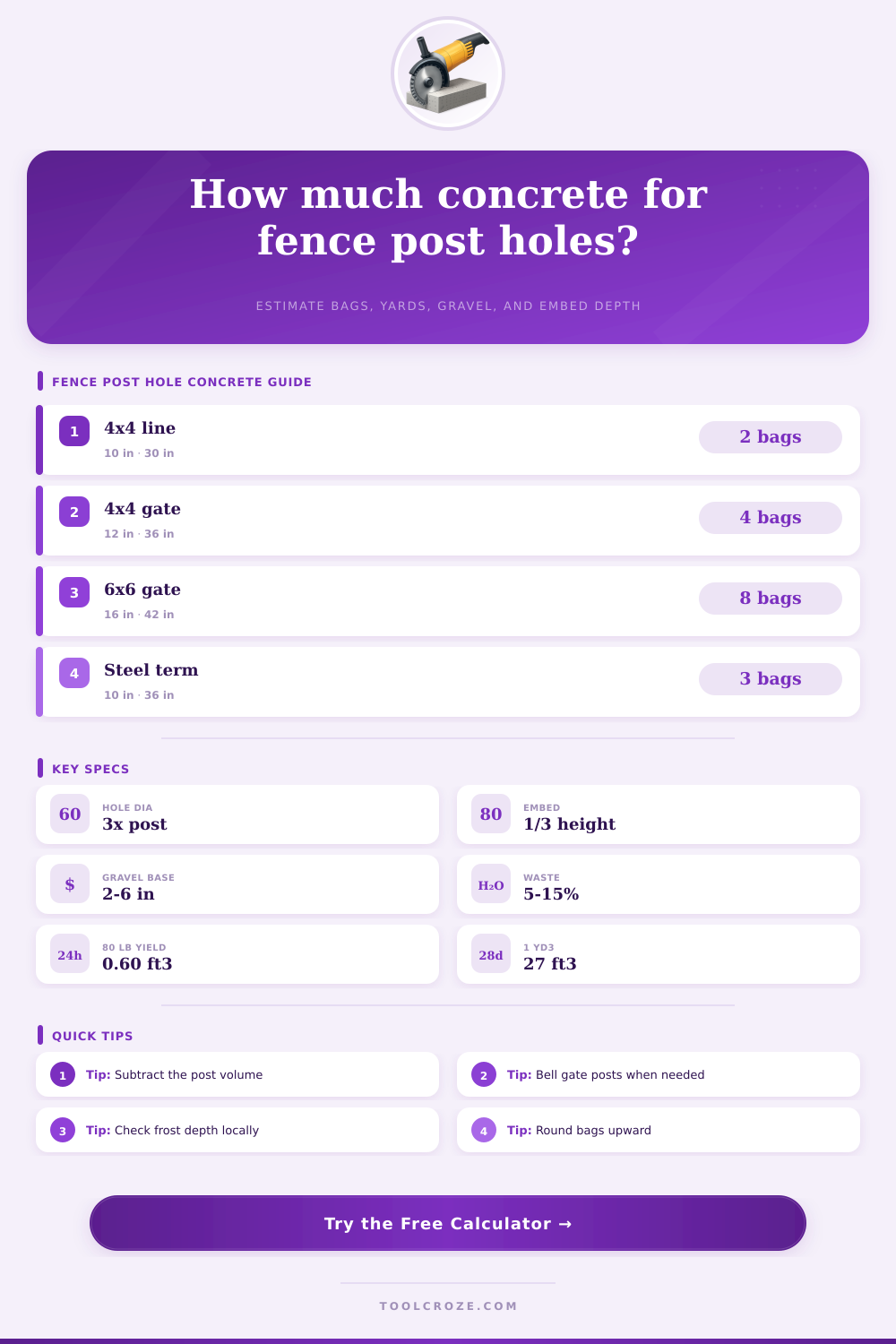
| Nominal 4x4 wood line post | 8 to 10 in | 24 to 36 in | Subtract actual 3.5 in square post volume |
| Nominal 4x4 corner post | 10 to 12 in | 30 to 42 in | Use larger diameter for pull and wind load |
| Nominal 6x6 gate post | 14 to 18 in | 36 to 48 in | Bell bottom often increases volume noticeably |
| Round steel chain link line post | 6 to 8 in | 24 to 36 in | Round post displacement is usually small |
| Chain link terminal or pull post | 10 to 12 in | 30 to 42 in | Plan extra concrete for tensioned fabric ends |
Bag yield reference for post holes
| Bag size or yield | Approx. yield | 10 in x 30 in hole | Best planning use |
|---|---|---|---|
| 50 lb concrete bag | 0.375 ft³ | About 3 to 4 bags | Small line post repairs |
| 60 lb concrete bag | 0.45 ft³ | About 3 bags | Moderate holes and easier lifting |
| 80 lb concrete bag | 0.60 ft³ | About 2 to 3 bags | Common fence post bag estimate |
| High-yield post mix | 0.75 ft³ | About 2 bags | Useful when bag count must stay low |
Embedment checks by fence height
| Above-ground height | One-third embedment | Common minimum | Planning note |
|---|---|---|---|
| 3 ft decorative fence | 12 in | 24 in | Minimum depth often controls |
| 4 ft chain link or picket | 16 in | 24 to 30 in | Terminals may need deeper holes |
| 6 ft privacy fence | 24 in | 30 to 36 in | Wind load usually drives sizing |
| 8 ft privacy fence | 32 in | 36 to 48 in | Check local rules before digging |
Straight hole volume before post displacement
| Hole diameter | 24 in concrete depth | 36 in concrete depth | 48 in concrete depth |
|---|---|---|---|
| 8 in | 0.70 ft³ | 1.05 ft³ | 1.40 ft³ |
| 10 in | 1.09 ft³ | 1.64 ft³ | 2.18 ft³ |
| 12 in | 1.57 ft³ | 2.36 ft³ | 3.14 ft³ |
| 16 in | 2.79 ft³ | 4.19 ft³ | 5.59 ft³ |
Bell-bottom and gravel base planning
| Detail | Typical dimension | Volume effect | Use case |
|---|---|---|---|
| Small gravel pad | 2 in deep | Reduces concrete depth | Draining line posts in firm soil |
| Standard gravel base | 4 in deep | Noticeable volume change | Most wood fence post holes |
| Wider bell bottom | 4 to 8 in tall | Adds extra concrete at base | Gate, corner, and pull posts |
| Deep frost footing | Below local frost | Increases total concrete | Cold-region permanent fence lines |
💡Concrete calculation tips
It’s one of those projects, building a fence, that make you all gung-ho when the idea first comes to you, but leaves you underplanned. And there you are, standing in your own yard with a pile of what seems like lightweight bag (until you attempt to hoist them) and a shovel, wondering why exactly your back has gone dead, and wondering how deep to dig for each post hole. You will eventually reach solid ground; or rather, a hard surface below, and find yourself looking in the hole, wondering how much concrete this require.
The answer: Not so much as you might think, and not so little either. It turns out that the geometry of a typical 4×4 post isn’t actualy four inches square, which change the volume calculation significantly if you want an accurate estimate. But then, you don’t have to do the math in your head (which always goes wrong when your mind go blank at crunch time), and this calculator does it all for you.
How Much Concrete Do You Need for Fence Posts
It even includes area taken by post itself inside the hole (a fact people forget till they’re halfway along a row with no mix left). It works out the number of bag or how many cubic yards you need, whether you’re getting a truckload ordered in or lugging around those 50-lb sacks up the drive. It also estimates for waste, since holes drilled in rock-filled ground will cave a bit. Because of this, you end up needing more than if you were pouring a perfect cylinder.
And don’t forget: depth of embedment (how far underground) is equally important. This is particularly true in areas prone to frost heave, which can twist what was once a straight fence into something crooked. As a rule of thumb, you want to bury roughly one third of the combined height of your posts, but that figure vary depending on your soil stability and wind load. Because gate posts take a beating and are subject to tension when the hardware swings open and closed, those needs larger footings.
The tool’s reference table spells this all out, illustrating how to size the hole according to post size so things won’t wiggle over time. This helps keep your investment protected over time with one particular type of drainage: gravel on the bottom of the hole. If there’s water pooled up around wood posts they’ll eventually start to rot. By putting down a few inches of stone (two to four), the timber stays off the moist ground and we have a porous surface as our base. The digital tool will adjust for this automatically when you input your numbers.
However, I think it’s important to mentally subtract depth of gravel when calculating how much concrete you need. This is because gravel adds lasting life in a way that no waterproof sealer ever could. But there’s one other level of choice besides quantity: mix selection. Fast-setting mixes is great for those who need something fast, like a small patch job. However, they will get hot during curing. If they are not mixed well, particularly with big pours, they might crack.
Regular portland cement mixes give you greater control over how the mix works and sets up, you’ll be able to trowel the surface smooth and create a nice finish. You can add a safety margin to account for uneven holes from using a shovel instead of a machine, or even just from spilling a bit. Use the % waste slider on the calculator to do this.
You should know: Depending on where you live, there might be a minimum depth (not related to fence height) stipulated by local building codes. If so, it’s below the frost line; otherwise the winter-thawing action will loosen your post holes and snap your rail. The “check for embedment” button points out any shortfall from proper depths, get out the shovel again and dig deeper before you mix a single bag. Otherwise the fence lean over, as if someone survived an earthquake.
For added stability, Bell-bottom a hole so its base is wider but the overall depth is only a little deeper. The added concrete forms a little cone at the bottom that resists side-to-side more effective than a straight cylinder would. It uses up a bit more concrete but provides enough structural benefit to be worth it on gates and corners subject to higher stresses. Line posts don’t typically require such treatment except when in really loose, sandy soils.
But all of this comes down to accurate estimating so you are not frustrated or wasteful. If you do not have enough concrete, you will stop work mid-project, usually on a Saturday afternoon, when no one wants to close their store. And then there’s running over and wasting money and ending up with a bunch of bags that will sit in your shed until they dry out. So getting it right means just ordering what you’ll need.
And you will move forward smoothly on the project from beginning to end. It’s easy math, but it’s paying attention to those little things which makes a job look like a pro did it.