Face Cord Calculator
Convert a stacked firewood row into face cords, full cord equivalents, solid wood volume, loose delivery comparison, estimated weight, and species-adjusted heat.
Presets fill the stack dimensions, log length, rows, void factor, species, moisture, and loose-pile factor. You can edit every field afterward.
Face Cord Results
Calculation breakdown
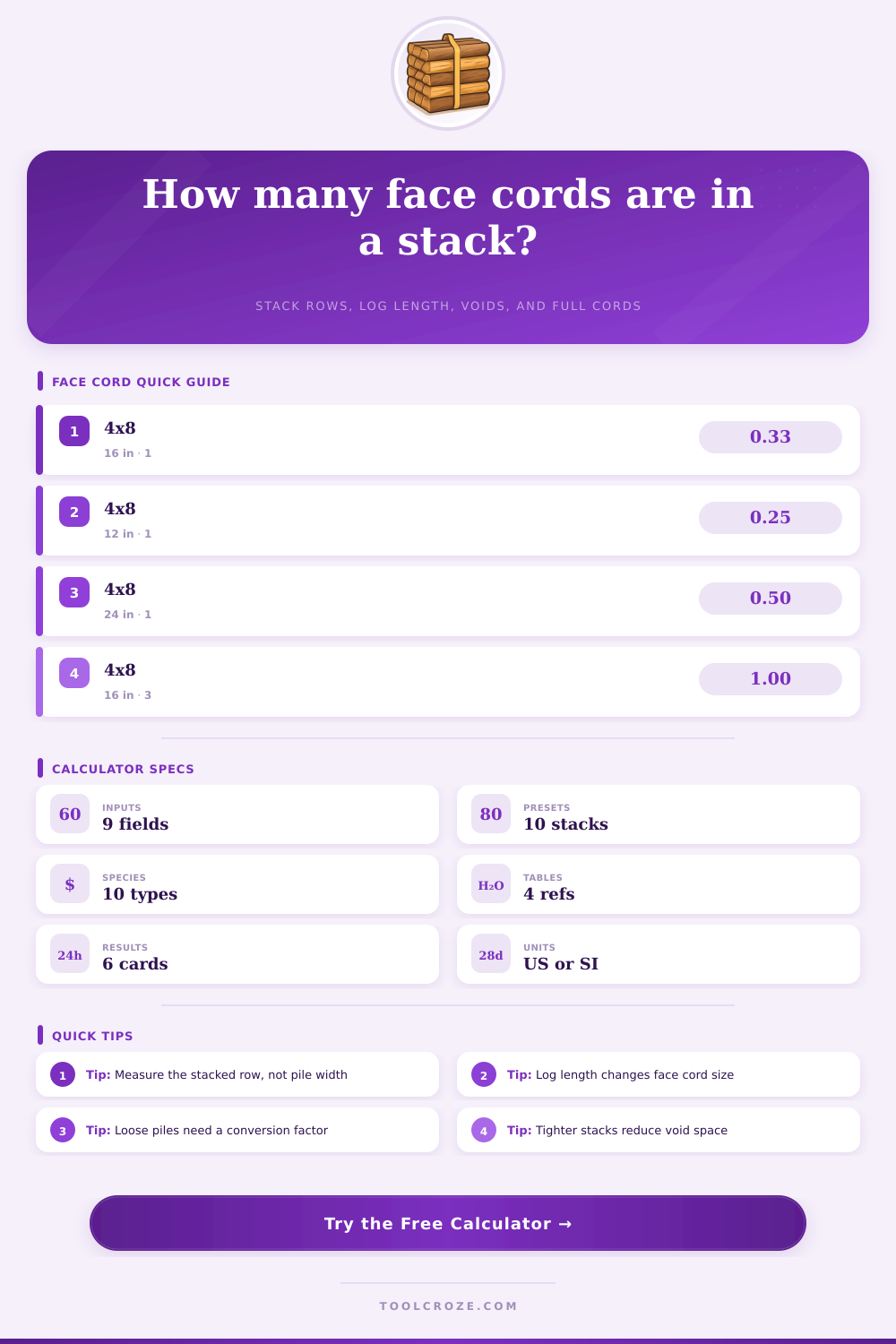
A full cord is a stacked volume of 128 cubic feet. A face cord changes with log length, so the same 4 x 8 face can be one quarter, one third, or one half of a full cord.
Use these tables to sanity-check stack depth, void factor, loose delivery factor, and moisture assumptions before relying on the final numbers.
| Log length | 4 x 8 face volume | Full cord equivalent | Typical use |
|---|---|---|---|
| 12 in | 32.0 stacked cu ft | 0.25 full cord | Small stove, camp bundles, short firebox |
| 16 in | 42.7 stacked cu ft | 0.33 full cord | Common household face cord size |
| 18 in | 48.0 stacked cu ft | 0.38 full cord | Wider stoves and fireplace inserts |
| 20 in | 53.3 stacked cu ft | 0.42 full cord | Large fireplaces and outdoor racks |
| 24 in | 64.0 stacked cu ft | 0.50 full cord | Boilers, furnaces, long fireboxes |
| Species | Dry density | Heat per full cord | Calculator note |
|---|---|---|---|
| Oak | 47 lb per solid cu ft | 24.0 million BTU | Heavy hardwood; volume checks matter |
| Hard maple | 44 lb per solid cu ft | 23.2 million BTU | Good benchmark for dense mixed loads |
| Ash | 40 lb per solid cu ft | 20.0 million BTU | Moderate weight and reliable heat |
| Birch | 39 lb per solid cu ft | 20.8 million BTU | Can lose quality if stored wet |
| Hickory | 50 lb per solid cu ft | 27.0 million BTU | Very dense; expect heavier stacks |
| Pine | 30 lb per solid cu ft | 15.5 million BTU | Light softwood; large volume, less heat |
| Stack condition | Void factor | Loose factor | Use in calculator |
|---|---|---|---|
| Very tight, uniform splits | 18% to 22% | 1.35 to 1.45 | Neat rack, similar split sizes |
| Typical stacked firewood | 23% to 30% | 1.45 to 1.65 | Most home deliveries and shed stacks |
| Chunky uneven splits | 30% to 38% | 1.60 to 1.85 | Knots, rounds, mixed lengths, crooked pieces |
| Tossed loose pile | Not stacked | 1.70 to 2.10 | Use delivered volume and loose pile factor |
| Moisture range | Weight effect | Heat adjustment | Practical interpretation |
|---|---|---|---|
| 10% to 15% | Lightest practical fuel | Best output | Kiln-dried or very well seasoned |
| 16% to 25% | Normal seasoned weight | Good output | Common target range for firewood |
| 26% to 35% | Noticeably heavier | Reduced output | Extra heat is spent evaporating water |
| 36% and higher | Green or wet load | Low output | Stack, cover top, and season longer |
A face cord are a unit of measurement of wood that is often misunderstood when people encounter this units. A face cord is measured by the height, the width, and the depth of the logs. However, the depth of the logs depend on the length of the logs in the face cord.
The longer the logs in the face cord, the more deeper the face cord. Because the length of the logs can vary, the volumes of wood in a face cord can also vary. It is possible to purchase a face cord of logs that is 16 inches in length and recieve more wood than another person who purchase a face cord of logs that are 12 inches in length.
How to Measure a Face Cord of Wood
The reason for this is simply that 16 inch logs are longer than 12-inch logs and that more logs will result in more heat for the individual use the face cord of wood. To calculate the amount of wood in a face cord, a person can use a calculator. To use the calculator, a person will need to enter the height of the face cord, the width of the face cord, and the length of the logs into a calculator.
This will allow the calculator to determine the number of units of wood in the face cord. Additionally, a person can use this calculator to compare the face cord of wood to a loose pile of wood to ensure that the person who purchased the face cord of wood receive the same amount as they purchased. In addition to these measurements, the void factor of the wood will need to be entered into this calculator.
When stacked in a face cord, there will be void space in the wood. The size of these void spaces will vary according to the way in which the logs are split and stacked. Therefore, you should of accounted for the size of these void spaces in the calculation of the amount of wood that is in the face cord.
The species of wood that is used will impact the amount of heat that that face cord of wood releases. This is due to the difference in density among the various species of wood. Dense species of wood will burn to produce more heat than less dense species of wood.
Additionally, dense species of wood will weigh more than less dense species of wood. The moisture percentage in the wood will also impact the amount of heat that the logs give off. Wood that has a high moisture percentage will burn less efficient than wood that has a low moisture percentage.
Additionally, wet wood will weigh more than dry wood because the weight of the wood will include the weight of the water in that wood. The heat calculator will change according to the moisture percentage so that the buyer does not purchase too much wood assuming that all wood produces the same amount of heat. To avoid confusion in the amount of wood in a face cord, it is best to measure the logs once they are stacked.
A person can measure the height of the logs with a tape measure, as can the width of the logs with a tape measure. Additionally, the person can measure the depth of the logs by taking the average length of the logs in the face cord. By measuring these logs, it is possible to calculate the face cord count of the wood in the face cord.
It is always best to measure the logs because the measurement will be more accurate than an estimate of how much wood is in the face cord. Additionally, measuring the logs will allow the buyer to avoid arguments with the seller over how much wood is in the face cord. These reference tables will allow a person to ensure that the face cord of wood has a realistic weight.
If a person estimates that the face cord of wood will be very heavy, the reference tables will show if that estimate is realistic. Additionally, if a person estimates that the face cord of wood will be very light, the reference tables will show if that estimate is realistic. These tables will allow a person to check their calculation to ensure that they have performed the calculation correctly.
Using these numbers a person will know how many face cord of wood are in the face cord, how many face cords of wood are in a cord of wood, and how much heat that face cord will produce. Theirs is a lot of information to learn but these tables helps. The face cords length and width is important too.
Youre gonna need to be careful with the calculation if you want to be comfortabley sure. It isnt easy, but the moddern ways to calculate it makes it easier then it used to be.