🏠 Exterior Paint Coverage Calculator
Estimate gallons needed for siding, trim, gables, soffits & fascia
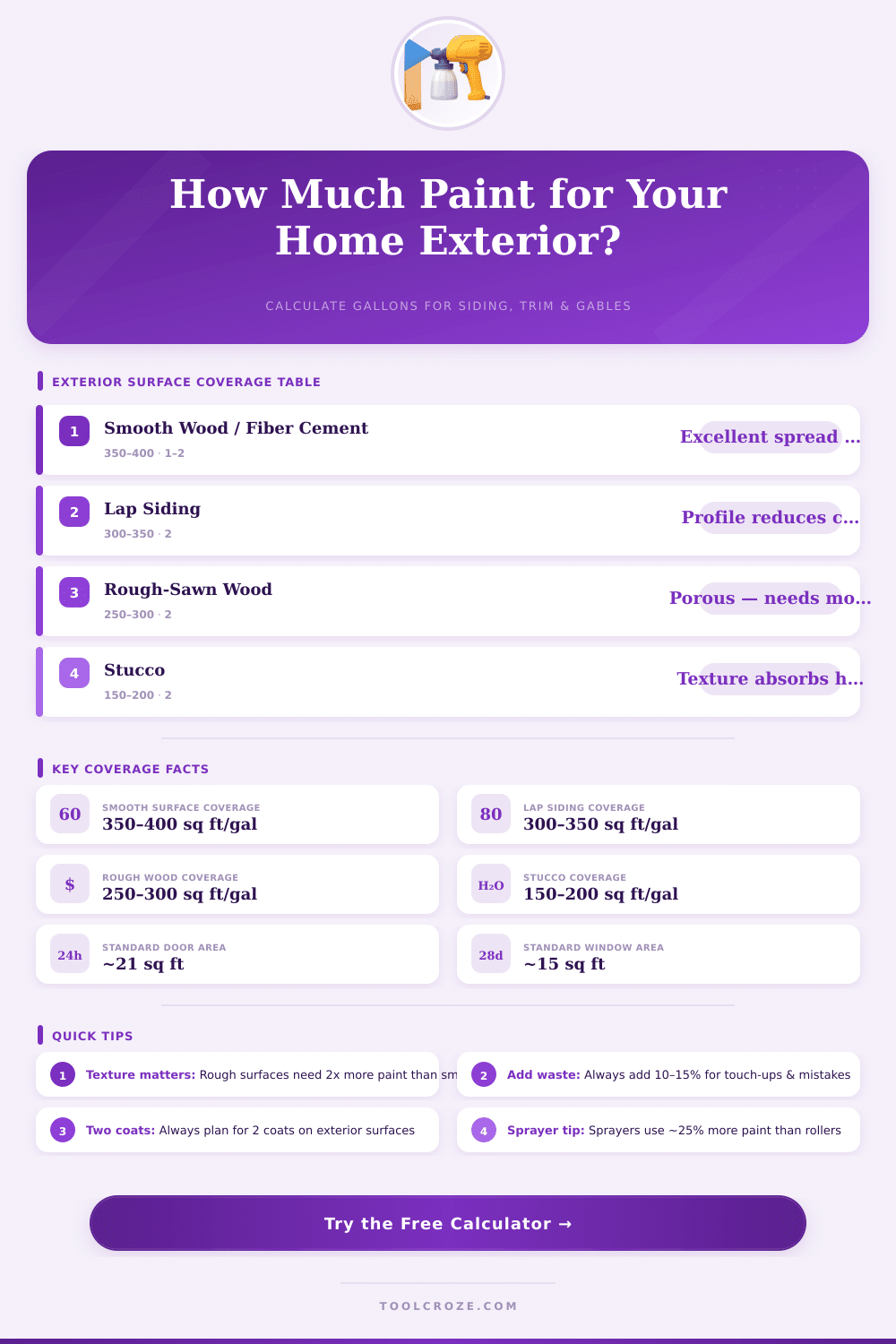
| Surface Type | Sq Ft / Gal | Typical Coats | Prep Notes |
|---|---|---|---|
| Smooth Wood / Fiber Cement | 350–400 | 1–2 | Sand lightly, clean surface |
| Lap Siding (horizontal) | 300–350 | 2 | Back-brush after spraying |
| Rough-Sawn Wood | 250–300 | 2 | Prime porous areas first |
| Stucco | 150–200 | 2 | Fill cracks before painting |
| Brick | 100–150 | 2 | Allow to cure, use masonry primer |
| Rough Masonry / CMU Block | 100–150 | 2 | Block filler recommended first |
| Finish | Sheen | Durability | Best Use |
|---|---|---|---|
| Exterior Flat | None | Moderate | Rough/textured surfaces |
| Exterior Satin | Low | Good | Siding, general walls |
| Exterior Semi-Gloss | Medium | Very good | Trim, doors, shutters |
| Exterior Gloss | High | Excellent | Doors, metal surfaces |
| Exterior Primer | None | N/A | Bare wood, repaired areas |
| House Style | Approx. Wall Area | Stories | Notes |
|---|---|---|---|
| Small Ranch (1,000 sq ft) | 900–1,100 sq ft | 1 | Simple footprint, low height |
| Medium Ranch (1,500 sq ft) | 1,300–1,600 sq ft | 1 | Includes gable ends |
| Two-Story Colonial (2,000 sq ft) | 2,200–2,800 sq ft | 2 | Double wall height adds area |
| Cape Cod (1,200 sq ft) | 1,400–1,800 sq ft | 1.5 | Large gables increase area |
| Split-Level (1,800 sq ft) | 1,800–2,200 sq ft | 1.5–2 | Multiple level transitions |
| Two-Story Large (3,000 sq ft) | 3,200–4,000 sq ft | 2 | Add 15% for complex trim |
| Method | Coverage vs. Brush | Best For | Notes |
|---|---|---|---|
| Brush | Baseline (1×) | Trim, detail work | Best penetration on wood |
| Roller | +5–10% efficiency | Large flat walls | Faster than brush |
| Airless Sprayer | –20–25% (more used) | Large areas, rough surfaces | Overspray increases usage |
| Pad Applicator | ≈ Roller | Lap siding edges | Reduces drips on siding |
For the right amount of exterior paint, understand clearly how long a gallon will last. The basic rule says that one gallon covers around 400 square feet. Even so exterior walls are different.
Because outdoor surfaces commonly are rough and absorbent, the coverage drops to about 250 to 350 square feet per gallon. Most painters count with around 300 square feet per gallon, because that helps for exterior work.
How Much Paint You Need for the Outside of a House
The type of surface that you paint, matters a lot. Materials like stucco, wooden panels or bricks soak up more paint because of their roughness and holes. So you will need more gallons than for a smooth wall.
A fresh house with only one coat or two after priming needs more than an old house with well coated walls. Also the roller that you use, and the thickness of the coating affect how much area you will cover.
The way you lay the paint is another important part. Quality exterior paint can cover 350 to 400 square feet per gallon, if one rolls it. If you spray, that drops to 250 to 350 square feet.
Sprayers use more, because part is lost in the air as fine mist. Professional teams have better spray gear than what one finds in a hardware store, which commonly is simpler and hard too use well.
Two coats always work for good coverage, even for bright and lasting protection against the weather. Dark colors maybe require three coats. Bright colors sometimes get by with one thick coat after good priming.
Pure white has fewer pigments, which naturally causes less coverage and can cause marks or streaks.
For a real example, a 4,000 square foot stucco outside with neat trim and attic could have more than 6,000 square feet of surface. With two coats that makes around 12,000 square feet of painting. At 300 square feet per gallon, one needs around 40 gallons.
Always add 10 to 15 percent for hard areas, porches or changes of colors.
Some paints are dense and cover more effectively. Sherwin-Williams Duration covers 250 to 300 square feet per gallon, but costs more. Some top paints even promise one-coat coverage up to 400 square feet per gallon.
An online paint calculator helps to estimate the exact amount for any project. Simply enter the data, and it does the math. The most reliable information stands usually directly onthe cans themselves.