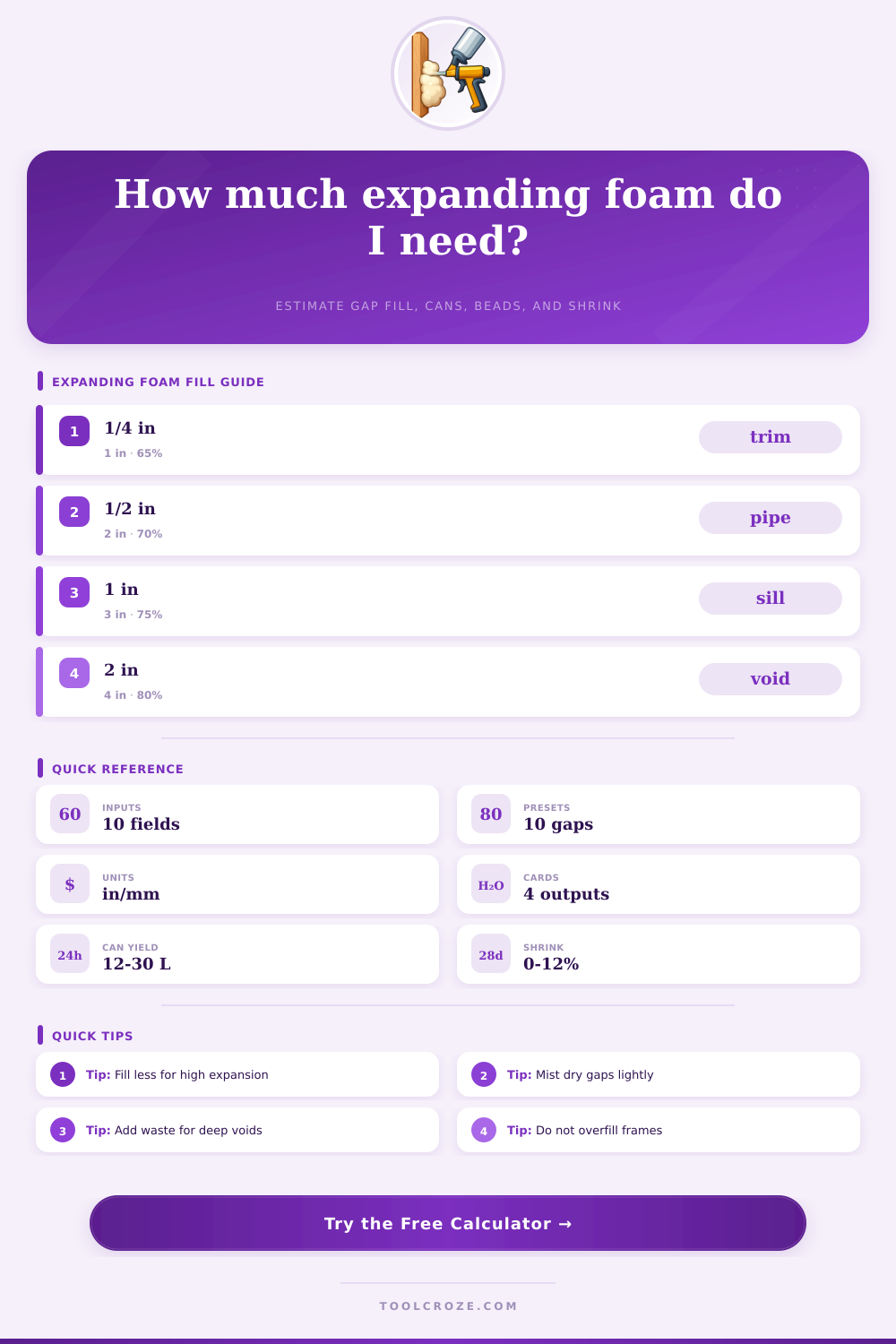
Expanding Foam Volume Calculator
Estimate can count, raw foam volume, cured fill, bead length, and shrink allowance from gap dimensions, expansion ratio, bead size, void fill percentage, and stated can yield.
Pick a common gap, then adjust the dimensions and foam behavior to match the actual cavity.
Foam Estimate
Use these tables as sanity checks for expansion ratios, fill percentage, can yield, and bead sizing.
| Foam Type | Expansion Range | Typical Fill | Shrink Allowance | Best Use |
|---|---|---|---|---|
| Window and door foam | 1.5x to 2x | 50 to 65 percent | 3 to 6 percent | Frames that can bow if overfilled |
| General gap filler | 2x to 3x | 60 to 75 percent | 4 to 8 percent | Pipe gaps, sill gaps, and cracks |
| Fireblock foam | 1.5x to 2.5x | 60 to 80 percent | 3 to 8 percent | Rated penetrations where allowed |
| Pest blocking foam | 2x to 3x | 65 to 80 percent | 5 to 9 percent | Utility gaps and exterior holes |
| Large void foam | 3x to 6x | 50 to 70 percent | 6 to 12 percent | Open cavities that can be trimmed |
| Gap Size | Gap Depth | Profile Factor | Suggested Bead | Fill Note |
|---|---|---|---|---|
| 1/4 in crack | 1 in | 1.00 slot | 1/4 in bead | Use low expansion control |
| 1/2 in pipe gap | 2 in | 0.80 rounded | 3/8 in bead | Build in a steady spiral |
| 1 in sill gap | 3 in | 1.15 rough | 1/2 in bead | Leave room for expansion |
| 2 in service void | 4 in | 1.15 rough | 5/8 in bead | Use layered passes if deep |
| 3 in open chase | 6 in | 1.15 rough | 3/4 in bead | Trim after full cure only |
| Can Yield Label | Cubic Inches | Cubic Feet | Good Fit |
|---|---|---|---|
| 12 L small can | 732 in³ | 0.42 ft³ | Short trim gaps and small holes |
| 18 L compact can | 1098 in³ | 0.64 ft³ | Window perimeter or pipe work |
| 22 L straw can | 1342 in³ | 0.78 ft³ | General household gap sealing |
| 30 L gun can | 1831 in³ | 1.06 ft³ | Long rim joist or sill runs |
| 40 L high yield | 2441 in³ | 1.41 ft³ | Large accessible cavities |
Frame Gaps
Use low expansion settings and 50 to 60 percent fill so the cured foam does not distort jambs or sashes.
Pipe Voids
Rounded gaps often need less volume than a rectangular slot with the same width and depth numbers.
Deep Cavities
Irregular hidden spaces need more waste because foam sticks to surfaces and may not bridge evenly.
Large Openings
High expansion foam can cover more volume, but it needs room to grow and should be applied in layers.
Expanding foam are a chemical product that expands after you apply it to the gaps that you are attempting to fill. In order to successfuly complete your project that utilize expanding foam, it is necessary for you to understand how the expanding foam expands. If you use to many expanding foam, it can exert excessive pressure upon door jams or window frames until they bow or warp.
If you use too little expanding foam, your HVAC system will have to work harder to compensate for an air leaks that will result. The volume of liquid expanding foam that come in the cans is not the same than the volume of cured expanding foam that will solidify within the wall. Thus, you must calculate the volume of expanding foam that are required for your project prior to beginning the application of the expanding foam.
How to Calculate and Use Expanding Foam
Additionally, different types of expanding foam has different rates of expansion. Thus, it is also necessary for you to determine the type of expanding foam that you will be using for your project. In determining the amount of expanding foam that you will need, you must determine the target void fill for the gap that you are attempting to fill with expanding foam.
You should never attempt to fill the gap that you are treating with expanding foam to 100%. Instead, you should fill the gap to a target void fill of 50% or 60%, especially if the frames that you are working with are more delicate then others. By filling the gap to 50% or 60%, the expanding foam will expand to fill the gap without placing any pressure upon the structure of the wood or frame that you are treating.
Another factor that can impact the amount of expanding foam that is required to fill a gap is the shape of the gap itself. Rounded holes require less expanding foam than slots of rectangular shapes and size. Thus, you can save expanding foam by treating each gap as a rectangle rather than a filled gap.
Each shape has a profile factor associate with it that can help you calculate how much expanding foam you will need to properly fill gaps of different shapes. Additionally, some types of expanding foam shrinks after it is applied to a gap. Thus, it is important to account for the shrink allowance for the expanding foam that you will be using.
If you do not account for how much the expanding foam will contract after it is applied to the gap, some of the wood or framing may permit air to passing through after the expanding foam has cured. Expanding foam will waste in various way during its use. For starters, expanding foam will adhere to your gloves, nozzles, and the area where it is applied.
Additionally, it often oozes out of the gap where it is being applied, and you must trim any expanding foam that exit the gap and is thus wasted. If your project includes working in a crawlspace or working any overhead structure, you will lose additional expanding foam to the floor. You should of account for this waste by purchasing more additional cans of expanding foam than you may initially calculate you need for your project.
The length of the bead that your expanding foam creates can help to indicate how well you are applying it to the gap. If the length of the bead of expanding foam that is calculated indicates that you will need a much longer bead of expanding foam than the length of the gap that you are treating, this could mean that your nozzle for the expanding foam is too small. Additionally, the way that you apply the expanding foam can impact the way that it cures.
For instance, if you apply expanding foam in only one thick layer, the middle of that layer of expanding foam may remain wet while the edges of that expanding foam layer hardens. Thus, you may want to apply expanding foam in thinner layer to allow for better curing. Overall, using a calculator to calculate the amount of expanding foam that you will need for your project will remove the guesswork of how much expanding foam you will need.
Thus, using such a calculator will allow you to create a plan for using expanding foam to seal gaps in your home.