
The tubing size make all the difference. You can spend hundreds of dollars on mufflers and headers but with an incorrect tubing size…it’s all for nothing. A properly designed and sized exhaust system are the lungs of an engine, and whether we’re talking about breathing easy or suffocating under a load depend on correct sizing of those pipes. It’s a delicate balance between flow efficiency and structural integrity.
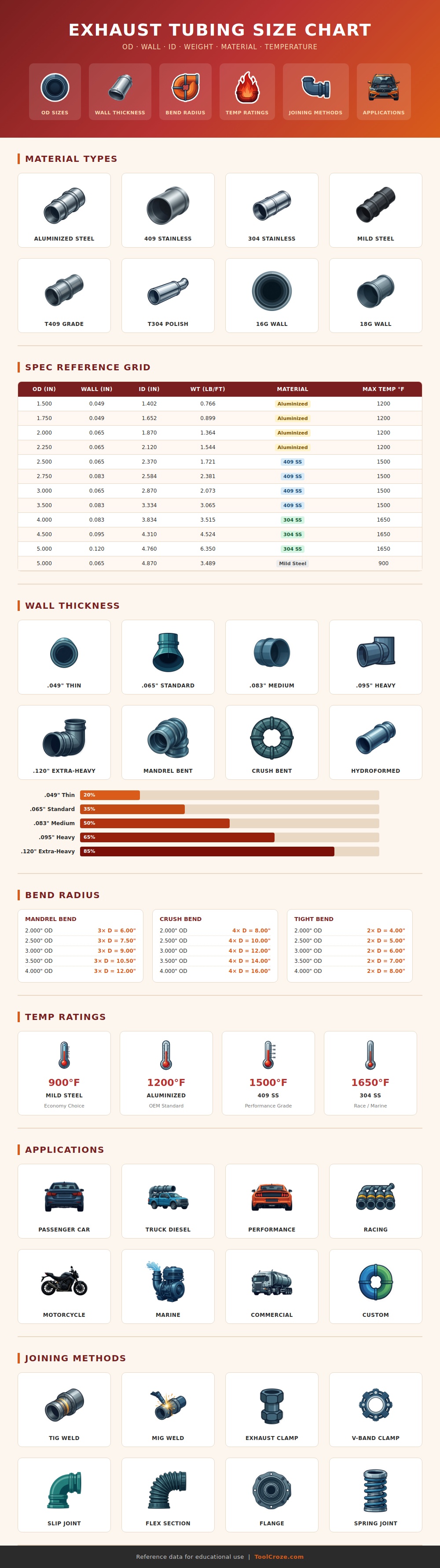
There is a fine line between structural integrity and efficiency of flow. Most builder focus entirely on diameter while ignoring wall thickness and material properties, leading to either poor performance or early fatigue failure. Knowing the weight per foot along with outer and inner diameters is start to building something that will hold up over time. The chart above provides a breakdown of these numbers and how even small changes in gauge affect final internal bore.
Choosing the Right Exhaust Parts
Your whole approach hinges on what material you select. Mild steel are inexpensive, easy to work with and resists warping well but is vulnerable to corrosion (rust) and won’t tolerate sustained exposure to extreme heat. For most users, aluminized steel is a good compromise; it costs slightly more then mild steel but provides improved corrosion resistance, making it the OEM norm for everyday cars. Driven in corrosive environments like salt air or if you’re really laying into it, stainless is required.
Aftermarket exhaust systems often use grade 409 which stands up to reasonable heat levels and has decent rust-resistance, while grade 304 offer even greater protection against rust and will sustain higher temperatures. As the chart points out, this translates into 304 stainless being able to endure upwards of sixteen hundred degrees F versus only nine hundred for mild steel. That’s a heck of a safety buffer when the manifolds’ hot gases comes out.
But not only does the material make a difference, but also the wall thickness. A thinner wall is more likely to ding from aggressive wrenching or road debris. However, a thinner wall is also lighter and easier to bend. A thicker wall are heavier but offers more protection from vibration fatigue and other physical impacts. Zero point zero six five inches seems to be a good all-around gauge for street applications.
Heavier ones, such as zero point zero eight three or even zero point one two zero, is more suitable for racing environments since the system will take some abuse. The graph above visually compares the wall thicknesses so you can see what all that extra metal weigh. It’s a matter of choosing curb weight vs longer life span and you have to determine that based off what you’re using the vehicle for.
There’s also more to bending technique than most people imagine. For instance, exhaust gases need to flow smoothly with minimal turbulence; a smooth, even inside diameter allow this. On the other hand, a crushed bend flattens out as it curves, creating a bottleneck that restricts flow and adds backpressure. In some cases, the limited space may force you into a crush bend, but for best performance, mandrel bending is always best.
Bend radius multipliers are listed in the reference data and clearly show how careful planning must of been made for tighter turns or else you’ll risk kinking the material completely. The result of a smooth pathway from header to tailpipe means your engine will breathe freely at every RPM range.
How do you join? The method determine whether your system will last. Properly welded pipes forms an inseparable, leak-proof joint. Stainless steel should be tig-welded for nice bead control and cleanliness. MIG welds is quicker for heavier gauge pipe but need cleaning up.
Slip joints and clamps offer removable, flexible options. They’re good if you change parts down the road. Performance folk like v-band clamps because they are easy to reach around turbochargers and cats. No leaks means no loss of power just irritating noises.
To conclude. When it comes to designing an exhaust system, you have to look at the entire picture instead of each piece separately. Joint type, diameter, wall thickness, and material grade all affect the end result. Do one wrong, and the rest won’t matter.
Invest some time and effort to get proper measurements and select materials suited for your style of driving. An exhaust system designed well not only sounds great but also lasts longer and allows your engine to run at peak performance. Keep in mind you want durable, efficient airflow. Begin with sound dimensions then work your way out from there.
