Epoxy Resin Calculator
Estimate total mixed epoxy, resin and hardener portions, pour coverage, allowance, and practical batch count from project dimensions and mix ratio.
✨ Project Presets
📐 Epoxy Project Inputs
Epoxy Estimate
Calculation Breakdown
🧪 Material & Mix Specs
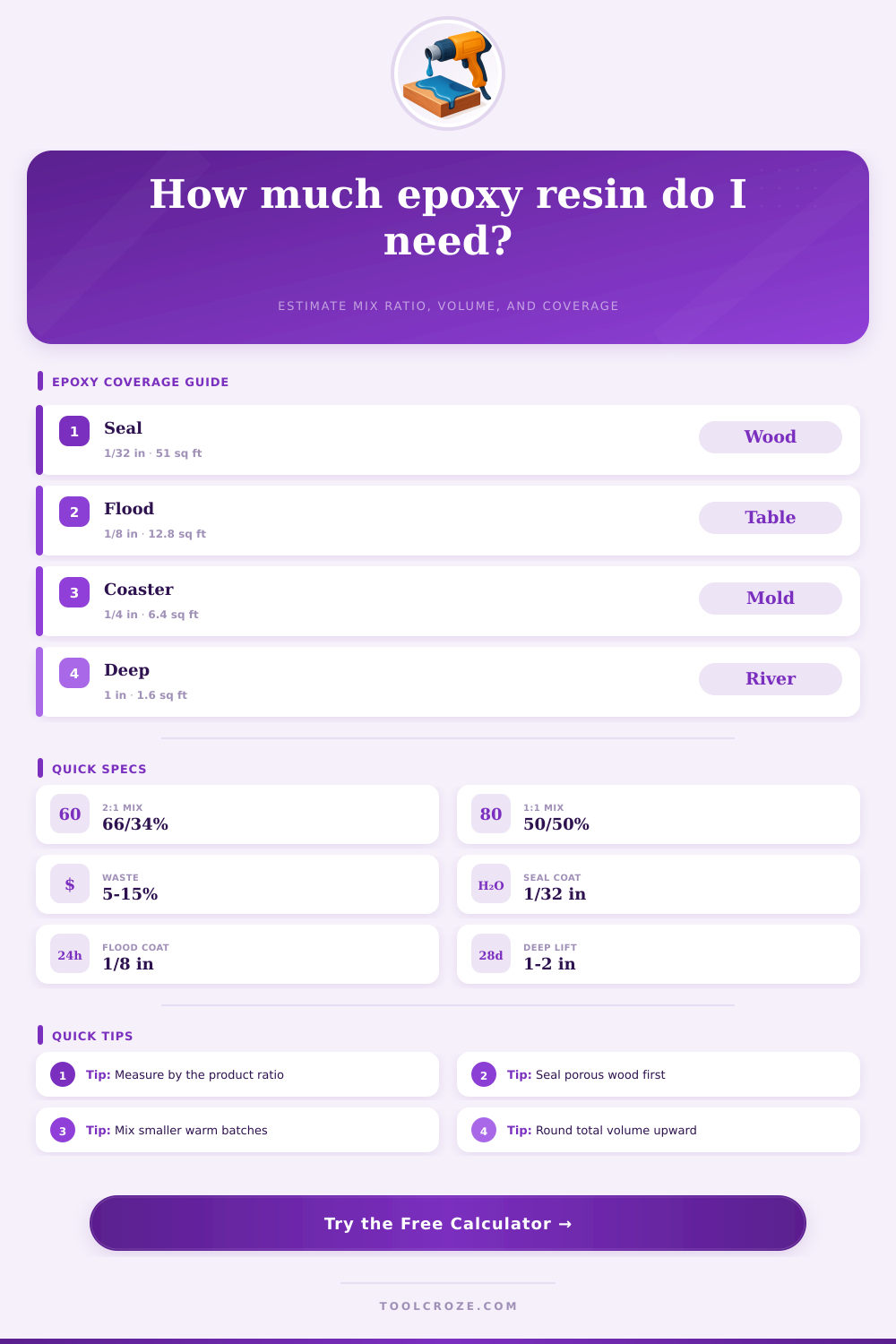
📊 Coverage Reference
| Epoxy layer | Typical thickness | Coverage per mixed gallon | Common use |
|---|---|---|---|
| Seal coat | 1/32 in | About 51.3 sq ft | Reduce bubbles on porous wood |
| Thin art coat | 1/16 in | About 25.7 sq ft | Panels and decorative skim coats |
| Tabletop flood | 1/8 in | About 12.8 sq ft | Bar tops, counters, and tables |
| Mold pour | 1/4 in | About 6.4 sq ft | Trays, coasters, and shallow molds |
| Deep cast | 1 in | About 1.6 sq ft | River tables and thick castings |
⚖ Ratio & Batch Reference
| Mix ratio by volume | Resin share | Hardener share | Example 24 fl oz batch |
|---|---|---|---|
| 1:1 | 50.0% | 50.0% | 12 fl oz resin + 12 fl oz hardener |
| 2:1 | 66.7% | 33.3% | 16 fl oz resin + 8 fl oz hardener |
| 3:1 | 75.0% | 25.0% | 18 fl oz resin + 6 fl oz hardener |
| 4:1 | 80.0% | 20.0% | 19.2 fl oz resin + 4.8 fl oz hardener |
🧱 Substrate Allowance Reference
| Surface condition | Absorption factor | Suggested allowance | Calculator use |
|---|---|---|---|
| Silicone mold | 1.00x | 5% | Clean cavity volume |
| Sealed wood | 1.03x | 5% to 10% | Flood coats and counters |
| Bare wood | 1.08x | 10% | First coat may soak in |
| End grain or live edge | 1.14x | 15% to 20% | Cracks, bark voids, and knots |
| Concrete or stone | 1.18x | 15% to 20% | Porous sealing coats |
📏 Project Size Reference
| Project | Typical dimensions | Common depth | Planning note |
|---|---|---|---|
| Small table top | 36 x 18 in | 1/8 in | Use a sealed flood coat setting |
| River table channel | 72 x 8 in | 1 to 2 in | Pour in lifts per product data |
| Round coaster mold | 4 to 12 in dia | 1/4 to 1/2 in | Use the round mold option |
| Bar top | 96 x 25 in | 1/8 in | Plan several manageable batches |
| Knot or void fill | Partial area | 1/4 to 1 in | Lower the filled coverage percent |
💡 Practical Tips
When working with epoxy resin, it is crucial to measure the resin and hardener accurate. The ratio of resin to hardener are essential for the chemical reaction that will enable the epoxy to cure and harden. If you dont measure the epoxy correct, the epoxy will not harden proper and will remain sticky.
Always follow the instructions printed on the bottle of resin and hardener. For instance, if the instructions reads two part resin to one part hardener, you will need to use twice as much resin then hardener. Using too much hardener will cause the epoxy to generate to much heat and may result in epoxy crack.
How Much Epoxy Resin Do You Need
Additionally, using too little hardener will make the epoxy remain tacky. Another essential calculation are to calculate the total volume of epoxy needed for your project. The volume of the project will not necessarily be the same as the volume of epoxy resin you purchase.
Forgetting to account for the substrate material may make you purchase less epoxy then you need for your project. For instance, if you are pouring epoxy into a silicone mold, the silicone will not absorb the epoxy resin. However, if the substrate material is wood, the wood will absorb a significant amount of epoxy resin.
In this case, you will need to apply a seal coat of epoxy resin to the wood to seal its pore. This will prevent air bubble from rising to the top of the epoxy resin during the pour. Another essential aspect when calculating the total amount of epoxy resin to purchase is to include a waste allowance.
Some epoxy resin will get stuck to the side of the mixing bucket. Additionally, some epoxy resin may drip from the edge of the poured epoxy. Planning for a ten or fifteen percent overage of epoxy resin will ensure you do not run out of epoxy resin before the project are complete.
Having extra epoxy resin is more better than having an incomplete project due to running out of epoxy resin before completion. The depth of the pour will dictate the type of epoxy resin you need to use for your project. For instance, deep pours, such as a river table, will require the use of deep-pour resin.
This type of resin will cure slow. Using a standard resin that can cure quick will generate a significant amount of heat that will damage the mold or the project. Deep pour resin will allow the project to remain cool as it set and cures.
Working in batches of epoxy may be easier than mixing all the epoxy needed for your project at once. Every batch of epoxy resin have a pot life. The pot life is the length of time the epoxy resin remain liquid before it thickens.
If you mix too much epoxy resin at once, it will thicken before you can pour and spread it on your project. By working in batches, you can manage the epoxy resins pot life and have a consistent supply of epoxy resin to work with. Lastly, it is essential to ensure that the work area or substrate is level when applying the flood coat of epoxy resin.
A flood coat is a thin layer of epoxy resin that will level out the work area to create a smooth pouring surface. If the work surface are not level, the resin will not spread evenly over the work area. You may end up pouring more epoxy resin to fill the low spot of the work area.
By calculating the volume of epoxy resin needed, accounting for epoxy resin absorption by the substrate, and considering the pot life of the epoxy resin, you will ensure you have enough epoxy resin to complete your project.