Epoxy Gel Time Calculator
Estimate epoxy pot life, working time, thin-film open time, and exotherm risk from temperature, mixed mass, hardener speed, layer thickness, humidity, fillers, and work area.
⚙Mix Presets
🌡Epoxy Conditions
Epoxy Timing Estimate
📊Current Mix Snapshot
🧪Hardener Speed Reference
| Hardener Type | Typical 100 g Gel Time | Best Fit | Calculator Use |
|---|---|---|---|
| Very fast repair | 6 to 10 min at 72°F | Small fixes, cold shops, quick tacks | Use only for small batches or short assemblies |
| Fast laminating | 12 to 18 min at 72°F | General bonding when room is cool | Watch heat buildup above 80°F |
| Medium general purpose | 25 to 35 min at 72°F | Coating, wet-out, small laminates | Default starting point when no label is known |
| Slow hardener | 45 to 60 min at 72°F | Warm rooms, larger layups, careful assembly | Often safer when work time matters |
| Extra slow hardener | 75 to 100 min at 72°F | Hot weather and broad laminating sessions | Still split batches in deep or insulated masses |
| Deep-pour casting | 120 to 240 min at 72°F | Thick clear pours within product limits | Do not substitute for normal adhesive epoxy |
🌡Temperature And Batch Reference
| Condition | Effect On Gel Time | Practical Rule | Risk Note |
|---|---|---|---|
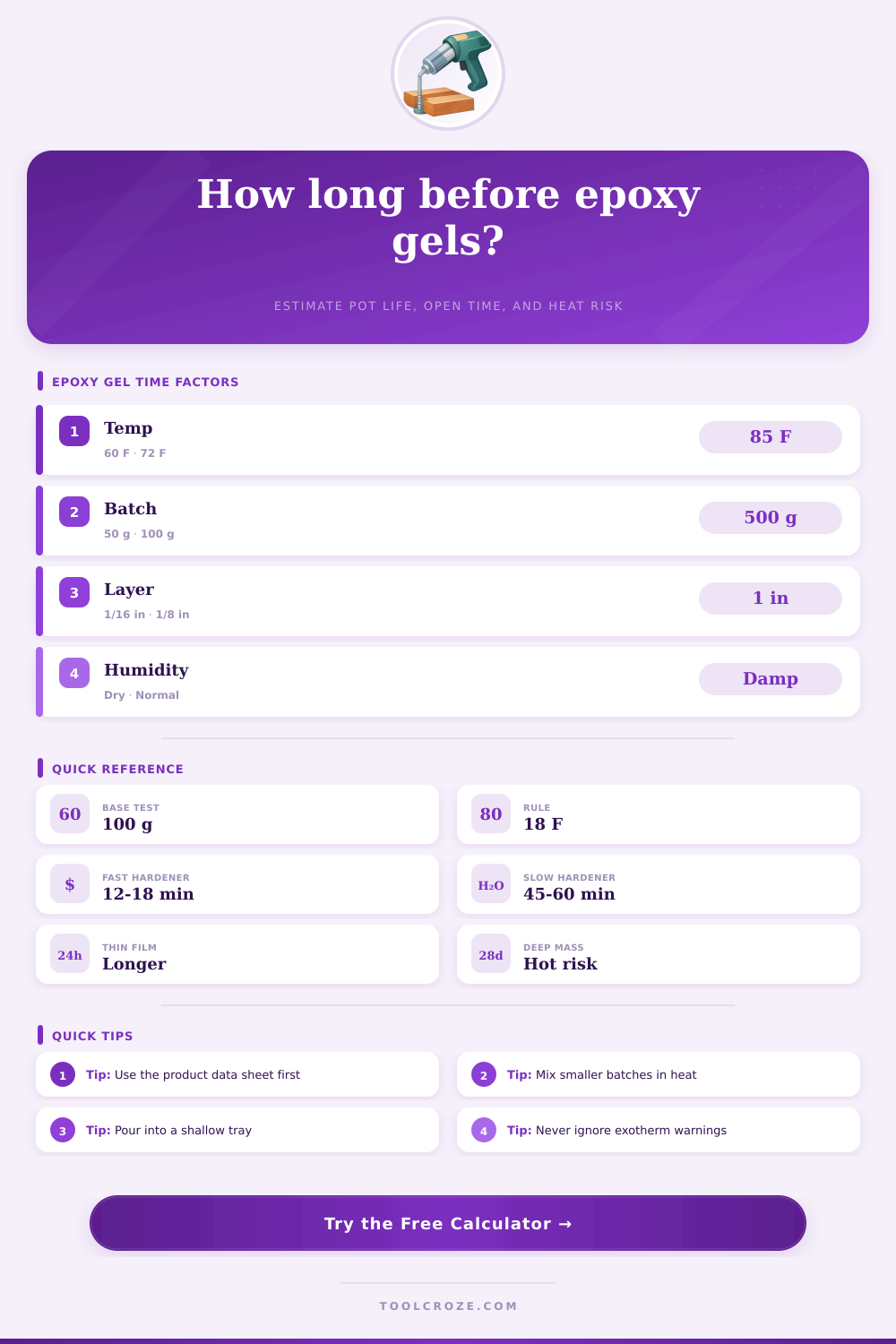
| Temperature increase | Shorter gel and cure time | About half per 18°F or 10°C warmer | Hot resin, hot substrate, and sun stack together |
| Temperature decrease | Longer gel and cure time | About double per 18°F or 10°C cooler | Low temperature can prevent proper cure |
| Larger mixed mass | Shorter pot life from retained heat | Split batches above the product test mass | Contained mass can run away thermally |
| Thin spread film | Longer open time than a cup | Move mixed epoxy to the work surface quickly | Do not count film time as cup pot life |
| Deep or insulated pour | Much faster heat buildup | Respect maximum pour depth on the data sheet | Smoke, melting, or fire can occur |
📐Application Factor Grid
📋Reference Sources And Assumptions
| Reference | Calculator Assumption | How To Use It | Source Link |
|---|---|---|---|
| Manufacturer technical data sheet | Base gel or pot life should override presets | Enter the published minutes for your exact resin and hardener | Example TDS |
| 100 g cup testing | Many epoxy pot-life values are based on a confined test mass | Compare your mixed mass with the product test mass | Epoxyworks |
| 18°F / 10°C rule | Warmer conditions roughly halve working time; cooler conditions roughly double it | Use as a field estimate, not a cure guarantee | Epoxy guide |
| Exotherm safety guidance | Large contained masses shorten pot life and can overheat | Split batches or spread resin promptly when risk is high | Exotherm safety |
💡Gel Time Tips
An exotherm is when a chemical reaction release heat. An exotherm can make epoxy harden more faster than the instructions on teh label. If there is an exotherm in the epoxy, the epoxy may turn into a thick syrups and may no longer level properley.
Once there is an exotherm in the epoxy, it is impossible to stop the chemical reaction. Many people believes that the pot life of epoxy is a static number. In fact, the pot life of epoxy is a variable that alter with the environment in which the epoxy is mixed and the amount of epoxy being mix.
Why Epoxy Gets Hot and Sets Fast
The time between when epoxy and hardener are mixed until they begin to gel is referred to as a pot life. The major factor that impacts the pot life of epoxy is the temperature of the epoxy. If the temperature in the area where the epoxy is being mixed increase, the pot life of the epoxy will decrease.
For example, if an individual is working in a room that is seventy degrees, the epoxy will have a longer pot life than if the individual is working in a room that is ninety degrees. Thus, the temperature in which the epoxy is mixed will dictate the time that an individual has to work with the epoxy. Another variable that impacts the speed at which the chemical reaction occur in epoxy is the mass of the batch of epoxy that is mixed.
If an individual mixes a small amount of epoxy into a wide tray, the heat created by the chemical reaction will be able to escape into the air, and the small batch will remain stable. Conversely, if an individual pours a large amount of epoxy into a deep plastic container, the epoxy in the center of the container will be insulated by the epoxy surrounding it. As a result, the heat created by the chemical reaction will remain trapped within the epoxy mixture.
This trapped heat will cause the chemical reaction to take place at a rapid rate. Furthermore, the chemical reaction will create more heat that will make the chemical reaction to take place even faster. Such a phenomenon is referred to as a thermal-runaway reaction, which can result in the epoxy smoking, cracking, and even melting the plastic container in which it was poured.
Calculators can be used to understand how the mass and temperature of an epoxy batch will impact the epoxy. If the user adjusts the batch size and the type of container in which the epoxy is mixed in the calculator, the user can understand the impact of changing batch size to deeper containers. If the calculation indicates that there is a high risk of a thermal runaway reaction, splitting the epoxy into smaller batches will reduce the risk of such a reaction.
It is true that it will require more effort to prepare multiple batches of epoxy rather than one large batch. However, preparing smaller batches of epoxy is safer than preparing one large batch of epoxy that may experience a thermal runaway reaction. The physical shape of the epoxy batch will also impact the timing at which the epoxy cures.
Pouring epoxy into a thin film increases the surface area of the epoxy. The increased surface area of the epoxy allows it to shed heat faster. Because epoxy can shed heat faster when poured into thin films, thin films will have a longer working time than the gel time of the epoxy.
Conversely, deep pours of epoxy that create a large mass of epoxy results in epoxy that holds the heat created by the chemical reaction. Thus, deep pours will set faster than thin films of epoxy. Some resins are specifically created as deep pour resins that react more slow to allow the thick mass of epoxy to release heat.
In addition to the variables described above, there are others that impact epoxy. For example, adding fillers to the epoxy, like silica or wood flour, changes the consistency of the epoxy. Furthermore, these fillers can act as a brake on the chemical reaction of the epoxy.
Thus, by adding these fillers, the gel time for the epoxy can be extended. One other variable is humidity in the air. High humidity levels can impact the way in which epoxy interacts with the air on the surface of the epoxy.
While high humidity may not be the cause of a failed epoxy project, high humidity does impact the timing of its cure. When preparing to mix epoxy, individuals should plan for the practical working time of the epoxy rather than the gel time. While the gel time is the length of time between mixing epoxy and hardener until the epoxy becomes a jelly-like substance that cannot be moved, there may not be much epoxy left to use before the gel time is reached.
Thus, individuals should plan for the practical working time of epoxy, which accounts for the amount of time in which the epoxy is fluid enough to level and degas. Within the planning phase, individuals should include a safety margin for the project timeline to account for delays. To gain better control over the epoxy pouring and mixing process, individuals must understand the variables that impact the chemical reaction of epoxy.
Furthermore, to gain control over epoxy, individuals can control the type of hardener used and the size of batches of epoxy. By understanding these variables, individuals can better turn mixing epoxy into a process that they can control.