Epoxy Countertop Calculator
Estimate mixed epoxy for countertop flood coats, seal coats, backsplashes, live edges, drips, ratio splits, waste allowance, and full kit rounding.
📌Countertop Presets
Presets load real countertop scenarios with practical flood coat depth, seal coat demand, vertical edge area, and waste allowance.
⚙Project Inputs
Countertop epoxy estimate
Enter slab dimensions, coating thickness, edge details, mix ratio, and waste allowance.
📊Material Snapshot
📑Reference Tables
| Flood Depth | Inches | mm | Use |
|---|---|---|---|
| Skim | 1/32 | 0.8 | Color refresh |
| Light | 1/16 | 1.6 | Thin overlay |
| Standard | 1/8 | 3.2 | Countertop |
| Heavy | 3/16 | 4.8 | Texture fill |
| Deep | 1/4 | 6.4 | River inlay |
| Surface | Seal Coats | Rate | Note |
|---|---|---|---|
| Laminate | 0-1 | 2 oz/ft² | Scuff first |
| Sealed wood | 1 | 3 oz/ft² | Watch seams |
| Raw wood | 2 | 4 oz/ft² | Air release |
| Concrete | 2 | 5 oz/ft² | Porous face |
| Tile/grout | 1-2 | 4 oz/ft² | Fill joints |
| Edge Type | Loss | Height | Planning Note |
|---|---|---|---|
| Taped square | 3% | 1-2 in | Clean dam |
| Open front | 6% | 1-2 in | Drips below |
| Waterfall | 9% | 12-36 in | Wet vertical |
| Live edge | 12% | 1-4 in | Uneven face |
| Mix Ratio | Resin Share | Hardener | Common Use |
|---|---|---|---|
| 1:1 | 50.0% | 50.0% | Art tops |
| 2:1 | 66.7% | 33.3% | Bar tops |
| 3:1 | 75.0% | 25.0% | Clear coat |
| 4:1 | 80.0% | 20.0% | Marine coat |
| 5:1 | 83.3% | 16.7% | Specialty |
💡Planning Tips
Calculating the correct volume of epoxy resin are a necessary part of the process for those that wish to use epoxy resin as a chemical products within a specific timeframe. If you find yourself out of epoxy resin at any point during your project, it isnt possible to add more epoxy resin to the initial batch of mixed epoxy resin that has begun to undergo the chemical reactions that sets the material into solid form. Thus, it is a requirement that you calculates the total amount of epoxy resin that is required for your project prior to beginning to mix the chemicals together.
Within the calculation of the proper amount of epoxy resin that a project will require, it is important to consider the various zone that must be coated in the project. For instance, some areas of the project may be flat and others may be vertical, such as an backsplash. Each of these areas may require a different amount of epoxy resin to allow for even coverage of the area.
How to Calculate How Much Epoxy Resin You Need
Furthermore, epoxy resin will roll off the edges of a countertop, so it is also important to consider how much epoxy resin will be lost to these edges when calculating the total amount of resin that is required. The type of surface that you will coat with the epoxy resin will also affect the amount of epoxy resin that is required. For instance, nonporous surfaces like laminate will cause the epoxy to sit on the surface of the laminate, but porous surface will lead to the material absorbing the epoxy.
Because the pores within the porous surfaces absorb epoxy, it is necessary to use a seal coat to fill those pores. If the seal coat does not coat the pores within the porous material, the air within those pores will lead to the formation of bubbles within the flood coat application of epoxy resin, which will result in an uneven application of epoxy resin. One of the main factors that will influence the amount of epoxy resin that you must purchase for a project is the thickness of the flood coat.
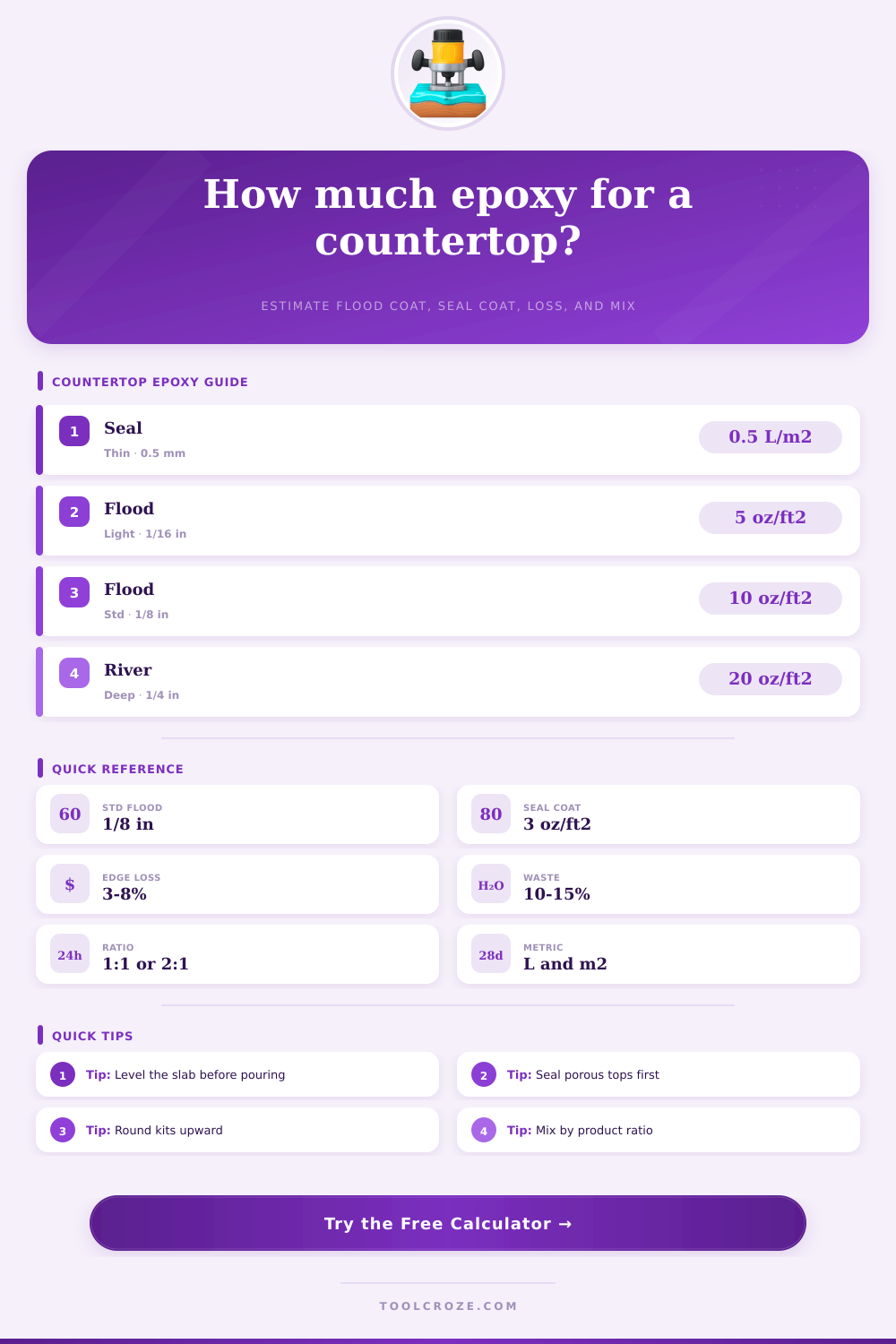
Flood coats are typically one-eighth of an inch in thickness, but may be deeper to provide for better coverage of some project areas. For instance, a flood coat that is one-quarter of an inch in thickness would be double the thickness of the standard flood coat, meaning that double the amount of epoxy resin would be required for coverage of the project area. Furthermore, it is also necessary to account for the edges of the countertops.
The edges that have natural dips and crevices, referred to as live edges, will require more epoxy resin to properly coat those edges due to the natural way in which the epoxy resin rolls into those notch in the natural edge. Another factor to consider within the estimation of the amount of epoxy resin that is required for a project is the mixing ratio of the chemicals. The ratio of resin to hardener must be exact; adding more hardener will not allow for the epoxy to dry faster, and adding more resin will not allow for the epoxy to last longer.
Furthermore, changing the ratio of resin to hardener will ruin the chemical bond of the epoxy resin, causing the epoxy to remain sticky once applied to an area. Thus, once you have calculated the amount of epoxy resin that is required for your project, you can use the mixing ratio to determine how much of each chemical will be required. It is also important to introduce a waste allowance in your calculation of the amount of epoxy resin that will be required for your project.
No matter how carefuly you pour the epoxy resin from the mixing container, some of the epoxy will remain within the container; it is impossible to pour out every drop. Thus, introducing a waste allowance of ten to fifteen percent ensures that there will be enough epoxy resin to cover even the lowest spots in the application area. Finally, it is also a recommendation to round the calculated amount of epoxy resin to the nearest full kit; having extra resin that can be used for touch-ups to the project is better than having an insufficient amount of epoxy resin prior to the completion of the project.