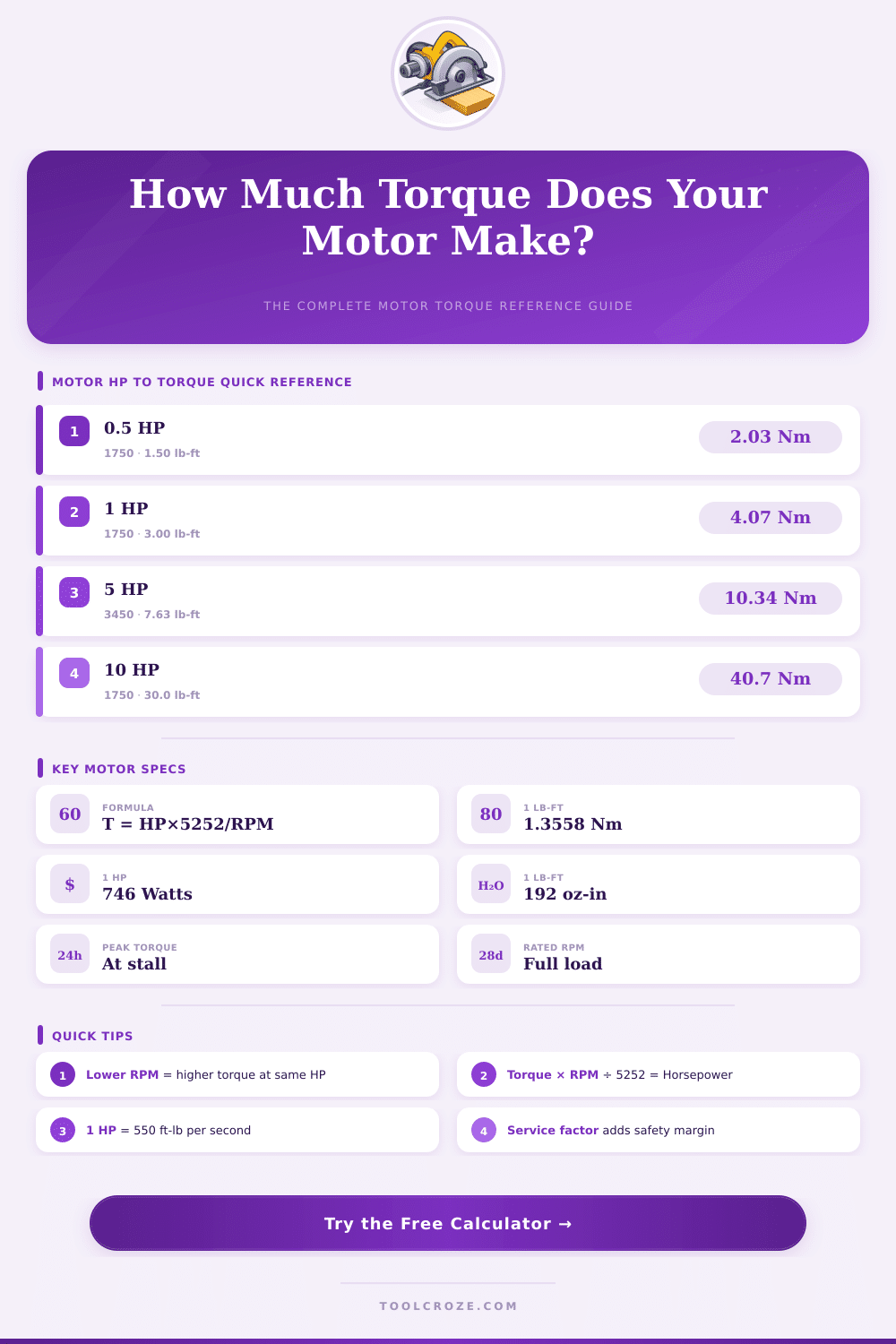
⚡ Electric Motor HP to Torque Calculator
Convert horsepower and RPM to torque in lb-ft, Nm, and oz-in instantly
| HP | @ 1750 RPM lb-ft | @ 1750 RPM Nm | @ 3450 RPM lb-ft | @ 3450 RPM Nm | Watts |
|---|---|---|---|---|---|
| 0.25 HP | 0.75 | 1.02 | 0.38 | 0.52 | 186 |
| 0.5 HP | 1.50 | 2.03 | 0.76 | 1.03 | 373 |
| 0.75 HP | 2.25 | 3.05 | 1.14 | 1.55 | 560 |
| 1 HP | 3.00 | 4.07 | 1.52 | 2.06 | 746 |
| 1.5 HP | 4.50 | 6.10 | 2.28 | 3.09 | 1,119 |
| 2 HP | 6.00 | 8.13 | 3.04 | 4.12 | 1,492 |
| 3 HP | 9.00 | 12.20 | 4.57 | 6.19 | 2,238 |
| 5 HP | 15.01 | 20.34 | 7.63 | 10.34 | 3,730 |
| 7.5 HP | 22.51 | 30.51 | 11.44 | 15.51 | 5,595 |
| 10 HP | 30.01 | 40.68 | 15.25 | 20.67 | 7,460 |
| 15 HP | 45.02 | 61.02 | 22.87 | 31.01 | 11,190 |
| 20 HP | 60.03 | 81.36 | 30.50 | 41.34 | 14,920 |
| 25 HP | 75.03 | 101.70 | 38.12 | 51.68 | 18,650 |
| 50 HP | 150.07 | 203.40 | 76.24 | 103.36 | 37,300 |
| Motor Type | Typical RPM Range | Speed Control | Starting Torque | Efficiency | Common Use |
|---|---|---|---|---|---|
| Single Phase AC | 1725 – 3450 | Poor | Medium | 70–85% | Fans, pumps, appliances |
| Three Phase AC | 1500 – 3600 | VFD required | High | 85–97% | Industrial, compressors |
| DC Permanent Magnet | 1 – 10,000+ | Excellent | Very High | 75–90% | Robotics, EVs, tools |
| DC Series Wound | Variable | Good | Very High | 70–85% | Cranes, traction |
| DC Shunt Wound | Near-constant | Good | Medium | 75–88% | Lathes, conveyors |
| Stepper Motor | 0 – 2000 | Excellent (steps) | High at low RPM | 50–70% | CNC, 3D printers |
| Unit | lb-ft | lb-in | Nm | oz-in | kgf-cm |
|---|---|---|---|---|---|
| 1 lb-ft | 1.000 | 12.000 | 1.3558 | 192.00 | 13.826 |
| 1 lb-in | 0.0833 | 1.000 | 0.1130 | 16.000 | 1.1521 |
| 1 Nm | 0.7376 | 8.8507 | 1.000 | 141.61 | 10.197 |
| 1 oz-in | 0.00521 | 0.0625 | 0.00706 | 1.000 | 0.0721 |
| 1 kgf-cm | 0.0723 | 0.8679 | 0.0981 | 13.877 | 1.000 |
| Application | Typical HP | Typical RPM | Req. Torque lb-ft | Req. Torque Nm |
|---|---|---|---|---|
| Small Drill Press | 0.25–0.5 | 3000–3600 | 0.4–0.9 | 0.5–1.2 |
| Pool / Spa Pump | 0.75–2 | 1725–3450 | 1.1–3.6 | 1.5–4.9 |
| Air Compressor | 1.5–5 | 1725–3450 | 2.3–9.1 | 3.1–12.3 |
| Table Saw | 3–5 | 3450 | 4.6–7.6 | 6.2–10.3 |
| Wood Lathe | 0.75–2 | 500–3000 | 1.3–21.0 | 1.8–28.5 |
| Conveyor Belt | 1–25 | 1750 | 3.0–75.0 | 4.1–101.7 |
| CNC Spindle | 1–10 | 3000–24000 | 0.3–1.8 | 0.4–2.4 |
| Industrial Fan | 1–50 | 1750 | 3.0–150.1 | 4.1–203.4 |
| EV Traction Motor | 50–300 | 1000–8000 | 33–1575 | 44–2135 |
Power shows how quickly one does the work. One measures it in watts or horsepowers. Even so for an electric motor the real driving force is the torque not the power.
Well understand that already from the start.
How Torque, Horsepower and RPM Work
The relation between horsepower, torque and RPM is fairly easy. One gets horsepower from torque multiplied by RPM and then divided by 5 252. That calculation counts for any kind of engine, no matter what it is.
Electric motors give torque right away. So the full force is ready without delay.
One horsepower matches 746 watts, when one talks about electric motors. Even so there are different meanings of horsepower. The metric horsepower matches only around 735.5 watts.
So it matters which one you use. Also the curves of power and torque cross each otehr in 5 252 RPM, if one uses horsepower and foot-pounds as units. With other units, like kilowatts and newton-meters, the crossing happens at other RPM.
An engine with 1 horsepower can truly manage to make a big amount of torque. It simply turns at very low speed. Torque matches power divided buy the turning speed.
One can measure torque in newton-meters or foot-pounds. At lower RPM one gets more torque for the same power. An engine of 500 horsepowers, that gives 500 foot-pounds of torque, reaches top power at around 5 000 to 6 000 RPM.
Electric motors are especially interesting compared to gas ones. They deliver almost steady and strong torque during most of their RPM range. Also they spin safely at very high RPM.
So they easily reach many horsepowers, while they give strong torque already from low RPM. Here is why electric cars feel like they push you into the seat, when they start. There is no drop at higher RPM, as with gas engines.
Gas engines work differently. They climb up until their peak horsepower and then quickly drop. Their torque curve forms a tiny peak.
With electric motors the torque curve is flatter at low RPM, but it starts to drop at the base speed, which sometimes is called the knee.
An engine with high horsepowers makes its torque more quickly than one with low. If an electric motor keeps steady torque through its whole speed range, then the horsepower grows together with the RPM. Torque helps to move things from a stop.
Horsepower keeps the speed. At low speeds electric motors give very strong torque. The base speed for a typical electric motor is around 1 750 RPM, compared to around 3 800 RPM for a gas engine.
A gas engine of 20 horsepowers, that runs at 1 750 RPM, would deliver only 9.21 horsepowers, so a 10-horsepower electric motor could matchit at that speed. The efficiency of electric motors, especially under 1 horsepower, can range a lot.