Edge Banding Calculator
Estimate edge banding length, selected cabinet edges, roll count, splice waste, setup waste, trim overhang, leftover roll length, and material behavior for shelves, doors, drawer parts, and panels.
📌 Cabinet And Shelf Presets
Load a common shop job, then adjust the panel count, exposed edges, banding width, roll size, overhang, splice loss, and waste allowances.
📐 Panel, Edge, Banding, And Roll Inputs
Calculation Breakdown
🧰 Banding Material Comparison
📊 Reference Tables
| Panel Job | Common Edge Selection | Typical Band Width | Planning Note |
|---|---|---|---|
| Closet shelf | Front long edge only | 21 to 24 mm | Fastest layout; count only visible fronts |
| Bookcase shelf | Front plus two sides | 21 to 24 mm | Side returns add length quickly in tall cases |
| Slab cabinet door | All four edges | 22 to 25 mm | Keep seam direction consistent across doors |
| Desk or table top | Full perimeter | 32 to 45 mm | Wide panels often need thicker banding |
| Banding Material | Typical Thickness | Best Fit | Waste Behavior |
|---|---|---|---|
| PVC edge banding | 0.4 to 3.0 mm | Cabinet shop batches | Moderate splice and trim loss |
| ABS edge banding | 0.5 to 2.0 mm | Durable furniture panels | Similar to PVC with clean trimming |
| Wood veneer tape | 0.4 to 0.8 mm | Plywood shelves and casework | More fragile at corners and end grain |
| Solid wood lipping | 3 to 8 mm | Premium plywood edges | Length planning matters more than roll count |
| Panel Thickness | Suggested Band Width | Trim Overhang | Use Case |
|---|---|---|---|
| 12 mm panel | 16 to 19 mm | 1 to 2 mm each face | Drawer bottoms, thin shelves |
| 18 mm panel | 21 to 24 mm | 1.5 to 3 mm each face | Most cabinet and closet panels |
| 25 mm panel | 28 to 32 mm | 1.5 to 3 mm each face | Thick doors and heavy shelves |
| 38 mm panel | 42 to 45 mm | 2 to 4 mm each face | Desk tops and built-up panels |
| Waste Source | What It Covers | Typical Range | When To Increase |
|---|---|---|---|
| Splice and starts | Lead-in, tail, color match | 1 to 4 in per panel | Short parts, hand ironing, visible seams |
| General waste | Bad cuts, defects, handling | 8 to 18 percent | Veneer, tight color match, many small parts |
| Setup length | Machine setup and tests | 3 to 15 ft | New glue, new trimmer, first roll |
| Width overhang | Face trimming on both sides | 1 to 4 mm per face | Wavy panels or thick banding |
💡 Practical Edge Banding Tips
An edge banding calculator is a tool that will help a person to determine the amount of edge banding material that will be required in a woodworking project. An edge banding calculator is of use to a person because it will prevent the person from guessing at the amount of edge banding material that will be required for the project. Should the person make an incorrect guess, it is possible that the person will run out of the edge banding material prior to completing the project.
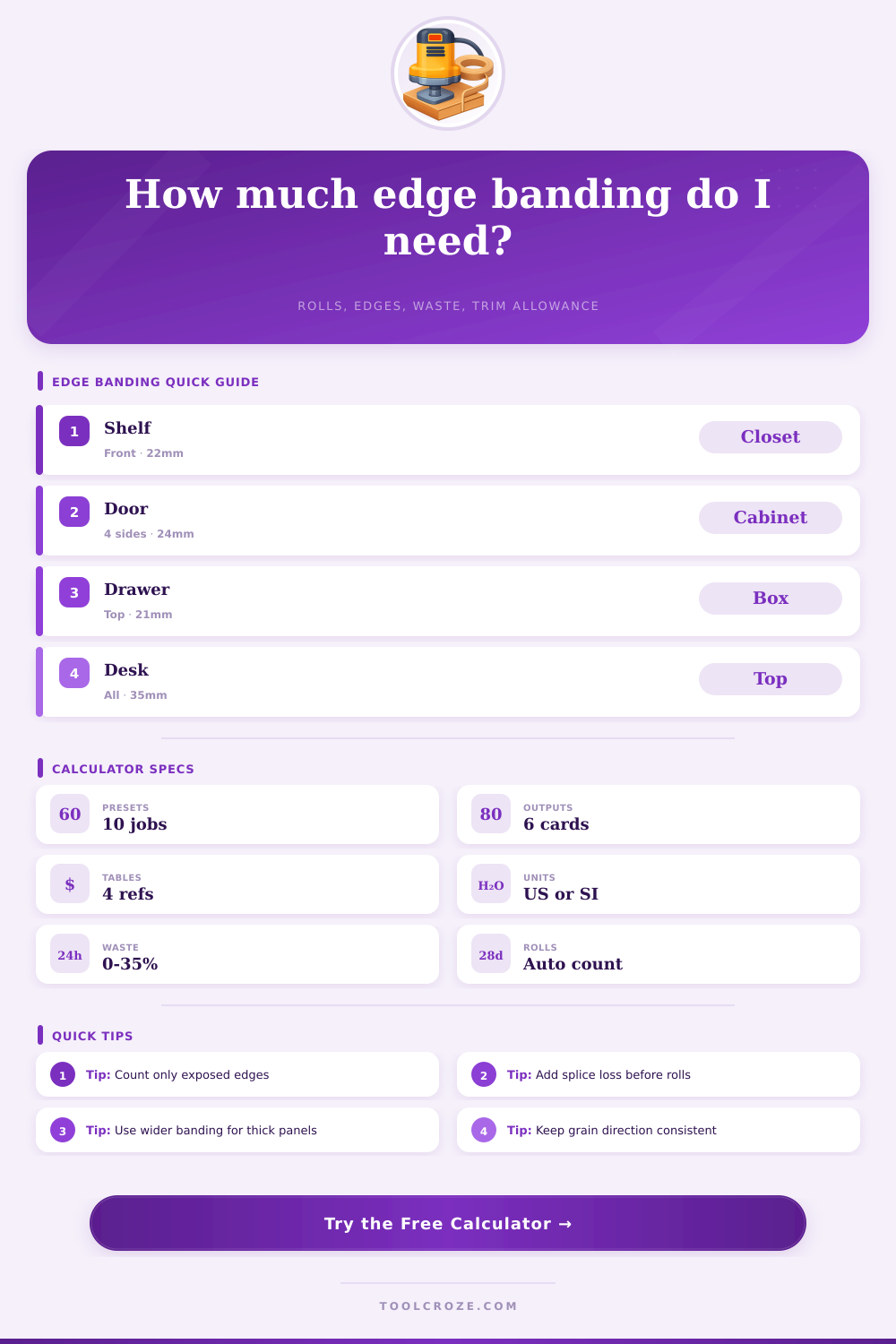
An edge banding calculator will take the dimension of the panels that will be edged, and convert those dimension into the amount of edge banding material that should be ordered. Before utilizing the edge banding calculator, a person must determine which edge of the panels will have edge banding. For instance, a shelf that is against a wall may only have edge banding on its front edge.
How Much Edge Banding Do You Need
However, a shelf that is floating from wall to wall will have edge banding on three of its edges. Additionally, a door slab will have edge banding on each of its four edge. The edge banding calculator will allow a person to select each of these edge patterns, and will calculate the total length of edge banding material that will be required for all of the panels.
The calculator also help to avoid any mistake in the placement of the edge banding if the person must have the grain of the edge banding to match a certain direction. In addition to determining the dimensions of the panels, the type of edge banding material that will be used will impact the amount of edge banding material that is purchased. For example, if a person is to use PVC or ABS edge banding, the material will be easy to trim, and will generate small amount of waste during the process.
In comparison, veneer and solid wood lipping is more difficultly to use at the corners of the panels, and may require more allowance for waste of the material. The edge banding calculator includes a waste percentage setting for the material. A person can increase or decrease this percentage to determine the amount of edge banding material that will be required.
For instance, increasing the percentage will show the number of rolls of edge banding material that is required for the project. Another factor that impact the amount of edge banding material that will be required is the loss of the material during the process. For example, a small amount of edge banding material is lost each time a person begins a new panel.
Additionally, if the edge banding machine require a test strip to be cut for each color change in the project, more edge banding material will be lost during the process of edging these panels. The edge banding calculator account for these losses in its total required amount for the project. The width of the edge banding material will also impact the amount of material that is required for each panel.
For example, if the edge banding material is wider than the panels, there will be extra material that can be lost to trimming of the panels to ensure that they are perfectly square. However, if the edge banding material is too narrow, it is possible that there will be a glue line between the panel and the edge banding material. The edge banding calculator or tables accompanying the calculator will show the proper width of edge banding material for each thickness of panel.
In addition to the specifications of the edge banding material, there are other factor that may impact the process of edging the panels. For instance, humidity in the environment in which the wood is located will cause veneer edge banding material to potentially curl. In these instances, more edge banding material may be required for the overhang of the edge banding.
In addition, if the color of the edge banding material does not match with the color of the rest of the wood on the panel, the person may discard the edge banding material. These factors are outside of the edge banding calculator. However, the calculator will provide a baseline measurement of the edge banding material that will be required.
Based on this measurement, a person can decide on an amount of edge banding material that will account for these potential issue. Finally, the amount of edge banding material will result in a number that represent the amount of the edge banding material that will remain as leftover material. This remaining amount can then be used for any future project that may develop and be of small sizes.
If the amount of required edge banding material calculates to a number near zero, then the edge banding material will be utilized efficient, but there will be no extra material to account for any error in the placement or cutting of the edge banding. This number is calculated based upon the measurements of the panels that are to be edged. By using an edge banding calculator, the person ensure that the math for the amount of edge banding material is completed prior to beginning the project.
Thus, by calculating the amount of edge banding material required in advance, the person can move at a fasterer rate to complete the project.