
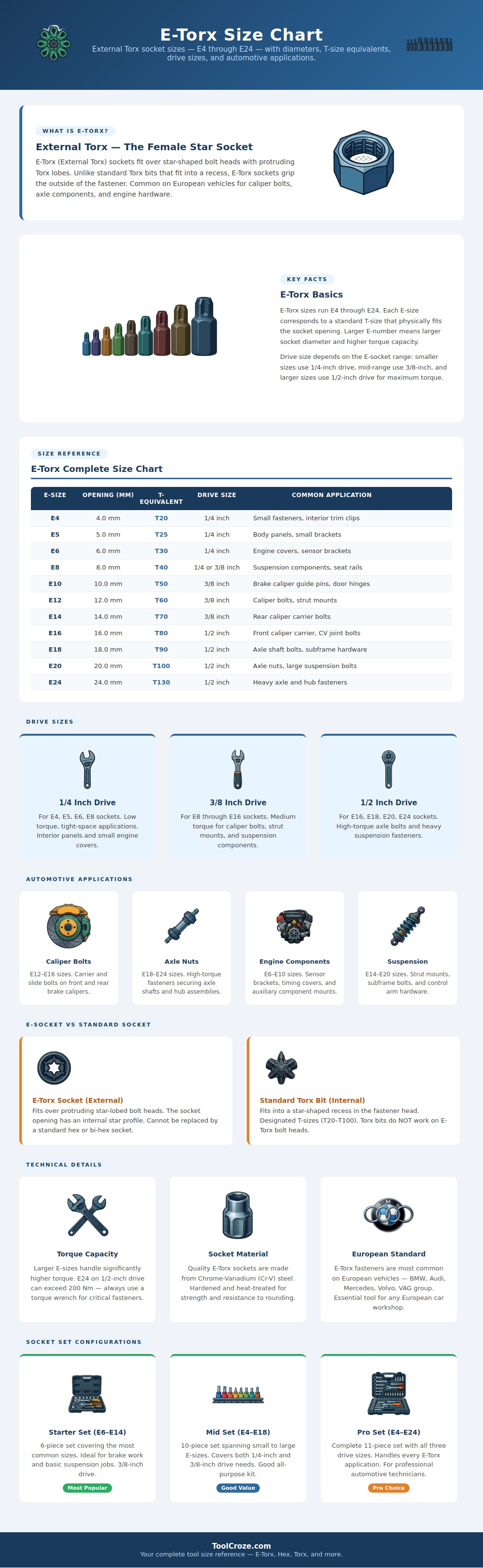
But what happens if a standard hex socket rounds off corners of your bolt head? It’s very common with standard hex sockets, especially on European cars. These is often designed to be star-shaped (with six points) to create even force transfer throughout the fastener while under heavy tension; this keep it from being stripped.
But what happens if the head stick up above the surface, too far for you to get a standard internal bit onto it? Then you need an external socket that fits over the head and grabs hold of star pattern from the exterior. These are E-Torx tools. They’re like regular Torx bits except they works in their own class. The ones you don’t use right is going to strip the fasteners and your time is wasted.
Understanding E-Torx Sockets
They range in size from E4 to E24. The bigger the E-number the greater the size of the opening of the socket and the more torque it can absorbs. It’s not just about fitting the bolt, but matching the mechanical stress of the application with the correct amount of strength for the tool. An axle nut need heavy duty force, while a small interior panel clip call for precision and lightness. You want a tool that won’t break when pressed.
This is a misconception by many; that all socket sizes uses the same drive size on your ratchet. As displayed in the chart above, each of these sockets is designed to fit a standard drive size. Quarter inch drive are most common for smaller sizes: E4-E8. Reason being? Often we use them for smaller things around a dashboard or in a closed-off engine bay. In those spots, you don’t really have a lot of room to swing a large wrench. You want to be able to get access and speed without having to apply too much brute strength.
Mid-range sizes, such as E10… E14, transition into the 3/8-inch drive. This provide a nice mix of power and control for strut mounts and brake caliper bolts. These parts require medium sized torques. For example, sizes E16 to E24 is only half-inch. They’re used for things like axle shafts, subframe hardware, etc… Stuff that holds the car together. There’s no safe way in hell you’ll be able to get an axle nut loose using a quarter-inch drive tool. That thing will snap/bend long before it move the bolt. This infographic divides them up so you don’t purchase a set which won’t have enough strength. Skipping over the half-inch E-sizes could of hurt you if you plan on working on suspension stuff in the future.
The other confusion is that you can’t mix external E-Torx sockets with internal Torx bits. An E4 socket slips on and sits around a protruding star head, whereas a T20 bit fit in a recessed star pattern. It doesn’t match exactly; don’t try to guess which one is right by looking for the same number. Instead, refer to how it’s used. Smaller ones such as E6 or E10 tend to be found on things like sensor brackets and engine covers that need precise placement but aren’t super-tough (so no need for high torque). Being able to know what size is used where will speed up your repair project.
The quality of the tools does matter. For example, get the best that you can afford. Choose Chrome-Vanadium steel because it provide a good blend of hardness and round-off resistance. Cheap alternatives might look fine in the box but can fail when you apply real force. There is a reason that these fasteners are used by European manufacturers in critical safety applications. Your tooling should live up to their engineers’ expectations. Respecting the design intent of the vehicle is as simple as having the proper E-Torx socket. From rusted bolts on an axle to a tiny trim clip, using the right tool can mean repairing something cleanly versus ruining your fastener. Next time you’re in the garage, keep this chart handy. It’s all about confidence and less guesswork.
