
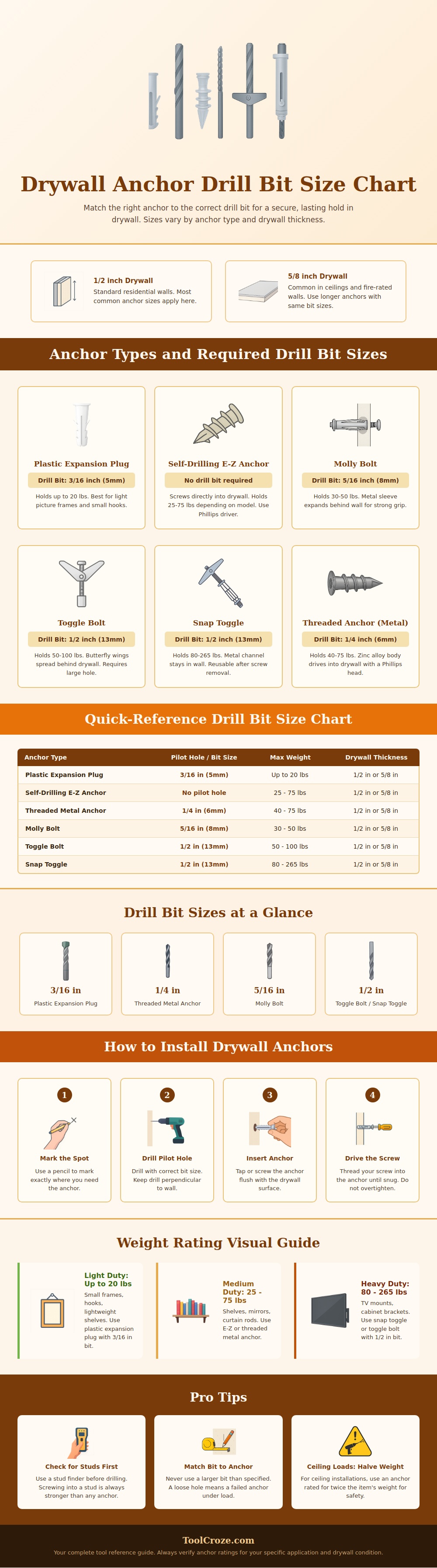
Choosing the right drill bit size for drywall anchors can seem hard, but it is simple when you understand the basics The drill bit size for the anchor does not depend only on its size, but also on its type. For light tasks you usually use drill bits of 1/4 to 3/8 inch, while toggle-type anchors for heavy work require something between 1/8 and 1/4 inch. Toggle bolt drywall anchors come in different sizes, because they intend to hold some of the heaviest objects in drywall.
A good way is to take the smallest part of the anchor to decide the drill bit size, or even a bit smaler. Compare the end of the anchor with that of the drill bit, they should be about the same size. Do not count the screw itself.
How to Choose the Right Drill Bit Size for Drywall Anchors
Line the shank of the drill bit against the body of the anchor, without the flange. You do a precise hole in the wall, that ensures a firm and safe setting for tools and other things.
There are some tricks to guess the right drill bit size. You can guess according to the size of the screw and the color of the plug of the drywall anchors. If in doubt between two sizes, better choose the smaller than the bigger.
A small hole you always can expand later, but too big can not be made smaller. Ideally the hole must be snug.
Some anchors from popular stores require specific sizes. For instance, some require holes of 5/16 inch, 1/4 inch or 3/16 inch, depending on which you use. A 3/16 inch drill bit worked well for one common anchor size.
Some bracket instructions also ask for a 3/16 inch drill bit. A 1/4 inch drill bit is another common size for drywall anchors.
For drywall and plasterboard, normal twist drill bits or brad point bits do good pilot holes for plastic anchors. You do not need special bits in most cases. Some anchors have deep cut threads and a tapered bottom, that punctures and makes its own hole in the drywall.
These self-drilling anchors can be removed by means of a number 2 Phillips drill bit. They are reliable for heavy objects.
Always check the package for the suggested hole size. If the package is missing, the website of the maker usually gives the info. When you do not drill directly into a stud, an anchor probably will be necessaryforthe project.
