🔧 Drill Bit Size Calculator
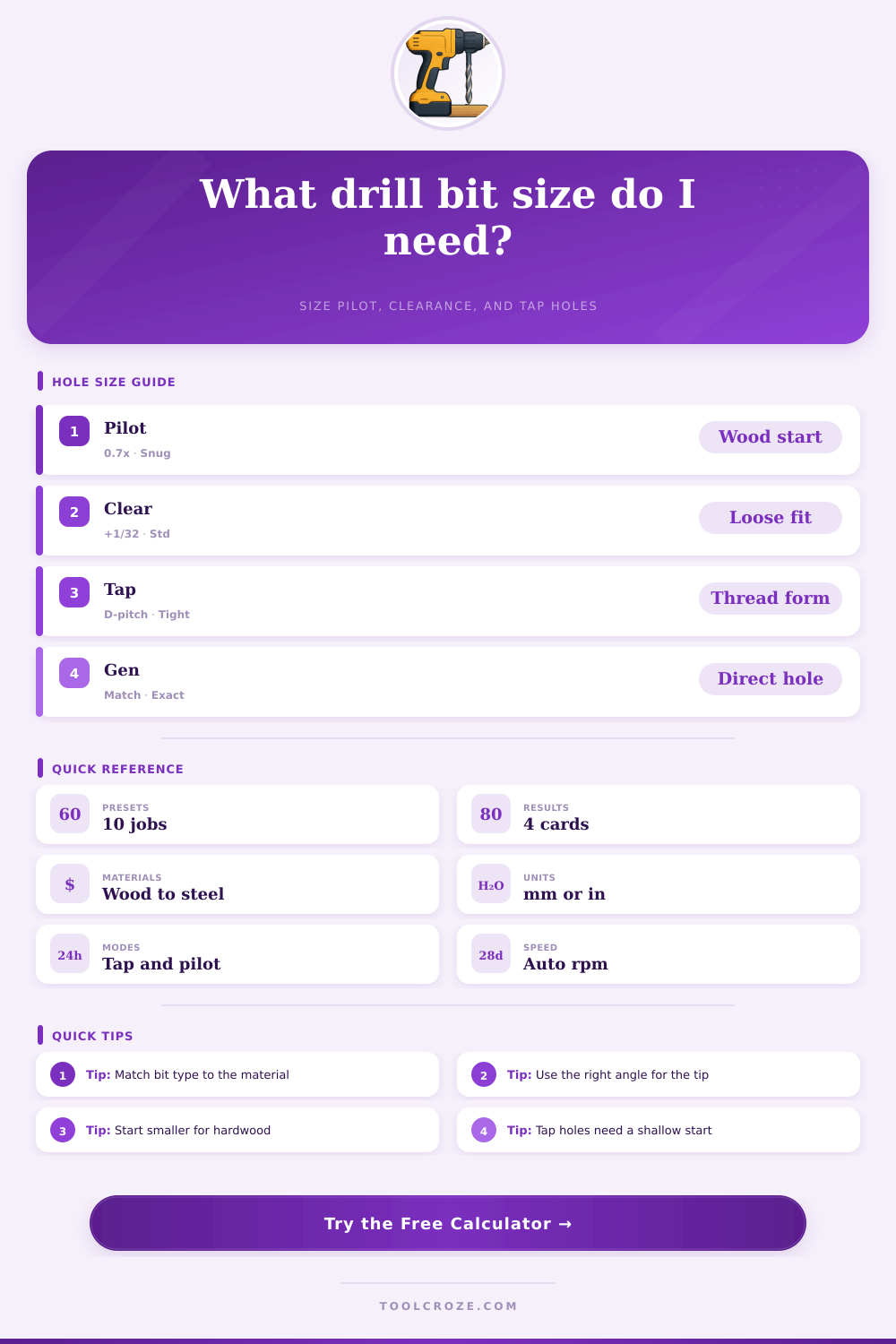
Choose the right bit size for pilot holes, clearance holes, tap drills, and general drilling in wood, plastic, or metal.
📌 Presets
📝 Inputs
📊 Results
🧰 Material Properties
📈 Speed and Feed Reference
| Material | Bit type | SFM | RPM at 1/4 in | Feed note |
|---|---|---|---|---|
| Softwood | Brad point | 200 | 3,054 | Fast chip load |
| Hardwood | Twist drill | 160 | 2,443 | Start slower |
| Plywood | Split point | 180 | 2,748 | Clean top face |
| MDF | Twist drill | 110 | 1,679 | Keep dust clear |
| Acrylic | Brad point | 90 | 1,373 | Reduce heat |
| Aluminum | Cobalt | 75 | 1,145 | Use lubricant |
| Mild steel | Cobalt | 45 | 687 | Peck drill |
| Stainless steel | Carbide | 28 | 428 | Light pressure |
🔧 Bit Selection Table
| Bit | Best use | Max RPM | Notes |
|---|---|---|---|
| Twist drill | General holes | 10,000+ | Most common |
| Brad point | Wood starts | 8,000+ | Clean entry |
| Split point | Reduced walk | 9,000+ | Good on metal |
| Cobalt | Hard metals | 6,000+ | Heat resistant |
| Carbide | Abrasives | 12,000+ | Very rigid |
| Step drill | Sheet metal | 3,000+ | Open one size at a time |
| Center drill | Starter point | 8,000+ | Use before tapping |
| Spade bit | Fast wood | 2,500+ | Rougher finish |
📑 Common Project Sizes
| Project | Typical hole | Suggested bit | Fit |
|---|---|---|---|
| #8 screw pilot | 0.136-0.147 in | 9/64 in | Snug |
| #10 screw pilot | 0.164-0.173 in | 11/64 in | Standard |
| 1/4 bolt clearance | 0.266-0.281 in | 17/64 in | Loose |
| 5/16 lag pilot | 0.210-0.230 in | 7/32 in | Snug |
| M5 tap drill | 4.2 mm | 4.2 mm | Tight |
| M6 tap drill | 5.0 mm | 5.0 mm | Tight |
| Cabinet shelf pin | 5 mm | 5 mm | Exact |
| 10 mm dowel | 10.0 mm | 10 mm | Press fit |
💡 Material Guidance
⚠ Safety Note
Drill bits are cutting tools for to holes in various materials. They have in many forms and sizes. For production matter to choose the apt size.
Standard charts about drill bit sizes list fractional, metric, wire and letter measures. Commonly it also shows decimal matches of inches and metric conversions. For instance, charts points decimal inch-measures for fractions, wires, letters and metric bits until 2 inches of diameter.
How to Choose the Right Drill Bit Size
Numerical sizes, or number bits, go of #1 (the biggest) until #80 (the most little), so of #107 (0.0019”) until #1 (0.228”). Fractional sizes start in 1/64” and progress by means of steps of 1/64”. They reach around 1. 1/2” and later adjust to steps of 1/32”.
Compare various sets are usefull. Standard imperial set has 29 bits, metric set around 25. The imperial covers a bit more exactly of 1.6 mm until 12.7 mm, so with better steps.
Some bits do from HSS, high fast steel, that answers for general use. If size is not mattered on the shank, use caliper either micrometer for control. Bits in steps of 1 mm find at engineer stores.
Little sets lack for most final steps, except for bits under 1 mm diameter. Small bits easily break, especially bearing manually. For particular size sort individual bits on-line.
Well provided hardware stores keep numerical and letter bits, but they no always are easily found.
Working with screws, the size matter. If screw passes through hole to the contrary aspect with washer and nut, it operates as bolt. Then bitilo suffice to be slightly bigger than the screwdiameter.
For intense closing in metal bear 1/64” less big and later ream until the final size. For loose closing or easy introduction, choose 1. 2 thousands of inches bigger. Bits with around 1 mm steps help to depress heat, deviation and tension in metal, wood or plastic.