
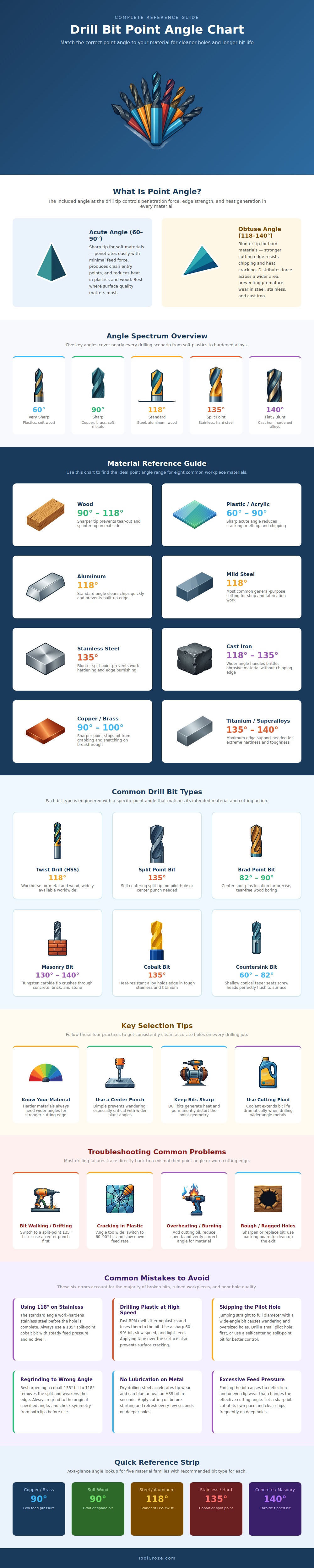
The point angle of a drill bit determine how a drill bit interacts with a workpiece. The point angle of a drill bit also determine the amounts of pressure you must apply with a drill bit and how long a drill bit will remain sharp. Many people select drill bits without considering the point angle of a drill bit.
The point angle of a drill bit is the reason why drill bits may wander across a workpiece. If the point angle of a drill bit do not match the workpiece being drilled, it can ruin the workpiece or damage the drill bit itslef. The angle at the tip of a drill bit determine the cutting force that a drill bit will use.
Pick the Right Drill Bit Point Angle
Drill bits with a narrow point angle will have a sharper cutting tip than those with a wide point angle. However, drill bits with a narrow point angle will be more fragile than those with a wide point angle. Drill bits with a wide point angle will have a blunt cutting tip that will last longer but require more pressure to drill into a workpiece.
When drilling into plastic or acrylic materials, the point angle of a drill bit must be sharp. Drill bits with a wide point angle will melt or crack the plastic or acrylic materials as they will push on the plastic or acrylic instead of slice it. Drill bits with a sharp point angle will reduce the contact areas between the drill bit and the plastic and allow the drill bit to slice the plastic.
However, drill bits need to have a different point angle when drilling into stainless steel or titanium as these materials is hard. Drill bits with a sharp point angle may work harden the metal, making it harder to drill. Therefore, people use drill bits with a wide point angle to drill into stainless steel or titanium.
Drill bits used for wood workpieces require a specific point angle to prevent the wood from splintering. Using a blunt drill bit on wood may cause the wood to splinter at the exit point of the drill bit on the workpiece. Using a drill bit with a moderately sharp point angle will allow the drill bit to drill into the wood without splintering the wood.
The most common point angle for drill bits used in wood applications is 118 degrees as this point angle work well for wood, aluminum, and mild steel. Drill bits have different point angles for specific purpose. Twist drill bits have a point angle of 118 degrees as this point angle allow them to penetrate workpieces well while providing enough strength to the drill bit.
Split point drill bits have a point angle of 135 degrees as this point angle allow the drill bit to center itself in the workpiece, so there is no need for a pilot hole. Brad point drill bits have a very sharp point angle that allow them to drill precisely into the workpiece without splitting the workpiece material. Finally, masonry drill bits use a wide point angle with a carbide drill tip that allow the drill bit to crush the material instead of cutting into the material.
The point angle of a drill bit dictate the way you must use a drill bit. For drill bits used in hard workpieces, you will need to use a slower speed with the drill bit. However, for soft workpieces, you can use a higher feed rate for the drill bit.
Using a wide angle point on a drill bit will require using a cutting fluid for the workpiece more frequent as there will be more heat created at the point of the drill bit contact with the workpiece. You will also need to ensure that the drill bit remains sharp when using a drill bit with a point angle as a dull drill bit will change the point angle of the drill bit. This change in the point angle will cause the drill bit to not perform as it is intended to perform.
Many error can be made with drill bits if a person does not understand how to match a drill bit to a workpiece. For instance, if a person uses a standard drill bit on stainless steel at a high speed, the stainless steel will work harden at a high rate and the drill bit will eventually damage its cutting tip. Additionally, if a person uses a drill bit too quickly on a plastic workpiece, the plastic will melt at the edge of the hole created by the drill bit.
Lastly, if a person uses a wide point angle drill bit without a pilot hole, the drill bit will wander across the workpiece. However, if a person understands how to match the point angle of drill bits to the behavior of the workpiece, it will result in the production of clean workpieces with holes that will be even in diameter. Additionally, fewer drill bits will break when the point angle is matched to the workpiece material, and the drill bit will last longer.
