Drawer Slide Calculator
Match side clearance, length, and load rating for a smooth drawer fit.
| Nominal | Metric | Best For | Notes |
|---|---|---|---|
| 10 in | 250 mm | Shallow tray | Compact spaces |
| 12 in | 300 mm | Desk drawer | Light storage |
| 14 in | 350 mm | Small cabinet | Short front |
| 16 in | 400 mm | Kitchen drawer | Common size |
| 18 in | 450 mm | Medium drawer | Most use cases |
| 20 in | 500 mm | Deep cabinet | Long reach |
| 22 in | 550 mm | Pantry bin | Extra travel |
| 24 in | 600 mm | Wide drawer | High capacity |
| Style | Side Gap | Rear Gap | Typical Load |
|---|---|---|---|
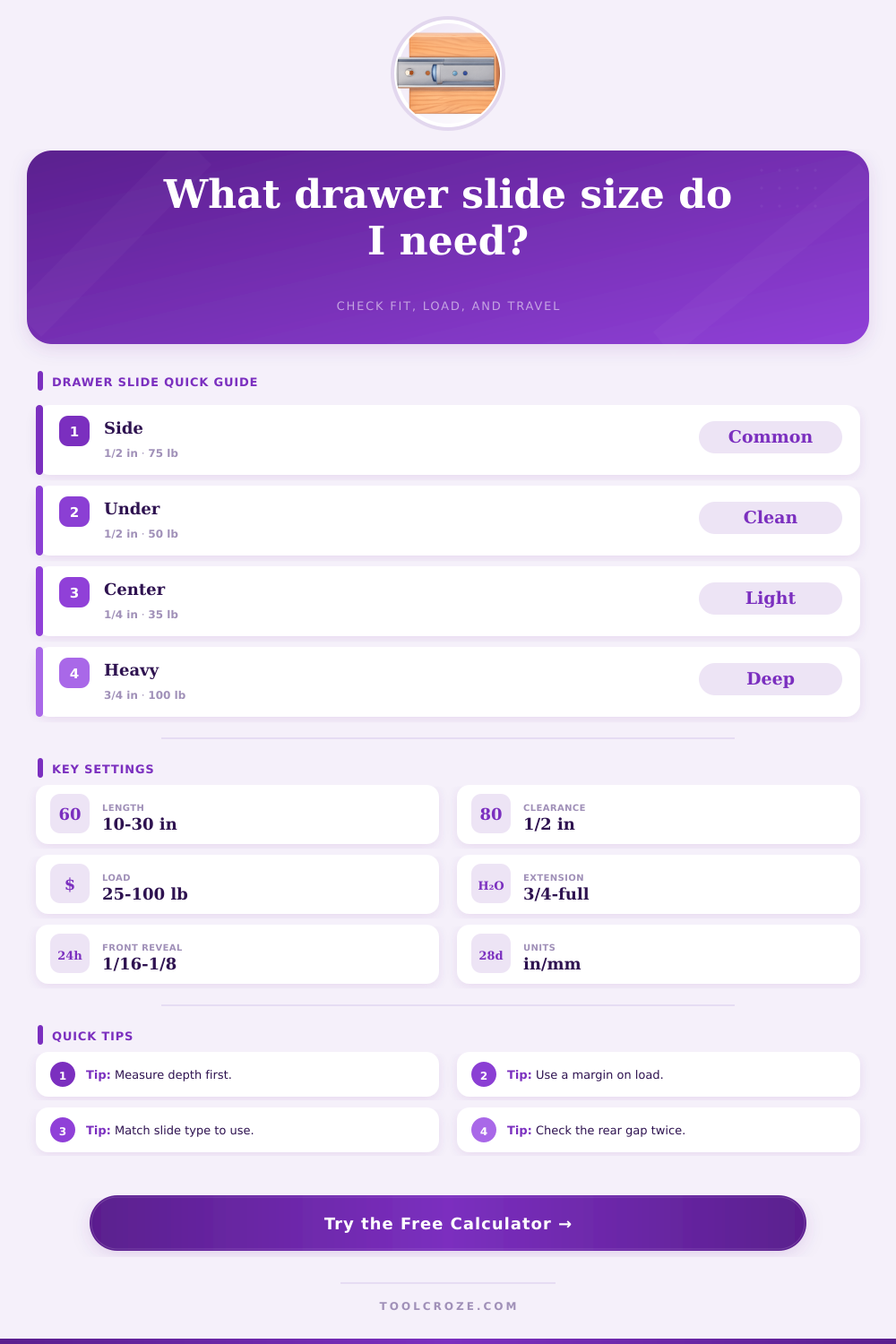
| Side-mount | 1/2 in | 3/4 in | 75 lb |
| Undermount | 1/2 in | 3/4 in | 50 lb |
| Center-mount | 1/4 in | 1/2 in | 35 lb |
| Heavy-duty | 3/4 in | 1 in | 100 lb |
When you install a drawer, you must calculate the specific measurement needed to ensure that the drawer operate correctly. For a drawer to operate correctly, it should glide smooth within the cabinet without scraping against the sides of the cabinet or the back of the cabinet. If you incorrectly calculate the measurements, the drawer will bind within the cabinet when you attempt to open or close the drawer.
The first measurement you must calculate is the clear opening width within the cabinet. This measurement is the distance between the two side of the cabinet opening and is not the same than the opening width of the cabinet frame. You must also account for the thickness of the sides of the drawer in this calculation.
How to Measure Drawers and Choose the Right Slides
For instance, if the thickness of the plywood is one-half inch, you must subtract the thickness of both sides of the plywood from the clear opening width of the cabinet. Additionally, if the drawer use side-mount drawer slides, it will require a gap for the drawers rail system to move in and out of the cabinet. The gap required for side-mount drawer system is usually one-half inch on each side of the drawer.
In this instance, the calculated width of the drawer box must be less than the clear opening width of the cabinet. The next measurement is the depth of the cabinet in which the drawer will be installed. The depth of the cabinet opening can be measured from the front of the cabinet to the rear stop or the back of the cabinet panel.
Drawer slides require a gap at the back of the cabinet to clear the back panel of the cabinet. The gap is usually three-quarters of an inch. Since the drawer slide will require this gap, the length of the drawer slide will be shorter than the depth of the cabinet opening.
When purchasing the slide, ensure that the length of the drawer slide match the depth of the cabinet opening. Drawer slide lengths are usually sold in standard size, such as 16 inches or 18 inches. The next important measurement is the load rating of the drawer slide.
The load ratings indicate the amount of weight that the drawer can hold. Drawer slides has a maximum weight limit. The weight of the contents of the drawer should not come close to the maximum weight capacity of the drawer.
For instance, a kitchen drawer that contain cutlery will have a significantly different load rating than a cabinet that contains heavy dinner plate. Many people calculate the weight of the contents of the tool chest incorrectly. Therefore, you should always include a 10 percent safety margin when you calculate the weight of the contents of your chest.
Side-mount drawer slides can handle 75 pound of weight. Undermount drawer slides have a slightly lower weight capacity of 50 pounds due to the different clipping mechanism that are used for undermount drawer slides. Heavy-duty drawer slides can hold 100 pounds or more of weight.
Use heavy-duty drawer slides for your tool chest if they will contain heavy objects. Another thing to consider when determining the weight capacity of your drawer is the material of the chest. If the chest is made of hardwood, it is going to be denser and resist flexing, allowing it to hold heavy loads.
If it is made of particleboard or medium-density fiberboard (MDF), it will be less dense than hardwood and may sag under heavy loads. High humidity could cause plywood to swell. As the plywood swells, it takes up more space within the tool chest.
This creates a decrease in clearance between the chest and the drawer box. This can cause the drawer to bind to the tool chest. The style of the drawers front can also play a role in the clearance of the drawer.
If the chest feature an overlay drawer front, the drawer front will sit on top of the cabinet frame, hiding any gaps between the drawer and the cabinet. An inset drawer front will be flush with the cabinet frame. There will be very little room for error when cutting these drawer fronts.
To account for the small gap between the drawer front and the cabinet frame, you will have to decrease the dimension of the drawer front by a small amount. Finally, always check the specifications of the drawer slides that you will use in the tool chest. The specifications for drawer slides can vary from brand to brand.
Always read the manufacturer specifications for drawer slides before drilling the holes for the chest. By following the specifications for the clear opening width, depth of the chest, and the load that the chest will take, the chest will function smooth.