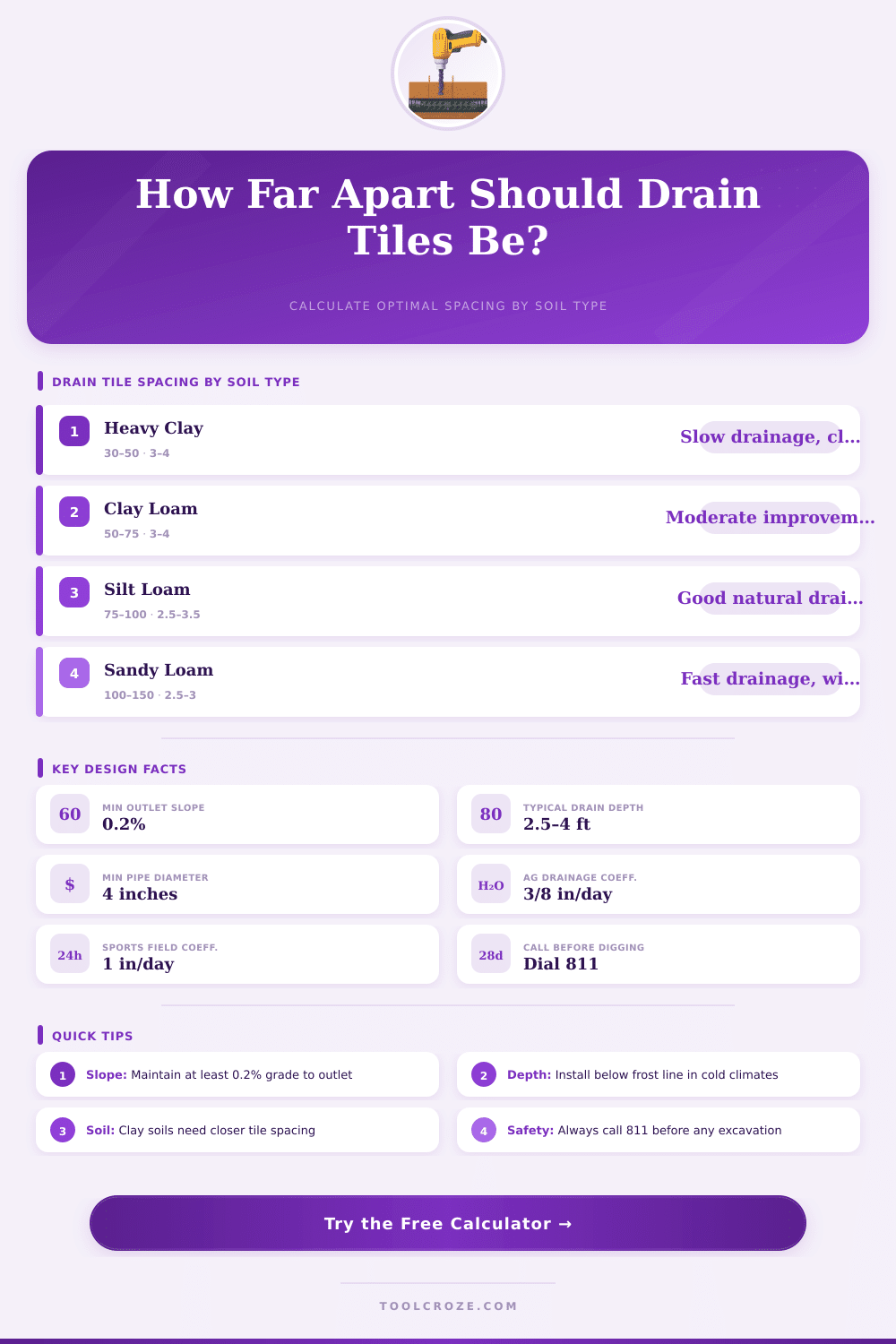
💧 Drain Tile Spacing Calculator
Calculate optimal subsurface drain tile spacing using soil hydraulic conductivity and the Hooghoudt drainage equation.
| Soil Type | K (in/hr) | Drainage Suitability | Typical Spacing (ft) |
|---|---|---|---|
| Heavy Clay | 0.01 | Very poor — tile essential | 30–50 |
| Clay Loam | 0.05 | Poor — tile beneficial | 50–75 |
| Silt Loam | 0.25 | Moderate — often benefits | 75–100 |
| Loam | 0.5 | Moderate-good | 80–120 |
| Sandy Loam | 1.0 | Good — wide spacing OK | 100–150 |
| Sandy | 2.0 | Excellent — rarely needed | 150+ |
| Application | q (in/24 hr) | Notes |
|---|---|---|
| Agricultural Crops | 3/8 (0.375) | Standard design for row crops |
| Vegetables / High Value | 1/2 (0.5) | Sensitive crops need faster removal |
| Lawns & Gardens | 1/4 (0.25) | Less critical timing |
| Sports Fields | 1 (1.0) | Rapid recovery after rain required |
| Perimeter Foundation | — | Design based on local hydrostatic conditions |
| Pipe Size | Slope (%) | Flow Capacity (gal/min) | Max Drainage Area (acres) |
|---|---|---|---|
| 4 inch | 0.2 | ~18 | ~5 |
| 4 inch | 0.5 | ~30 | ~8 |
| 6 inch | 0.2 | ~55 | ~15 |
| 6 inch | 0.5 | ~90 | ~25 |
| 8 inch | 0.2 | ~130 | ~35 |
| 8 inch | 0.5 | ~210 | ~58 |
| Crop / Application | Recommended Depth (ft) | Frost / Notes |
|---|---|---|
| Row Crops (corn, soybeans) | 3.0–4.0 | Below typical frost penetration |
| Small Grains | 2.5–3.5 | Shallow roots, shallower OK |
| Vegetables | 2.5–3.0 | Avoid deep tillage interference |
| Lawns & Gardens | 1.5–2.5 | Stay below frost line in cold zones |
| Sports Fields | 2.0–3.0 | Gravel envelope recommended |
| Perimeter Foundation | At footing level | Must be below slab or footing |
| Orchards / Vineyards | 3.0–5.0 | Deep roots require deeper drain |
Install drain tile for drainage with the interval is important decision for the farming in agricultural areas. The main goal is to remove too much water from the ground, so that the crops grow without trouble. Even so, to find the ideal distance, we must consider several different things.
The drain tile works almost in form of “V” from the centre. It fits to remove water from region of around 20 to 25 feet at both sides. Although, the precise coverage depends on the kind of soil, on the crops that grow here and on the amount of water that needs to be removed.
How Far to Space Drain Tiles on a Farm
Some farmers choose to lay 3-inch drain tile in 40 feet one of the other, in depth of 30 inches. The thought behind this is place them a bit more closely, but set them less depth for more quickly drain the ground. Whether 30 inches is enough for depth, that deserves careful thought before start the work.
For 30-foot interval, the math shows 1,100 to 1,200 feet of drain tile for one acre. With price of around 77 cents each foot and 1,150 feet for acre, the amount reaches about 885 dollars for acre. Like this the distance directly affects the cost.
In southwest Ontario, a research program studies whether narrower distance, even with 10-foot intervals, works more effectively in soils based on clay. The clay is difficult, because the water moves threw it very slowly.
There are online tools that help to estimate the best interval for drains according to the local ground and the weather. Those tools consider things like the water flow of the soil, the depth of drain, the wanted height of the water level and the rate of drainage, to find the right amount. One of them even takes in calculation 1,845 different types of soil.
The goal of those tools is find the distance that ensures the best yearly profit from the investment in the drain tile system.
Also the rates of drainage have weight. They usually drop in the north and west of the Corn Belt, around 0.25 to 0.5 inches in day in areas like the Dakotas and west Minnesota. In the south and east, those values rise, from 0.375 to 0.75 inches in day.
The size of the tubes also matters, because different sizes give different surfaces for inflow, which changes the water flow.
Study about drain tile distance and water quality showed interesting results. When the interval changed from 4.2 metres to 7.5 metres, the whole water outflow grew by 10 percent, but the amount of nitrates dropped by 28 percent. So bigger distance truly can help the management of nutrients.
Even with 60-foot interval, one sees good drop of the stress on crops. In 2024, although without big rains, happened days when the soil packed. The drainage by means of drain tile helped to ease the tension for crops during those times.
Generally, 4-inch drain tile beats the 3-inch kind, because the pricedifference is tiny, the install cost stays same and the 4-inch bits are much more easily found.