Doyle Board Foot Calculator
Estimate Doyle board feet from small-end diameter, log length, trim, bark, sweep, and recovery on each log or lot.
📍Preset Doyle log scenarios
🔧Doyle inputs
📊Results
Full breakdown
🧱Species and taper guide
📈Doyle rule reference
| Rule | Formula shape | Bias | Best fit |
|---|---|---|---|
| Doyle | ((D - 4)^2 x L) / 16 | Low on small logs | Rough sawlog check |
| Scribner | (0.79D^2 - 2D - 4) x L/16 | Middle ground | Common mill estimate |
| Intl 1/4 | (0.22D^2 - 0.71D - 1) x L/8 | Closer on smaller logs | Finer scale option |
| Net lot | Gross x loss factors | Recovery only | Use after trim |
📈Common Doyle scale examples
| Log size | Doyle | Scribner | Intl 1/4 |
|---|---|---|---|
| 10 in x 8 ft | 18 BF | 28 BF | 14 BF |
| 14 in x 16 ft | 100 BF | 123 BF | 64 BF |
| 16 in x 16 ft | 144 BF | 166 BF | 88 BF |
| 20 in x 20 ft | 256 BF | 316 BF | 180 BF |
📈Loss and recovery guide
| Condition | Sweep loss | Defect loss | Mill note |
|---|---|---|---|
| Straight, clear | 0-3% | 0-4% | Use as baseline |
| Mild sweep | 4-7% | 5-8% | Farm or yard logs |
| Visible knots | 8-12% | 8-15% | Utility stems |
| Crooked / short | 13-20% | 15-30% | Stay conservative |
📈Metric to imperial guide
| Metric input | Imperial equivalent | Use | Note |
|---|---|---|---|
| 250 mm | 9.8 in | Top DIB | Round to tenths |
| 350 mm | 13.8 in | Butt DIB | Compare spread |
| 5.0 m | 16.4 ft | Log length | Trim first |
| 25 mm | 1.0 in | Bark thickness | Only if DOB |
💡Doyle tips and safety
Doyle scaling is a way to calculate the volumes of lumber that is within a log. The Doyle scale is use to calculate how many board foot of lumber are within a log when a sawmill processes that log. Edward Doyle created the Doyle scale in 1857, and many sawmill in the Northeast and South regions of the United States still uses it.
To calculate the volume of lumber within a log using the Doyle scale, you use the diameter of the small end of the log and the length of the log. Because the Doyle scale assumes heavy saw kerf and lumber loss during the sawmill process, the Doyle scale will always show more fewer board feet of lumber for smaller logs. This accounts for the loss of lumber during the sawmill process and ensures that the buyer of the logs are not overpaying for logs that will have a low recovery rate during sawmill processing.
How to Use the Doyle Scale to Measure Lumber in a Log
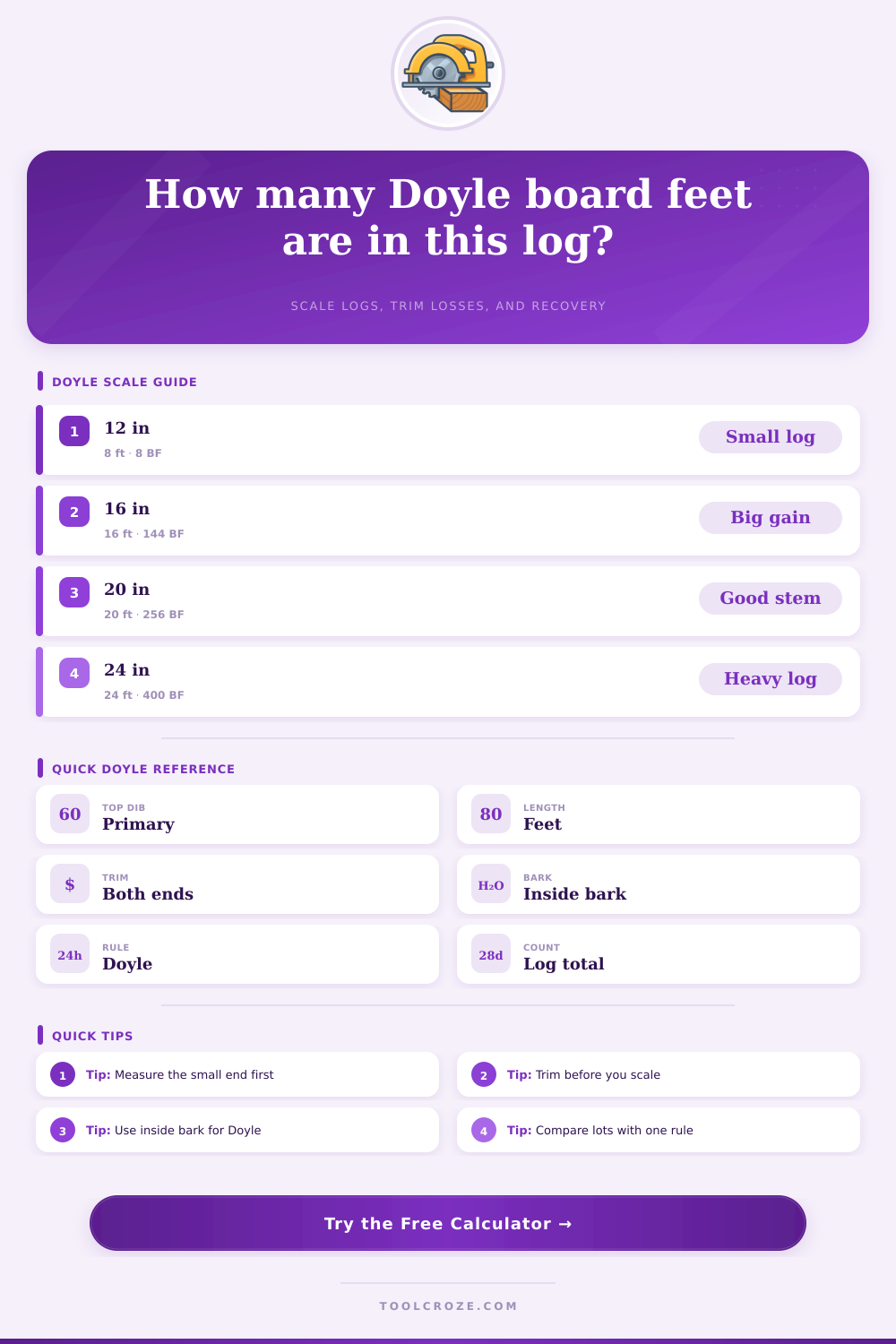
To use the Doyle scale proper, you must first measure the diameter of the log at it’s small end. You should measure the diameter of the log inside the bark, as the bark of the log do not contain usable lumber. If you measure the diameter of the log outside the bark, you will get a measurement that is too large.
You must measure the length of the log. Any trim losses on the log must be accounted for. Trim losses are the loss of lumber at the end of the log.
These can result from the log being cut when it was being felled or transported to a sawmill. You must account for them by subtracting the length of the logs trim from its total length. Finally, the sweep of the log must be accounted for.
The sweep of the log is the curvature of the log. This reduce the amount of lumber that can be cut from the log. The species of wood also has different considerations for the Doyle scale.
For instance, because the logs of hardwoods like pine are often straight, they often have high recovery rate when processed at a sawmill. The logs of hardwoods like oak is more denser than pine, but they have more defect in there logs. For hardwoods like walnut, which are a premium hardwood species, it is important to get the measurements of the log precisely, since the taper of the log can have an impact on the volume of lumber that is sawn from that log.
For lots of logs that are mixed hardwoods, it is best to assume a higher rate of loss of lumber from sweep and defects. You must account for the characteristics of each species of wood that you are sawing to ensure accurate measurements. There are a few error with the Doyle scale if you dont account for all of the variables.
One of the most common error is not deducting the thickness of the bark of the logs. This can make the board foot measurements higher than they should of been. Another of the most common error is ignoring the taper of the logs.
However, the Doyle scale account for this as the small end of the log is weighed more heavy than the large end. You must account for the recovery rate of the sawmill. Sawmills will lose some of the logs when they create the lumber.
This loss is call mill recovery. Most sawmills will have a recovery rate of between eighty-eight and ninety-four percent of the logs that they saw. Thus, assuming a recovery rate of ninety-eight percent will result in error.
There are a few ways to improve the accuracy of the Doyle scale. First, ensure that all logs in a lot has the same measurements. For instance, if some logs are measured inside the bark and others outside the bark, the total volume of lumber from the sawmill will be inaccurate.
Second, document the Doyle scale measurements of the logs on a sheet that you will give to the loader of the logs and the sawmill itself. This will provide proof of the Doyle scale measurements should the sawmill rescale the logs. Finally, ensure that the logs are securely fasten before beginning to scale the logs.
A moving log is an safety hazard.