Dovetail Cutter Feed Calculator
Calculate dovetail cutter RPM, feed rate, chip load correction, depth pass logic, MRR, and cut time from cutter geometry and material speed.
| Material | Carbide SFM | Chip load range | Dovetail note |
|---|---|---|---|
| Aluminum 6061-T6 | 350-700 | 0.0015-0.0040 in/tooth | Good chip evacuation; avoid rubbing at the neck. |
| Brass 360 | 250-500 | 0.0010-0.0030 in/tooth | Stable finish with moderate SFM and a sharp edge. |
| Mild steel 1018 | 90-160 | 0.0008-0.0020 in/tooth | Reduce feed for full-width undercut engagement. |
| Stainless 304 | 45-90 | 0.0004-0.0012 in/tooth | Keep feed positive to avoid work hardening. |
| Gray cast iron | 70-130 | 0.0007-0.0018 in/tooth | Dry or air blast is common; watch abrasive dust. |
| A2 tool steel annealed | 45-85 | 0.0004-0.0010 in/tooth | Use short stickout and conservative engagement. |
| Titanium 6Al-4V | 30-60 | 0.0003-0.0008 in/tooth | Limit heat and use steady coolant coverage. |
| Acetal / Delrin | 400-800 | 0.0020-0.0060 in/tooth | Use sharp edges and enough feed to make chips. |
| Cutter geometry | Formula | Use | Practical check |
|---|---|---|---|
| Effective diameter | d + 2 × depth × tan(angle / 2) | RPM calculation | Cannot exceed the cutter large diameter. |
| Maximum profile depth | (D - d) / (2 × tan(angle / 2)) | Depth limit | If exceeded, the tool geometry is too small. |
| Spindle speed | SFM × 12 / (pi × effective D) | Speed setting | Cap by machine and cutter rated RPM. |
| Feed rate | RPM × flutes × adjusted chip | Programmed feed | Correct for finish mode and holder rigidity. |
| Cut time | travel length × passes / feed | Cycle estimate | Add approach distance, not just finished length. |
| Holder condition | Feed factor | SFM factor | Dovetail risk |
|---|---|---|---|
| Rigid arbor, short stickout | 0.95 | 1.00 | Best choice for wide profiles and steel. |
| Standard end mill holder | 0.85 | 0.92 | General setup for aluminum and mild steel. |
| Extended reach holder | 0.65 | 0.78 | Reduce chip load to limit chatter at the lip. |
| Light machine or long overhang | 0.50 | 0.65 | Use shallow passes and inspect finish early. |
| Named setup | Angle | Material | Starting strategy |
|---|---|---|---|
| Gib slide bearing strip | 60° | 6061 aluminum | Rough at 30-40% radial engagement, finish at 0.6x chip. |
| Fixture key undercut | 45° | 1018 steel | Use two depth passes when profile depth exceeds 0.100 in. |
| Clamp jaw retention slot | 60° | 304 stainless | Keep coolant on and avoid dwell at the ends. |
| Machine way relief | 55° | Gray cast iron | Use air extraction and conservative feed at full width. |
| Optic or sight base | 65° | Brass | Use a finish pass with lower chip load for sharp shoulders. |
| Die lock pocket | 60° | A2 tool steel | Prefer rigid holder, low SFM, and small engagement. |
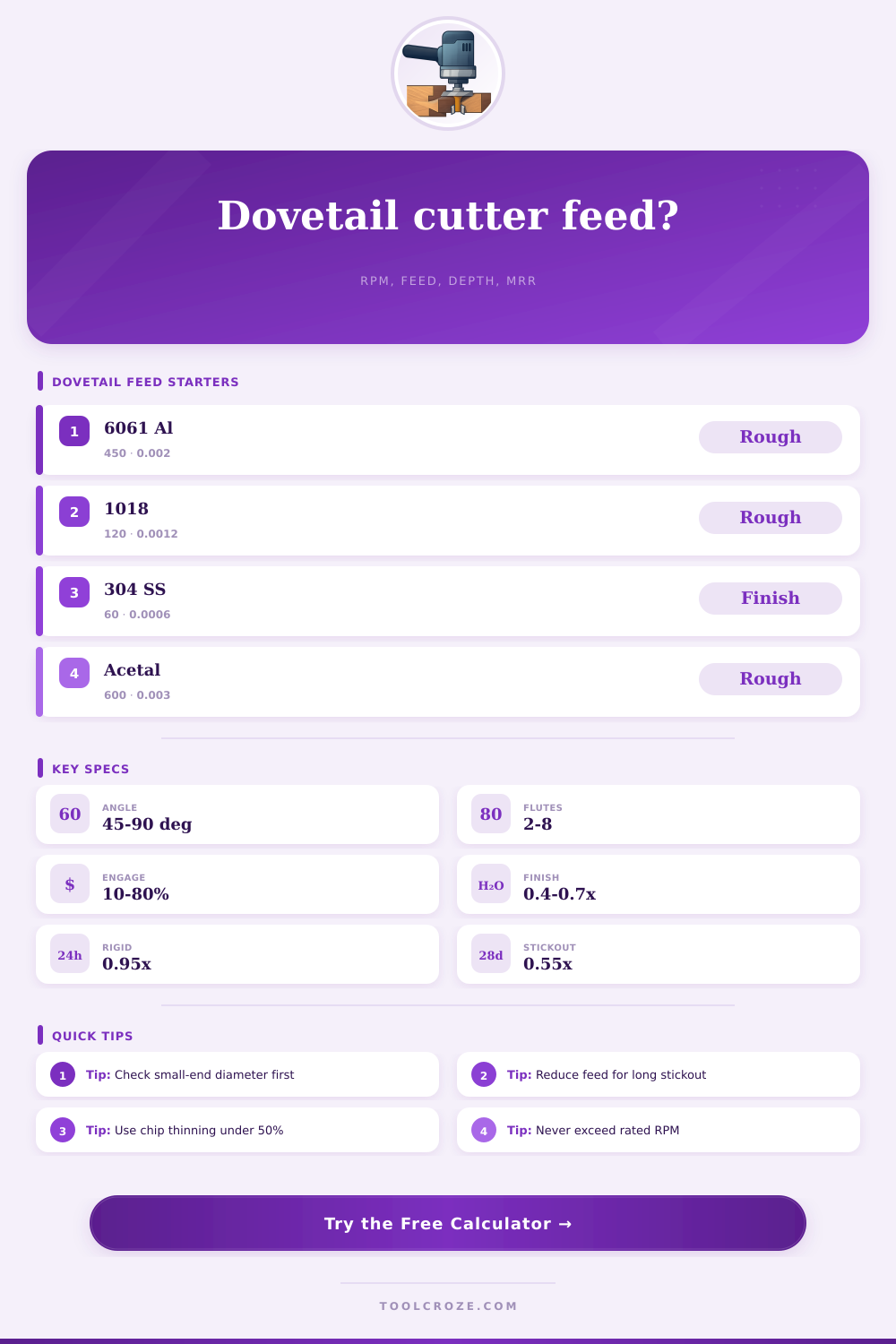
This dovetail cutter feed calculator use material information and the cutter’s geometry to calculate the adjusted chip load and safe RPM. It also calculates the feed rate, number of passes, material removal rate, and machining time. Use this to determine feed rates to prevent damaging tools.
The complication arises with the dovetail’s geometry: As it goes deeper into the workpiece its effective diameter increases. The root move slower than the outer lip. Spindle speed needs to be based on the biggest cutting circle at the final depth. Go wrong here and you will either burn the corners or rub in the neck.
How to Use the Dovetail Cutter Calculator
The second part of it is material behavior. Stainless steel will work-harden, aluminum will tend to fly off, and acetal turn into a stringy mess when you drop your chip load below a certain point. These behaviors affect what you can get away with in terms of speed and feed.
The calculator include factors for coolant, coating, holder rigidity, and mode. These factors takes that shift in behavior into account and adjust the output to match based on realistic corrections. That doesn’t mean you don’t need to know WHY they are there. If you have a long stickout then a stiff cut becomes a delicate cut as tool deflects. Your chipload changes unpredictably, and you might end up with profile that has wavy walls. Reducing feed by thirty or forty percent often looks conservative on paper but keeps the cutter alive and finish acceptable.
Speed matters, but depth planning also matter. Don’t expect to make a deep dovetail in a single pass. The calculator divide up the total depth into reasonable increments and lets you know how many passes it generates. More passes = longer cycle time, less passes = higher loads against the delicate neck. This balance between force and duration are central to all good dovetail setups.
Similarly, radial engagement is also key here. You can make thinner chips by reducing the side cut to less than 50 percent. However, this only works if the rest of system holds enough stiffness. Once you exceed 70 percent push engagement, the forces rises rapidly. Instead of cleanly shearing, the tool begin pushing sideways. This causes your edges to dull and heat build before the part is finished.
The one thing experience has taught me is there is no such thing as leaving the small-end diameter check off. Before you get to the full profile, the neck hit the walls if your last depth is more than the cutter geometry can handle. It’s simple math and after you run it, most machinists find their limits the hard way. This typically happens at about the third pass when the finish is suddenely not so good.
The coolant selection isn’t just for comfort. A strong stream of air or liquid keeps the chips flowing out of narrowing slot. When it dries up on plastic or cast iron, the chips pack in and the cutter rub instead of cutting. The difference between a clean evacuation and a jammed slot is often twenty percent on tool life.
None of this happen on its own. Changing one input shifts spindle load, actual surface speed and total cycle time together. And that’s why the guys with experience don’t see feed and speed as two separate numbers (they’re part of a system).
Begin conservatively, adjust based off how it cuts and listen. The calculator put you on a believable starting line where initial cut isn’t far off. It’s up to sound and intuition from there.
The dovetail isn’t just an angle cut. It’s a tiny engineering riddle whose solution pleases him who honors its shape and respects both its material and the delicate mix of control and force built into it. Run the numbers first. Trust your eyes and ears in the shop. Every thoughtful choice pays off when the piece fits together just right.