🚪 Door Hinge Calculator
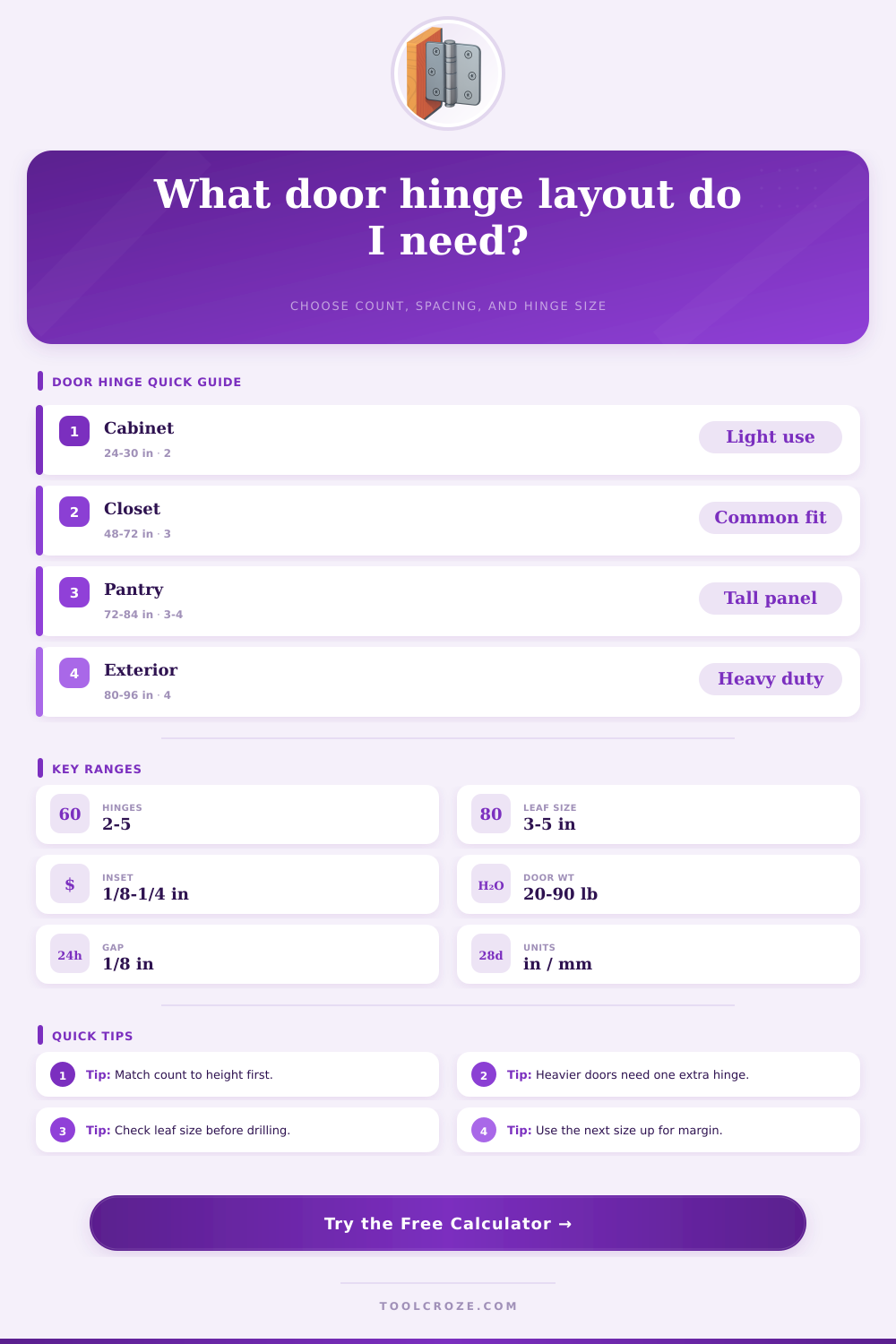
Estimate hinge count, spacing, leaf size, and load per hinge for cabinets, closets, pantry doors, and heavier entry panels.
| Hinge | Leaf | Rating | Use |
|---|
| Door height | Hinges | Top inset | Bottom inset |
|---|
| Material | Density | Load factor | Note |
|---|
| Style | Reveal | Offset | Use |
|---|
This door hinge calculator estimates hinge count, spacing, and load per hinge for cabinets, interior doors, and heavy panels so you can set clean layouts before drilling.
Hinges is the mechanical components that help to support the weight of a door. Additionally, hinges allow the door to swing on it frame. Placing hinges in the wrong spots on the door or provide insufficient number of hinges will lead to the door sagging in its frame.
To avoid such a problem, you must select the number of hinges on a door correctly and place them in the correct spots on that door. The height of the door play a primary role in determining the number of hinges that is required on a door. For doors that are shorter than three feet, two hinge will be sufficient to support the door.
How Many Hinges Does a Door Need
Such a short door has less mass than a tall door. For doors that are taller than five feet, an third hinge is required in the middle of the door. Such tall doors has more mass and are more likely to warp.
The mass of the door is also a determining factor in the number of hinges that is required. Doors that contain heavy material, such as solid wood or metal, will require more hinges than doors that contain light materials, such as hollow core door. The material of the door will change the mass of the door and also the material of the door will change the way in which the door is likely to sag.
Doors made of softwoods, like pine, is likely to be lighter than doors made of hardwoods, like oak. However, the softwood door is also likely to sag more than the hardwood door. Hardwoods, like oak, is more dense than softwoods like pine.
Additionally, hardwoods are more likely to be stiffer and less likely to sag. The mass and sagibility of the door will also impact hinge selection; hinges have a load rating that indicate the amount of weight that they can support. Using hinges whose load rating is less than the weight of the door will cause the screws of those hinges to eventually pull out of the door jamb.
If the screws of the door hinges pulls out of the jamb, the door will begin to sag. The placement of the hinges on the door have an impact on the stability of that door. The top hinge of the door and the bottom hinge of the door should be place at specific distances from the edges of the door for even distribution of the torque of the door.
Evenly distributing the torque will prevent the door from tilting or becoming crooked. Additionally, the gap between the door and the frame, known as the reveal, will also affect the placement of the hinges. Different types of hinges is used for different types of doors.
Butt hinges is the most common type of door hinge. Such hinges are strong due to the overlapping leaves of the hinges. Concealed European hinges are used on cabinet doors where precise hole are required in the edges of the cabinets.
Piano hinges is a long hinge that runs the entire height of the door. They are useful for even distributing the weight of the door. Strap hinges is another type of hinge, but they are only used for specific types of doors.
The door must have a gap between the door and the door frame for such hinges to be install. Avoiding common mistake during the installation of door hinges will ensure that the door remains stable for a long time. Using too few hinges on a tall door is a common mistake that will result in that door drifting or sagging over time.
Using screws that is too short is another common mistake. Such short screws will not allow the hinges to be securely placed into the door. Using longer screws on doors that are used frequently will prevent the hinges from eventually wearing down.
Using specific measurement can help determine the number of hinges that is required on a door. A hollow core closet door that is thirty-six inches wide and eighty inches tall is a light door. Therefore, three hinges of the butt type are a sufficient number of hinges.
A steel faced garage door that weigh ninety pounds is a heavy door. Therefore, at least four hinges will be required on such a door to prevent it from shaking when the door is open or closed. Checking the manufacturer specification for the door will reveal the amount of weight that the door can take.
The angle that a door opens to has an impact on the hinges that is used on that door. A door that opens to a 180-degree angle will place more stress on the hinge than a door that only opens to an 110-degree angle. Such stress have to be considered in the selection of the hinge that is to be used on that door.
Additionally, there must be a gap of approximately 1/8-inch between the door and the door frame. Such a gap will allow the door to swing open and close without causing any rubbing between the door and the door frame. If you verify the weight of the door and the specifications of the hinges, the hinges will appropriately support the door for a long period of time.