Weight of Dimensional Lumber Calculator
Estimate single-board weight, stack load, board feet, and volume using nominal or actual dimensions, wood species density, moisture content, count, and length.
⚙ Lumber presets
📏 Board details
📊 Current lumber summary
📐 Reference tables
| Nominal size | Actual size | Area | SPF weight at 8 ft |
|---|---|---|---|
| 1x4 | 0.75 x 3.5 in | 2.63 in² | 3.9 lb |
| 1x6 | 0.75 x 5.5 in | 4.13 in² | 6.2 lb |
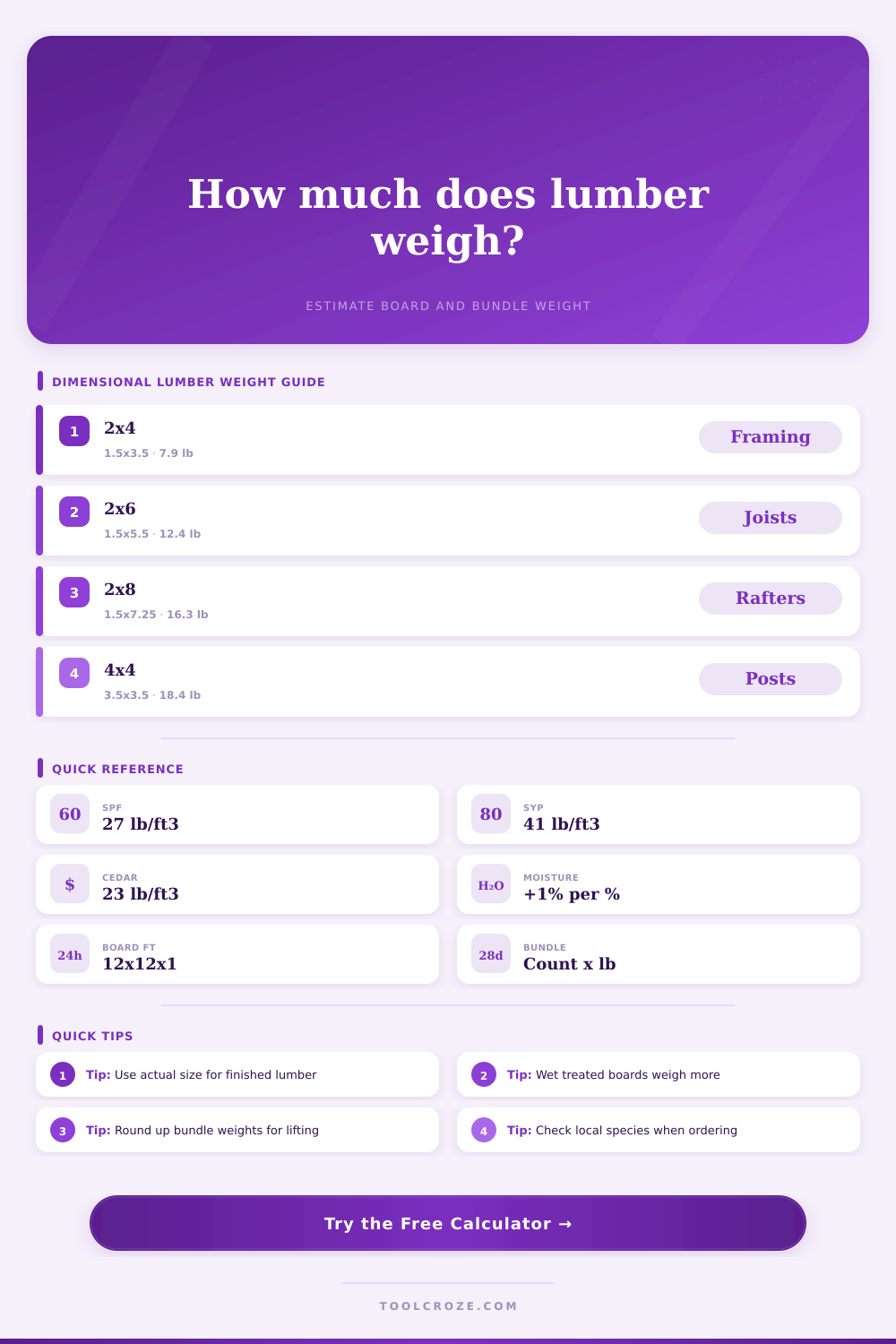
| 2x4 | 1.5 x 3.5 in | 5.25 in² | 7.9 lb |
| 2x6 | 1.5 x 5.5 in | 8.25 in² | 12.4 lb |
| 2x8 | 1.5 x 7.25 in | 10.88 in² | 16.3 lb |
| 2x10 | 1.5 x 9.25 in | 13.88 in² | 20.8 lb |
| 4x4 | 3.5 x 3.5 in | 12.25 in² | 18.4 lb |
| 6x6 | 5.5 x 5.5 in | 30.25 in² | 45.4 lb |
| Species | Density used | Relative weight | Typical dimensional use |
|---|---|---|---|
| SPF framing lumber | 27 lb/ft³ | Light | Studs, plates, trusses |
| Hem-fir | 29 lb/ft³ | Light-medium | Framing and roof members |
| Douglas fir | 34 lb/ft³ | Medium | Joists and rafters |
| Southern yellow pine | 41 lb/ft³ | Heavy | Structural lumber and treated stock |
| Western red cedar | 23 lb/ft³ | Very light | Decking, fence, exterior trim |
| White oak | 47 lb/ft³ | Very heavy | Blocking, sills, specialty parts |
| Moisture condition | Moisture input | Weight effect | Planning note |
|---|---|---|---|
| Kiln dried interior | 8% to 12% | Baseline | Use normal density values |
| Outdoor air dried | 12% to 18% | Moderate | Add a small load margin |
| Green or wet stock | 25% to 45% | High | Expect much heavier boards |
| Fresh treated lumber | 25% to 60% | Highest | Use treatment factor and margin |
| Load check | What to compare | Calculator output | Use case |
|---|---|---|---|
| Per board lift | Single-board weight | Card 1 | Manual handling |
| Full bundle | Total adjusted weight | Card 2 | Truck bed or trailer load |
| Rack bay | Total weight by count | Breakdown | Shop storage planning |
| Split loads | Groups by lift limit | Card 4 | Forklift, cart, or rack limits |
💡 Calculation tips
If you’ve ever attempted to lift anything into a pickup solo, you probably recall that memory. There’s a pile of 2-by-4s, so you figure: I got this. You grasp one end, pull up, and holy cow, the thing weigh a ton. How could it? That looks exactly like the kiln-dried lumber stored in your garage. But this just arrived from the yard as newly pressure-treated lumber. It’s saturated with water…which means it’s heavy. It is also dense, which means it ain’t going up there alone. And that’s when most self-help homeowners discover that nominal isn’t real and that moisture content make a huge difference in weight.
So what are all those numbers? Once you enter the conditions and the species, the calculator above do the rest of the math for you. This way, you don’t have to guess if a stack of joists will fit into your pickup bed.
How to Calculate Lumber Weight
What it does is take the actual dressed dimension (not the nominal dimension listed) and multiplies it with density of whatever wood species you chose. For example, a two-by-four isn’t actualy two inches by four inches. It’s been planed out to one and a half inches by three and a half inches. Small difference right? Nope. That makes a big difference when calculating the volume. If you order based off the label without considering how the wood was milled, your load estimation will be way off.
The other primary variable that catches folks off guard is species density. For example, Spruce-Pine-Fir is lighter and suitable for almost any use. Southern yellow pine is a very dense wood that are stronger and ideal for structural framing, but it weighs much more then cedar. Cedar is light, that’s why they prefer using cedar for siding and decking, as you don’t want to battle gravity each time you drive in a nail. This is laid out in the reference table on the page. You’ll see that an eight-foot board of equal physical dimensions might weigh several pounds differently just based on what tree the board originated from. So you choose the species that fits the needs of your project, then the tool will adjust its baseline weight to match.
The true drama unfolds with moisture. When lumber comes out of the treatment tank it’s full of water. Water weighs roughly eight pounds per gallon. So that board fresh off the treatment tank (or left outside in the rain) may be 15 percent heavier than the identical board once it dries out in your garage. For this reason there is a moisture adjustment for the tool as well. If you intend to pick up wet timber, you’d better account for a handling allowance. I’m not just talking about weight of the wood here, but also the safety margin required because your grip could slip on a wet surface.
The tool then spits out both the total bundle weight and the single board weight. Those two sets of data is telling you two things. One is whether or not you can pick up one of those boards by yourself. That’s the single board weight. Then there is also whether your forklift needs a high weight capacity, or if your truck bed will sag under the load. And that’s where the load groups really comes into play with job site logistics.
Let’s say you’ve got a 500 pound limit for manual movement, but you have an order of fifty board. The tool breaks that pile down into something you can actualy manage. You quit trying to move the whole thing at once and you start moving it in safe increments.
Treated lumber also has a lot more weight due to all those preservatives added, but it’s easy to underestimate that by a lot. It doesn’t create a void; the chemicals take up space where water was inside the wood cells. It just becomes denser. That’s what makes a treated post so heavy compared to dry interior framing. To account for this, the tool has a treatment condition factor. Simply choose if the wood is fresh off the mill (treated), if it’s wet on one side (surfaced wet), or if it’s dry as you’ll find at the lumber yard (kiln dried). From there, the formula take the density up to reflect how much moisture it contains after treatment and how much chemical it retains.
The number isn’t as important as the weight. Maybe you can afford all that lumber, but do you have the equipment to get it in there? Do you have the muscle power to carry it up the stairs? Knowing how much it weighs lets you know if you need to spend more on extra labor. It also helps you decide if you should of break the order into multiple deliveries or rent a hand truck. It goes from a vague “I think I can handle this” to a solid plan, you step on the job with a clear idea of what’s being lifted, which means no more back injuries and no delays to the work.
Next time you look at a pile of lumber, don’t think “wood.” Think “manageable load,” “density” and even “moisture”.