Die Grinder Air Consumption Calculator
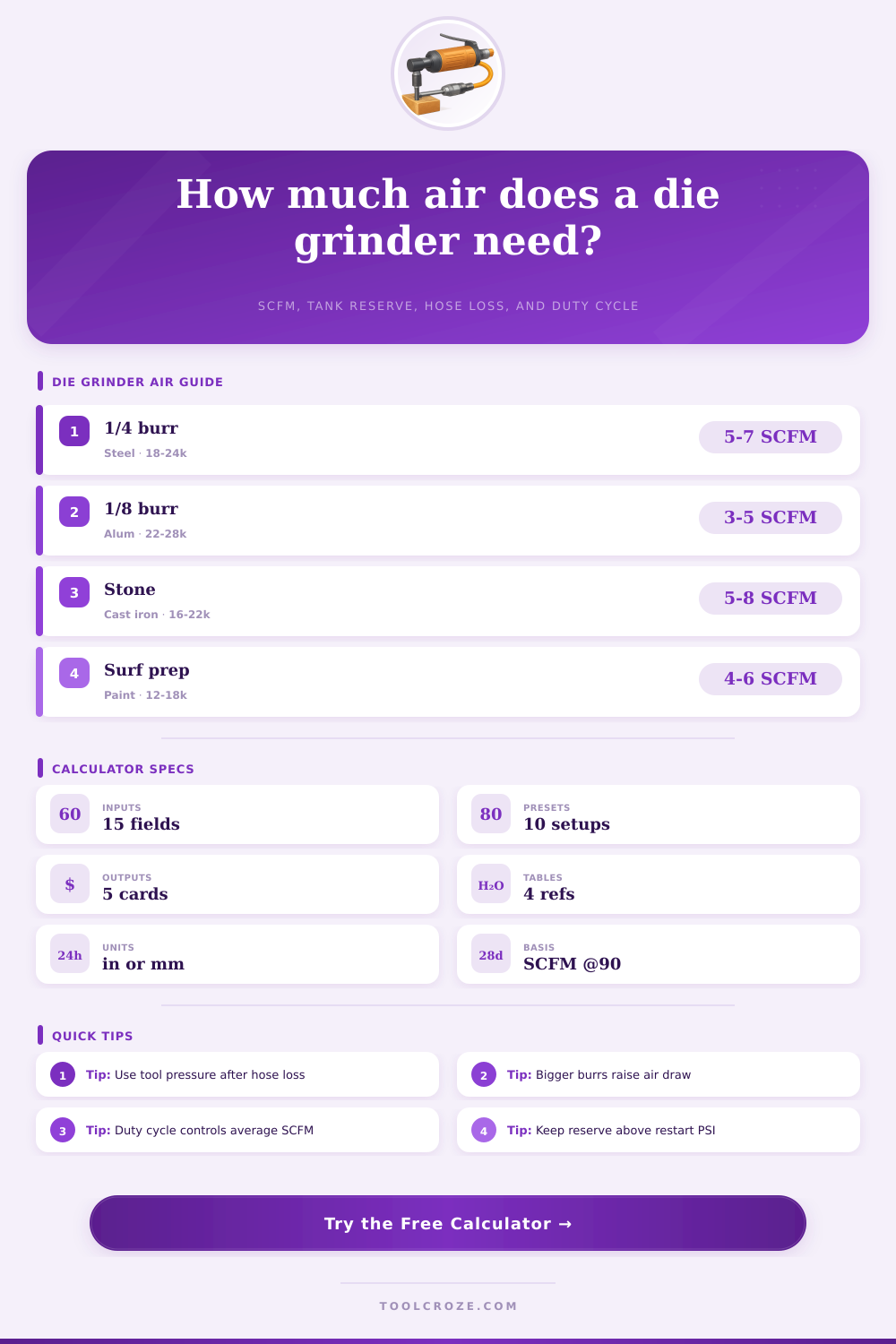
Estimate die grinder SCFM demand from tool rating, burr load, material, pressure loss, duty cycle, compressor output, and tank reserve.
Choose a realistic die grinder setup, then adjust pressure, runtime, and compressor capacity for your shop.
Die Grinder Air Consumption Results
Light stock removal in slots, ports, small castings, and tight corners.
Common shank and head size for steel deburring and weld cleanup.
Higher load on stainless, welds, and cast iron; needs more compressor headroom.
Lower bite but larger swept area; watch pad maximum RPM.
Steady contact and abrasive drag can draw more air than a light burr pass.
Useful for finishing bores and ports with moderate air demand.
Air draw is moderate, but safe speed and guard clearance matter.
Small contact patch makes low average demand during trim and detail work.
| Accessory | Typical diameter | Air load | Use case |
|---|---|---|---|
| Carbide burr | 1/8 to 3/8 in | Medium to high | Deburring, shaping, weld toes |
| Aluminum-cut burr | 1/4 to 3/8 in | Medium | Nonferrous deburring with less loading |
| Mounted stone | 1/4 to 1 in | High | Castings, tool touch-up, small grinding |
| Surface prep disc | 1-1/2 to 3 in | Low to medium | Gaskets, paint, light corrosion |
| Cartridge roll | 1/4 to 1 in | Medium | Ports, tubes, inside radii |
| Material | Load behavior | Air impact | Shop note |
|---|---|---|---|
| Aluminum | Soft, can load burrs | Slightly lower | Use aluminum-cut burrs to reduce drag |
| Mild steel | Baseline cutting load | Normal | Most ratings feel close to published SCFM |
| Stainless steel | Tough and heat-prone | Higher | Short bursts help avoid slowing the grinder |
| Cast iron | Abrasive and dusty | Moderately higher | Stones and burrs keep steady drag |
| Heavy weld bead | Interrupted high bite | High | Use more compressor reserve than for deburring |
| Air path | Flow range | Typical loss | Best use |
|---|---|---|---|
| 3/8 in hose, short whip | 4 to 8 SCFM | 2 to 5 PSI | Most 1/4 in die grinders |
| 1/4 in hose, 25 ft | 4 to 7 SCFM | 5 to 10 PSI | Short touch-up sessions |
| 1/4 in hose, 50 ft | 5 to 9 SCFM | 10 to 18 PSI | Light duty only |
| High-flow couplers | 6 to 12 SCFM | 1 to 4 PSI | Continuous burr and stone work |
| Stacked adapters | Any flow | Variable | Avoid when the tool sags under load |
| Tank | Drawdown | Stored free air | What it means |
|---|---|---|---|
| 20 gal | 135 to 90 PSI | 8.2 SCF | Short cushion for a 6 SCFM gap |
| 30 gal | 135 to 90 PSI | 12.3 SCF | Useful buffer for medium die grinding |
| 60 gal | 145 to 95 PSI | 27.2 SCF | Better for long burr or stone sessions |
| 80 gal | 150 to 100 PSI | 36.3 SCF | Good reserve when compressor nearly matches demand |
Die grinders allow a person to reach into a port and cleaning around welds or casting edges. Die grinders is helpful in that they can fit into areas where other hand tools cannot go. However, die grinders use an air from an air system to operate the tool.
Because die grinders can use up significant amount of air from an air system if a person does not pay attention to how much air each die grinder use, the air system can easily become depleted. Furthermore, the air that leaves the tank of an air compressor should be equal than the air that the compressor puts into the tank. If the air that leaves the tank of an air compressor is faster then the air that the compressor puts into the tank, then the die grinder will stall.
Choosing the Right Air Compressor for a Die Grinder
Although each die grinder has a published air rating that manufacturers provides, that published air rating is just a starting point for a person using the tool to understand how much air the tool will use. The actual air demand from a die grinder will change with the type of accessory that is attach to the die grinder, the type of material that the die grinder is cutting or cleaning, and the condition of the hose that supply air to the die grinder. For example, a carbide burr will use more air to cut stainless steel than it will to cut aluminum.
Additionally, a mounted stone will require the motor of the die grinder to work harder than if the die grinder is simply making a pass to deburr an edge of an object. These variable can be entered into a calculator that estimates the amount of air that will be used by a die grinder while in use. Using such a calculator allows a person to avoid guessing how each of these variables will impact the air demand of the die grinder.
Another factor to consider with die grinders is the effect that pressure loss have on the air system. Pressure loss occurs between the regulator and the collet of a die grinder. A small hose or a coupler that restricts the amount of air that pass through it can lead to a drop in air pressure of ten PSI or more.
Thus, the die grinder will recieve less air pressure from the air system than the air pressure that is published by the regulator. Since die grinders slow down when they receive less air pressure, a person may push down on the tool more forcefully to try and achieve the same result as when the die grinder was functioning properly. Thus, the load on the die grinder increase.
Increased load results in the die grinder using more air from the air system. Therefore, the inlet pressure of the die grinder should be measured so that air pressure loss can be accurate calculated. Another factor that is important in the selection of an air compressor for a die grinder is the duty cycle.
The duty cycle is just as important as the peak air draw of a die grinder. For example, a die grinder may draw seven SCFM of air while the trigger is held down, but over the course of an hour of use by a person, the average air draw may be four SCFM. The air compressor must account for this average air draw over time.
Additionally, the air tank acts as a buffer for the air compressor. Thus, if the average air draw of a die grinder exceed the air output of the air compressor, the air tank will eventually empty. The selection of the air compressor that will power a die grinder require a decision to be made by the buyer of the air compressor and die grinder as to how much downtime of the air compressor is acceptable.
If the air compressor has a small margin of air output above the air demand of the die grinder, the motor of the air compressor will not have to run as much as possible. For example, the air system will have time to recover if a person works at a faster rate than the air compressor motor was calculated to require. However, if the air compressor has too little air output reserve above the air demand of the die grinder, the air pressure will drop each time the die grinder makes a heavy cut.
Thus, the air compressor motor will run at maximum capacity each time the die grinder makes such a cut. Finally, if the air compressor has too much reserve in its output in addition to the air demand of the die grinder, the air compressor will be paying for air output capacity that the die grinder do not use. Air demand tables published by die grinder manufacturers show the typical air load that each type of die grinder accessory will use for different materials.
For example, one of these tables may show that the air demand for using a carbide burr to clean a weld on stainless steel is higher than using the same carbide burr to perform a light deburring on mild steel. Thus, these tables allow a person to understand that the two job may require different air compressor setups to fulfill the air demand for those tools. There are many variable that can change the air demand for a die grinder.
Each of these variables is not show on the specification sheet of the die grinder. For example, an air filter that has not been changed in a while will change the air that is supplied to the die grinder. Additionally, if the coupler of the air system have leaks, this could change the air that is supplied to the die grinder.
If the air hose that connect the air compressor to the die grinder has been stepped on and therefore the inner diameter of the hose is reduced, this will also change the air that is supplied to the die grinder. Finally, the amount of water that condenses in the air tank of an air compressor changes with the temperature of the air that enter the air tank. Thus, these variables are other factor that could affect the amount of usable air that reaches the die grinder.
The goal is not to provide the same amount of air as the die grinder will publish for each accessory. Instead, each person should understand how the different accessories, materials, hose, and duty cycle can change the published air demand of the die grinder. Once a person understands each of these factors, the die grinder will maintain the speed at which it should run.
Furthermore, the air compressor motor will not have to work too hard to supply the amount of air that is need by the die grinder. Additionally, the air tank will have time to refill and provide the buffer in the air system that is needed to complete a job.